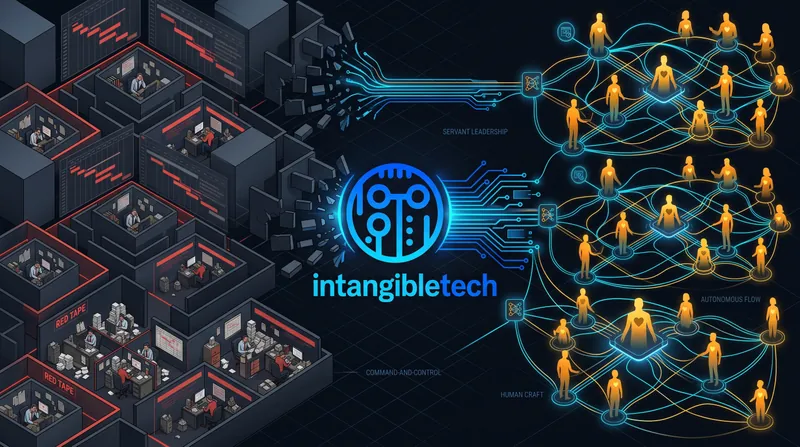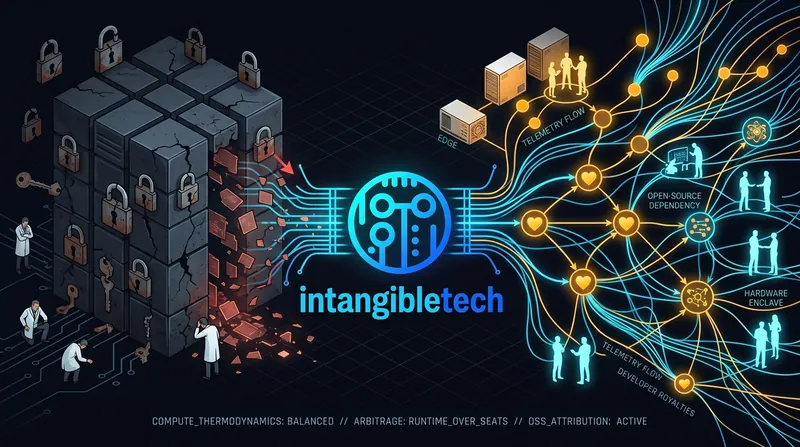
There is a recurring pathology in the technology industry that I call the “Greenfield Delusion.”
Software architects, economic theorists, and Silicon Valley venture capitalists love to write whitepapers that assume the world is a blank slate. They describe grand theoretical architectures where every physical machine is connected to high-speed fiber, every kilowatt-hour of energy is metered by a tamper-proof cryptographic chip, every software pull request is automatically verified by artificial intelligence, and every human contribution is cleanly mapped into a mathematical graph.
It is an inspiring vision of the future. But anyone who has actually spent time inside real enterprise manufacturing facilities, hospital supply chains, or municipal infrastructure networks knows that the physical world looks nothing like a Silicon Valley pitch deck.
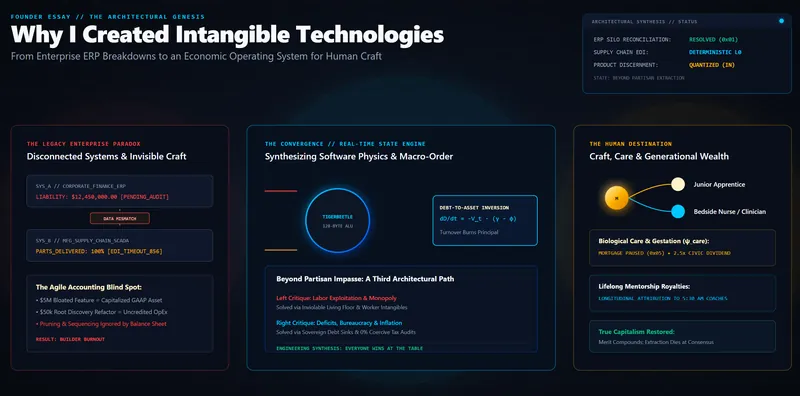
The real world runs on thirty-year-old programmable logic controllers (PLCs) with no internet connection. It runs on legacy enterprise software instances stitched together with fragile night-shift batch scripts. It runs on CNC milling machines operated by master machinists who track daily tolerances on physical clipboards, and clinical hospital wards where patient care handoffs are scribbled on whiteboards—an operational disconnect I witnessed firsthand across global manufacturing lines at GE and P&G, detailed in Why I Created Intangible Technologies.
When we present the master architecture of Intangible Technologies, enterprise executives quickly grasp the conceptual power of the system:
- Continuous, real-time asset depreciation tethered to actual physical runtime rather than static paper schedules.
- Human craft and systems architecture is recognized as appreciating working capital.
- Self-amortizing credit facilities powered by transactional velocity.
Yet their immediate, practical question is inescapable:
“This architecture requires hardware-level telemetry and live operational feeds to function perfectly. Most of our equipment doesn’t have secure enclaves or IoT sensors, and our human processes are largely manual. Does that mean we have to wait twenty years for our physical infrastructure to catch up before we can adopt this operating system?”
The answer is an emphatic no.
If an economic operating system requires the entire planet to upgrade its physical machinery before delivering value, it is not an enterprise solution; it is an academic fantasy.
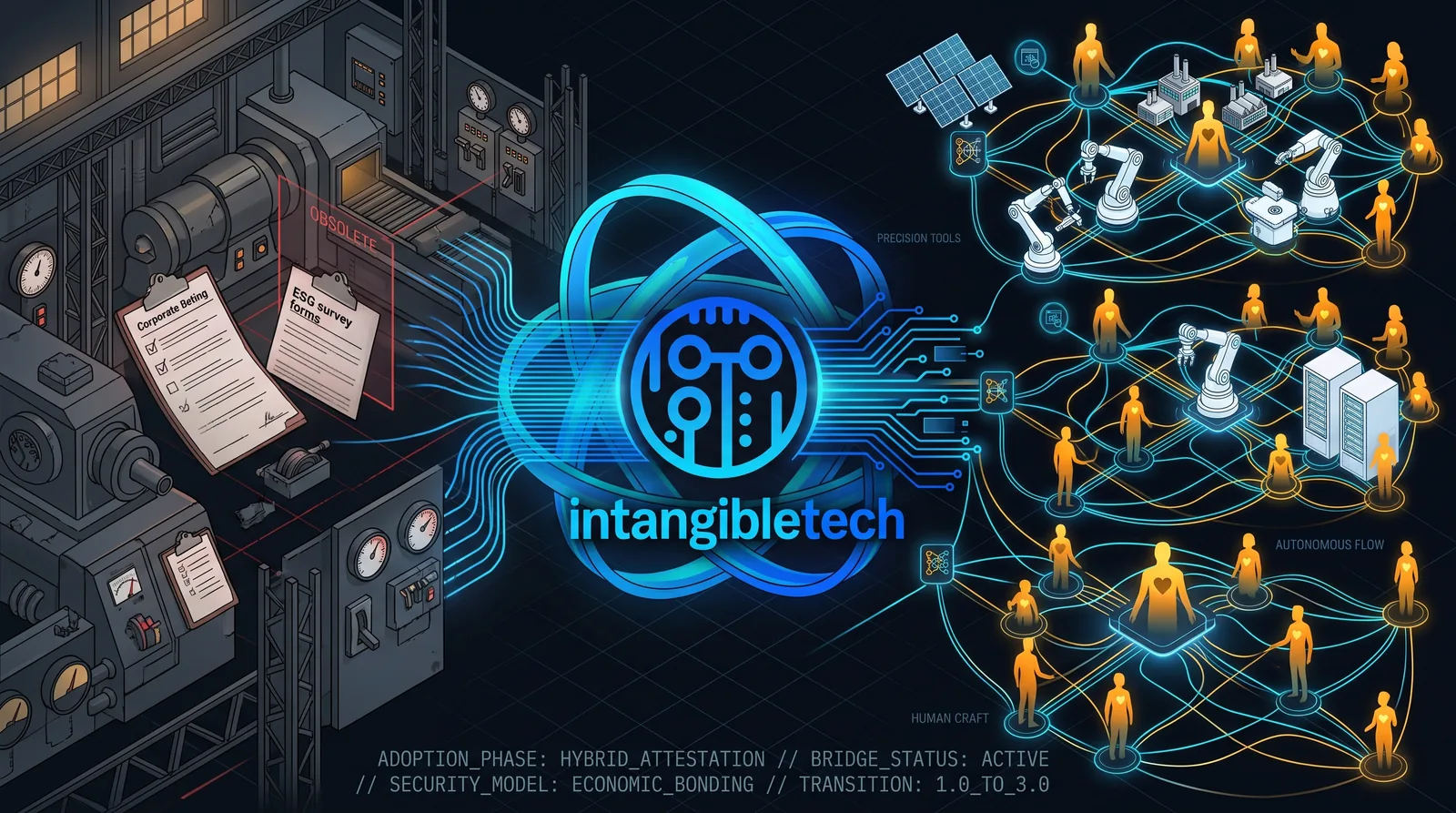
Transformation is not a binary light switch; it is a progressive bridge. We engineered Intangible Technologies with a pragmatic adoption continuum—allowing enterprises to bootstrap into the network today using hybrid, semi-manual inputs, capturing immediate balance-sheet and capital benefits while progressively closing the security and automation loop over time.
The Core Dilemma: Perfect Security vs. Immediate Utility
In systems engineering, there is always an inherent tension between security guarantees and implementation velocity.
In our ideal end-state, physical reality is bound to digital state through Hardware Roots of Trust:
- Laser part-counters, vibration sensors, and power monitors sign runtime data inside cryptographic hardware enclaves directly on the factory floor.
- This data is committed to the ledger with zero human intervention, making falsification physically impossible.
That is the destination. But if we insist that an enterprise cannot participate until every piece of machinery has an onboard cryptographic chip, we trap organizations in the very status quo that is suffocating them.
Consider the alternative: Today, corporations manage multi-million-dollar physical assets using 500-year-old double-entry accounting on disconnected spreadsheets.
A financial controller sits in an office, guesses at a straight-line depreciation schedule, types a manual journal entry into an enterprise resource planning (ERP) database once a quarter, and an outside audit firm reviews a sample of paper invoices six months after the fact. The current baseline of corporate trust is not cryptographic perfection; it is manual, slow, fragmented, and vulnerable to human error and accounting manipulation.
Even a semi-manual, hybrid input running across an immutable, append-only distributed ledger is orders of magnitude more transparent, auditable, and operationally resilient than the corporate databases running Fortune 500 balance sheets today.
We do not need to achieve silicon-sealed perfection on day one to radically improve the cost of capital and eliminate financial friction. We simply need a pragmatic bridge.
The Three-Phase Adoption Horizon
To bring this architecture into the real world, we designed a three-stage evolutionary path that allows enterprises to transition from manual workflows to fully autonomous hardware telemetry without disrupting ongoing operations:
PHASE 1: THE HYBRID BRIDGE (TODAY)
• Input Mechanism: Manual Shift Sign-Offs, Supervisor Keys & CSV Batch Feeds
• Trust Engine: Economic Bonding, Staking & Bilateral Counterparty Confirmation
• Security Posture: Optimistic Settlement with Challenge Windows & Reputation Slashing
• Enterprise Benefit: Real-Time Cash Clearance, Initial Spread Arbitrage & Shared Ledger
PHASE 2: THE SOFTWARE INTERMEDIARY (NEAR-TERM)
• Input Mechanism: Automated SCADA Adapters, ERP APIs & Git Commit Lineage
• Trust Engine: Multi-System Consistency Checks & Cross-Departmental Reconciliation
• Security Posture: Algorithmic Anomaly Detection & Cryptographic Server Signatures
• Enterprise Benefit: Sub-Second Internal Accounting, Automated Defect Tracking
PHASE 3: THE SILICON BEDROCK (LONG-TERM)
• Input Mechanism: Hardware Roots of Trust (TPM 2.0 chips, Optical Counters & Smart Meters)
• Trust Engine: Direct Silicon Attestation (Zero Human Intervention)
• Security Posture: Hardware-Enforced Byzantine Fault Tolerance
• Enterprise Benefit: Autonomous Telemetry Depreciation, Zero-Float Global Trade
Phase 1: The Hybrid Bridge (Manual Attestation with Economic Bonding)
In the initial phase, an enterprise connects its existing operations to our Layer-0 ledger using the tools it already possesses: supervisor portals, digital signature cards, and periodic batch data feeds.
Instead of an automated machine sensor, a plant manager, shift supervisor, or maintenance lead logs asset utilization:
- “Lathe Number 4 ran for seven hours today, cut four hundred precision components, and required one tool change.”
- “Our senior data architect completed a five-week refactoring project, stabilizing the inventory pipeline and mentoring two junior engineers.”
This data is signed with the individual’s Sovereign Digital Identity (SID) key and posted to the enterprise’s local Layer-0 state vector.
How do we ensure accuracy if the input is manual and the hardware is not yet cryptographically sealed?
We don’t rely on blind faith. We replace hardware guarantees with Game-Theoretic Economic Bonding:
- The Attestation Bond: When an enterprise or supervisor posts manual operational logs, they must pledge an economic bond held in an on-chain reserve pool.
- Bilateral Counterparty Confirmation: An enterprise cannot record an internal asset milestone in a vacuum. If Factory A logs that it produced and transferred four hundred components to Assembly Plant B, the entry does not finalize until Assembly Plant B’s intake manager signs off on the receiving hash. Both parties must corroborate the physical handoff.
- The Cost of Dishonesty: If an enterprise attempts to inflate machine runtime or fake maintenance milestones to artificially lower its borrowing rates, any counterparty or internal auditor can trigger an evidentiary challenge. If the log is proven fraudulent upon physical inspection, the enterprise’s posted bond is slashed, and its Impact Score Index (ISI) suffers an immediate, catastrophic downgrade (a mechanism examined in depth in The Incorruptible Compass).
By making the financial penalty of falsifying manual logs vastly higher than any short-term accounting gain, we establish practical integrity long before automated sensors are installed.
Phase 2: The Software Intermediary (API and SCADA Integration)
As enterprises establish confidence on the ledger, the human-in-the-loop requirement begins to dissolve.
Modern factories and corporate offices already generate enormous amounts of digital exhaust; the problem is that this data is trapped inside isolated software silos.
In Phase 2, organizations deploy lightweight, open-source protocol adapters that connect directly to existing digital systems:
- Industrial SCADA and Historians: Instead of humans recording machine hours, software bridges ingest operational data directly from existing supervisory control systems (such as Wonderware, Rockwell, or Siemens industrial servers).
- Software Development Lineage: Instead of manual reports on engineering progress, protocol adapters read cryptographically signed Git commit histories, continuous integration build logs, and automated test coverage pipelines.
- ERP Cross-Reconciliation: Commercial invoices, bills of lading, and freight tracking data are pulled automatically from existing ERP APIs, signing transactions using corporate server keys.
In this phase, human manual entry is phased out in favor of automated software reconciliation. While these servers do not yet have tamper-proof hardware enclaves, they cross-reference dozens of independent digital data streams, making systemic falsification extraordinarily difficult to coordinate.
Phase 3: The Silicon Bedrock (Autonomous Edge Telemetry)
The final stage is the full realization of the Intangible Architecture.
As older industrial equipment reaches the end of its natural lifecycle and is replaced, new machinery arrives with factory-installed Trusted Platform Modules (TPM 2.0), optical laser sensors, and cryptographically secure edge microcontrollers.
At this stage:
- The machine communicates directly with the Layer-0 ledger at the hardware level—anchoring micro-transactions onto decentralized finality without intermediary overhead (as discussed in The Anchor of Truth).
- Physical runtime hours, electrical load curves, and component wear are signed inside encrypted silicon registers, triggering continuous asset depreciation in real time.
- The transition is complete: human subjectivity is completely removed from the accounting loop, and the enterprise operates as an autonomous, self-balancing kinetic engine.
Why Enterprises Adopt Today: Reaping the Benefits Immediately
The most critical aspect of this phased strategy is that an enterprise does not have to reach Phase 3 to reap the revolutionary economic benefits of the platform.
Even in Phase 1, operating on a hybrid model delivers immediate, transformative advantages over legacy corporate finance:
1. Unified Operational Truth (Ending the Multi-Million-Dollar Reconciliation Waste)
Inside large industrial enterprises, tens of millions of dollars are burned every year simply trying to reconcile internal financial databases with physical supply-chain reality.
Department A thinks inventory is at eighty percent; Department B thinks it is at sixty percent; corporate accounting is working off a six-week-old forecast.
By moving internal asset records onto an append-only Layer-0 state machine in Phase 1, the entire enterprise—from the shop floor to the executive suite—shares a single, immutable operational timeline.
Internal reconciliation costs drop to zero immediately.
2. Immediate Working Capital via Spread Arbitrage
An enterprise does not need hardware sensors to demonstrate that it has retained world-class systems architects, disciplined product managers, and master toolmakers.
By linking the Sovereign Digital Identities of its senior staff to the corporate state vector in Phase 1, the company immediately demonstrates human institutional succession.
The enterprise’s composite Impact Score Index expands, qualifying it for Spread Arbitrage (turning human institutional knowledge directly into working capital, as outlined in The Geometry of Human Value):
- Its commercial credit facilities compress from nine percent down to prime tiers between one and three percent.
- The enterprise immediately saves millions of dollars in annual debt service cash flow—cash that can be deployed into buying better tooling, raising worker compensation, or retrofitting factory machinery.
3. Transitioning from Retrospective Audits to Continuous Settlement
In the legacy world, supplier invoices take thirty, sixty, or ninety days to clear because accounting departments must manually verify that goods were delivered.
Under our Phase 1 hybrid model, bilateral counterparty sign-offs clear across our native Layer-0 settlement rails in milliseconds. When a shipping manifest is digitally confirmed at a receiving dock, the payment settles automatically out of the company’s operating reserves, completely bypassing legacy bank wire delays and interchange fees.
The enterprise eliminates its reliance on expensive short-term bridge loans and reclaims control of its cash flow on day one, demonstrating how continuous settlement and real-time velocity invert corporate debt obligations.
The Courage to Build in the Real World
It is easy to stay in the ivory tower. It is comfortable to design elegant, mathematically pristine protocols that can only function in a hyper-futuristic world where every physical atom is wired with fiber-optic sensors.
But that is not how real industrial progress is achieved.
The steam engine was not invented with precision digital sensors; it was built with iron boilers, mechanical flywheels, and manual coal shovels. The internet was not deployed on high-speed global fiber; it was bootstrapped across copper telephone wires and screeching dial-up modems.
Every transformative technological leap in human history began as a messy, courageous bridge between the imperfect realities of the present and the possibilities of the future.
Intangible Technologies was not built to sit on a research shelf waiting for the world to become perfect. We engineered an operating system that respects the grit, the friction, and the analog realities of the physical enterprises that feed, house, and power civilization.
We do not ask the enterprise to dismantle its factories or discard its history.
We hand them the tools to step onto the bridge today—to take their manual craft, their experienced builders, and their physical tools, and anchor them to an economic engine that finally honors their true worth.
The future is not an all-or-nothing leap.
It is an open road, and the bridge is open.