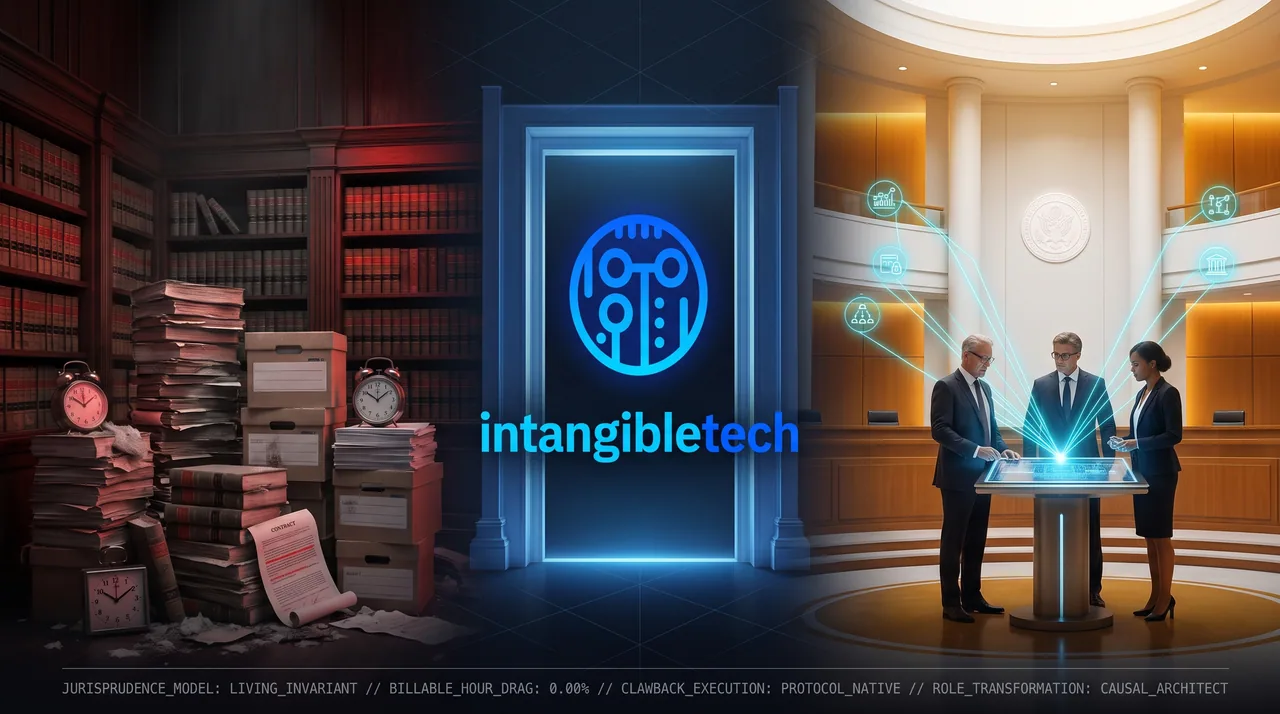
Ask any young associate at an elite corporate law firm to describe their daily reality, and you will hear a story of quiet intellectual suffocation.
A brilliant twenty-six-year-old graduates at the top of their class from an elite law school. They have spent three years studying constitutional history, the philosophical foundations of justice, and the delicate art of statutory interpretation. They arrive at a firm eager to shape enterprise strategy and champion the rule of law.
Instead, they are handed a billing timer and told to track their life in six-minute increments—one-tenth of an hour at a time.
They spend eighty hours a week sitting in a windowless room:
- Manually combing through thirty thousand pages of corporate emails in electronic discovery document reviews.
- Redlining standard ninety-page indemnification clauses in non-disclosure agreements that nobody reads.
- Proofreading signature blocks on boilerplate debt covenants.
- Drafting tedious interrogatories designed not to uncover the truth, but to impose financial exhaustion on an opposing litigant.
The legal industry calls this the practice of law. An economist calls it an extractive, fee-for-friction cartel.
The business model of the modern legal profession is built on a perverse economic foundation: The Billable Hour.
Under this model, a law firm’s revenue is decoupled from the value delivered to the client; it is tied directly to the time and inefficiency required to produce the work.
If an associate finds a brilliant way to resolve a contract dispute in ten minutes, the firm loses ninety-eight percent of its revenue for that task. If the dispute drags out for three years of depositions, motions, and discovery battles, the firm bills four million dollars.
The model punishes speed, penalizes precision, and rewards bureaucratic slowness.
Now, into this fragile ecosystem enters Generative Artificial Intelligence.
Corporate legal departments and tech founders point to large language models and boast that AI will soon draft briefs, write fifty-page contracts in seconds, and replace junior lawyers entirely. Law firm partners panic as clients demand an “AI discount,” wondering why they should pay nine hundred dollars an hour for a contract review that an algorithm executed in three minutes.
Yet that panic misses the deeper, systemic reality: Generative AI alone does not solve the legal crisis.
An AI model that drafts twenty pages of natural language text in five seconds simply floods the court system with faster, cheaper boilerplate. A contract written in natural language—whether written by an exhausted associate or an AI model—remains what it has always been: a static, ambiguous piece of dead paper.
When a counterparty breaches that agreement, the victim still has to hire litigators, spend three years in court, pay hundreds of thousands of dollars, and wait for a judge’s ruling that may be impossible to collect.
The problem with the law is not the speed of drafting text. The problem is that the law operates after the disaster occurs.
To transform the legal profession, we do not need faster document generators. We must transform the physics of the agreement itself.
By encoding legal rules directly into the deterministic monetary physics of Layer-0, Intangible Technologies replaces the billable hour with unassailable value architecture. We transform contracts from passive paper claims into Living Invariants, replace years of litigation with Protocol-Native Clawbacks, and elevate lawyers from clerical wordsmiths into the most vital constitutional architects of the modern enterprise.
1. The Fallacy of the Paper Promise: Why Legacy Contracts Always Fail
To understand why the legal profession is ripe for structural transformation, one must examine what a legal contract actually is in the legacy world.
Strip away the Latin phrases and the fifty pages of definitions, and a traditional contract is merely a conditional promise written on paper:
- Party A promises to deliver precision aerospace components meeting exact metallurgical tolerances by October 1st.
- Party B promises to wire four million dollars upon delivery.
- If Party A delivers defective parts, or Party B refuses to pay, the contract specifies that Party B will face liquidated damages or contractual breach remedies.
Notice what happens the moment a breach occurs: Nothing.
The contract cannot enforce itself. The paper has no hands. It has no kinetic energy. It cannot reach into Party B’s bank account to recover the funds, nor can it prevent Party A from transferring those funds to an offshore account.
To enforce the promise, the injured party must enter the adversarial legal meat grinder:
- They file a complaint in a civil court.
- They spend twelve months in pre-trial discovery, spending hundreds of thousands of dollars arguing over email archives.
- The breaching party files motions to dismiss, delaying the proceedings to drain the plaintiff’s cash reserves.
- Three years later, after burning forty percent of the disputed value on attorney fees, the court issues a judgment.
- If the breaching party has declared bankruptcy, hidden its assets, or dissolved its corporate shell in the interim, the judgment is an uncollectible piece of paper.
This is why major corporations spend tens of millions of dollars on legal departments: they are forced to maintain a private defense army simply to protect against the structural un-enforceability of paper promises.
The entire apparatus of modern corporate law—drafting endless representations, warranties, covenants, and indemnities—is a desperate, expensive attempt to construct a verbal fortress strong enough to survive a court battle three years down the road.
2. The Mental Inversion: Contracts as Living Invariants in Monetary Physics
To fix the legal system, attorneys, corporate general counsels, and judges must execute a foundational conceptual inversion:
Stop viewing a contract as a retrospective paper document to be litigated in a courtroom after a breach. Start viewing a contract as a deterministic, self-executing Living Invariant embedded directly in the settlement rails of the economy.
In systems engineering, an invariant is a mathematical condition that must remain true for a system to operate. If an invariant is violated, the system does not file a lawsuit; the state transition is rejected, or an automated corrective routine executes immediately.
In the Intangible Architecture, a commercial agreement is not an eighty-page PDF sitting in a filing cabinet.
It is registered as an active Capability Agreement Node on the network’s open Directed Acyclic Graph (DAG), executed across Layer-0 silicon and anchored to the Stellar network:
LEGACY ADVERSARIAL CONTRACT:
Structure: 80-Page Ambiguous Natural Language Text Document
Execution: Passive (Relies on voluntary human compliance)
Breach Event: Complete Failure ──► 3-Year Civil Lawsuit & Massive Legal Fees
Collection: Retrospective & Fragile (Hollow judgments, bankrupt entities)
INTANGIBLE LIVING INVARIANT:
Structure: Deterministic State Machine on Layer-0 (Bound to Hardware Telemetry)
Execution: Active (Consensus enforces boundary conditions in real time)
Breach Event: PROTOCOL-NATIVE CLAWBACK (Sub-second automated restitution)
Collection: Absolute & Certain (Locked liquidity escrows and programmatic recovery)
Consider how a commercial transaction executes under this architecture:
1. Deterministic Conditional Escrows
When two enterprises enter an agreement—such as a major manufacturer ordering precision turbine blades from an industrial supplier—the payment is not held as an unbacked invoice sitting on an accounts-payable ledger.
- Capital is committed into a Protocol-Native Conditional Escrow Vault.
- The parameters of the agreement—delivery dates, dimensional tolerances, material certifications, and shipping conditions—are encoded as deterministic boundary conditions.
- The funds are mathematically locked: the buyer cannot arbitrarily withhold payment out of spite, and the seller cannot take the funds until the conditions are met.
2. Hardware-Attested Fulfillment
When the components arrive at the receiving facility:
- Ultrasonic scanners, optical coordinate measuring machines, and hardware roots of trust (TPM 2.0) inspect the components at the receiving dock.
- The physical inspection telemetry is signed into Layer-0.
- If the components satisfy the encoded engineering invariants, the protocol executes an Atomic Settlement Split: the funds release from escrow to the supplier’s sovereign vault in under four seconds.
There are no invoice disputes, no thirty-day payment delays, and no accounts-receivable factoring fees.
3. Protocol-Native Clawbacks: Automated Restitution at Consensus
What happens if the components fail inspection, or if a supplier commits an intentional breach?
In legacy law, the buyer must sue for breach of contract and fraud.
Under our ledger, the agreement includes pre-compiled, deterministic Restitution and Clawback Opcodes:
- The moment the hardware sensors attest that the delivery failed required tolerances or that the delivery window expired without fulfillment, the protocol’s consensus engine executes an immediate state transition.
- The committed capital in the escrow vault is instantly clawed back to the buyer’s operating reserves.
- Simultaneously, if the contract included a verified liquidated damages covenant, the protocol assesses the penalty directly against the supplier’s bonded balance-sheet reserve on Layer-0.
- The supplier’s Impact Score Index (ISI) is automatically downgraded, spiking its borrowing costs across the network.
Restitution does not take three years of civil litigation. It settles at the speed of light.
Breaching a contract ceases to be a calculated corporate game of “can our lawyers out-delay their lawyers.” It becomes an impossible, self-liquidating disaster.
3. The GenAI Alliance: The Translation Compiler of Intent
This brings us to the profound convergence between generative artificial intelligence and protocol-native monetary physics.
Today, observers look at GenAI and believe it will replace lawyers because it can draft legal text. They fail to realize that GenAI without deterministic execution is dangerous, while deterministic execution without GenAI is inaccessible.
A raw Layer-0 state machine requires precise, formal logic. Everyday business executives, factory managers, and local entrepreneurs do not think in formal state vectors; they think in human language, commercial goals, and contextual business relationships.
This is where GenAI and the Intangible Architecture form a flawless Translation Pipeline:
Step 1: HUMAN INTENT
Corporate leaders express natural language commercial intent:
“We want a supplier to provide 10,000 titanium bolts monthly, guaranteed delivery within
48 hours of order, with full restitution and a 10% penalty if tensile strength fails.”
Step 2: GENAI COMPILER (THE SEMANTIC ENGINE)
Generative AI translates natural language into structured logic:
Synthesizes terms, identifies edge-case ambiguities, aligns cross-jurisdictional rules,
and drafts the formal state machine specifications.
Step 3: THE LAWYER AS SYSTEMIC ARCHITECT (THE FIDUCIARY SHIELD)
The human attorney inspects the model:
• Audits the boundary invariants: Does this violate constitutional or statutory law?
• Stress-tests the failure vectors: What happens during a force majeure grid blackout?
• Certifies the alignment: Signs the capability node with their Sovereign Digital Identity (SID).
Step 4: LAYER-0 DETERMINISTIC EXECUTION
The agreement is committed to the Dependency DAG:
Operates as an un-breachable, self-executing Living Invariant on the Stellar network.
Generative AI does not replace the lawyer; GenAI becomes the compiler, and the lawyer becomes the systems software architect.
Just as computer programmers evolved from manually writing machine punch-cards to managing high-level software architectures, attorneys evolve from manually typing boilerplate contract clauses to architecting the living legal systems of civilization.
4. The Daily Life of the Modern Lawyer: Causal Jurisprudence
If lawyers are no longer redlining standard NDAs, reviewing discovery emails, or managing billing stopwatches, what does an attorney actually do all day?
Their daily life transforms from administrative drudgery into High-Order Strategic Jurisprudence:
LEGACY LITIGATION ATTORNEY:
Daily Work: Reading 500 emails in discovery; arguing over deposition dates.
Billing Metric: Billable hours (Target: 2,200 hours/year; every 6 minutes tracked).
Core Skill: Exploit linguistic ambiguity in court; procedural delay tactics.
Client Dynamic: Adversarial; client dreads the monthly legal invoice.
CAUSAL JURISPRUDENCE ARCHITECT:
Daily Work: Designing enterprise governance models; auditing protocol invariants.
Billing Metric: Senior Risk-Suppression Yield & Performance-Bonded Alpha (Opcode 0x08).
Core Skill: Systemic risk identification, institutional diplomacy, constitutional alignment.
Client Dynamic: Strategic partner; the attorney directly lowers the firm’s capital costs.
The New Frontiers of Legal Practice
1. Invariant Systemic Risk Auditing
Before an enterprise deploys a multi-billion-dollar supply-chain network or launches a novel biomedical manufacturing pipeline, the legal team conducts a Systemic Invariant Audit:
- The attorney models the agreement across the Dependency DAG.
- What happens if an international trade scalar is applied?
- Does this contract protect the enterprise’s intellectual property attribution under Opcode 0x08?
- Does this governance structure preserve the firm’s top-tier Impact Score Index (ISI)?
The lawyer ensures that the enterprise’s legal plumbing is mathematically bulletproof.
2. Cross-Jurisdictional Statutory Harmonization
Sovereign nations maintain distinct legal traditions, labor standards, and environmental statutes.
A protocol-native lawyer is the master of Jurisdictional Boundary Interfaces:
- Ensuring that an enterprise operating across the United States, the European Union, and Singapore configures its capability nodes so that transactions automatically comply with local laws in real time.
- Structuring digital commercial flows so that statutory consumer protection standards and localized environmental regulations are satisfied at consensus.
3. Enterprise Value Creation via Spread Arbitrage
In our architecture, an enterprise’s borrowing spread on its credit lines (1.5% vs. 8%) is dictated by its Impact Score Index (ISI). The score is driven by verified defect suppression and operational resilience.
Who guarantees that an enterprise’s governance contracts suppress defects? The legal team.
When a corporate legal team structures clear, low-friction, self-executing contracts that eliminate supply-chain disputes and ensure operational stability, the enterprise’s ISI rises:
- The firm’s borrowing costs compress across its entire balance sheet.
- The legal department walks into the executive committee not as a cost center, but as a team that just unlocked twelve million dollars in annual cash savings by de-risking the company’s operations.
5. Human Judgment at the Edge: Why Common Law and Equity Endure
A crucial, legitimate objection that every seasoned jurist, law professor, and judge will raise is:
“Code cannot be law. Human life is filled with unforeseen tragedy, nuanced ambiguity, and unique dilemmas. What about the doctrines of equity, unconscionability, mutual mistake, and force majeure? You cannot reduce five hundred years of Anglo-American common law to deterministic silicon opcodes!”
This critique is profoundly correct.
The naive technologist who believes that every human dispute can be settled by an automated algorithm without human discretion understands neither law nor human nature.
The Intangible Architecture does not abolish human judgment. It elevates human judgment by liberating it from the mundane.
Ninety percent of modern corporate legal disputes are not profound constitutional dilemmas; they are simple, petty conflicts over non-payment, missed delivery dates, hidden accounting fees, and clear breaches of contract.
These mechanical disputes should never consume a single hour of a judge’s or an attorney’s time. They are handled cleanly and deterministically by protocol invariants.
The Human-in-the-Loop Judicial Layer
For the remaining ten percent—the genuine human edge cases, the catastrophic natural disasters, the novel ethical questions, and the subtle nuances of equity—the protocol provides native Arbitration and Jurisprudential Escalation Vectors:
Autonomous Layer-0 Execution (Handles 90% of deterministic commerce cleanly)
(Unforeseen Event: Force Majeure / Novel Ethical Dilemma)
CRYPTOGRAPHIC DISPUTE ENVELOPE ACTIVATED
(Escrow frozen in deterministic equilibrium)
HUMAN JUDICIAL ARBITRATION TRIBUNAL (THE GUILD)
Experienced Jurists & Domain-Expert Attorneys review physical and human context:
• Was there coercion, fraud, or an unprecedented biophysical catastrophe?
• Does strict algorithmic enforcement violate fundamental equity or human dignity?
JUDICIAL DETERMINATION COMMITTED
Tribunal issues signed cryptographic resolution via Sovereign Digital Identity:
• Payouts executed with surgical human discretion
• Formal precedential ruling published as a new Policy Node on the DAG
• The network learns: the precedent informs future automated simulations
When an unprecedented crisis occurs—such as a once-in-a-century earthquake that disrupts an attested supply line—the affected parties activate a Cryptographic Dispute Envelope:
- The associated escrows are paused in an equitable holding state.
- The matter is routed to a specialized Human Jurisprudence Guild composed of seasoned, respected attorneys and retired judges.
- The tribunal does not spend three years fighting over discovery paperwork; they review the immutable telemetry of the ledger and conduct focused hearings on the human and physical reality of the situation.
- Their equitable ruling is committed to the ledger with their Sovereign Digital Identities.
The law returns to its highest calling: The application of seasoned human wisdom, equity, and moral conscience to complex human dilemmas.
6. Why Law School Still Matters: Protecting the Future of the Profession
This brings us to the ultimate question that every aspiring student, anxious parent, and law school dean is asking:
“Why would anyone spend two hundred and fifty thousand dollars and three grueling years of their life to go to law school if AI and protocol systems automate contracts? Aren’t we leading an entire generation of students into financial ruin?”
If law schools continue to train students to be biological document-processing machines, then yes—that degree is an obsolete, overpriced ticket to unemployment.
A law school that teaches students how to bill two thousand hours a year doing manual discovery and proofreading boilerplate indentures is committing educational malpractice.
The Intangible Architecture does not destroy the value of legal education. It restores the true, historical value of the Juris Doctor.
The Death of the Pyramid, the Birth of the Guild
For half a century, BigLaw firms operated on a brutal Leveraged Pyramid:
- A handful of equity partners at the top made millions of dollars by billing out legions of overworked, sleep-deprived junior associates at five hundred dollars an hour.
- The junior associate spent seven years doing low-value clerical work, hoping to survive the tournament and make partner.
In the new architecture, the pyramid collapses into a high-margin Jurisprudence Guild:
- Law firms no longer need fifty junior associates to review boxes of documents for six months.
- They need small, elite teams of brilliant legal minds who understand institutional architecture, systems governance, and human negotiation.
- The legal career stops being an endurance test of physical sleep deprivation. It becomes an intellectually vibrant, prestigious calling where young lawyers are mentored directly by senior partners from day one in the high-stakes arts of strategic judgment, statutory design, and client stewardship.
The Return on Educational Investment
Why go to law school?
Because the skills acquired in a great legal education are among the rarest and most valuable cognitive capabilities in an automated world:
- The Power of Rigorous Analytical Deconstruction: The ability to look at a chaotic human situation, identify the core principles at stake, and see how competing incentives interact.
- The Discipline of Fiduciary Duty: The ethical commitment to stand as an incorruptible guardian of another human being’s rights, property, and freedom.
- The Art of Rhetoric and Persuasion: The capacity to bring clarity out of confusion, de-escalate human hostility, and build enduring consensus among adversarial parties.
- The Stewardship of Justice: The profound understanding that without the rule of law, civilization dissolves into raw, unconstrained power.
These are not skills that can be replaced by a neural network or a distributed ledger.
These are the foundational skills required to govern neural networks and distributed ledgers.
The future lawyer does not bill for the hours they sit in a chair.
They are compensated for the resilience, solvency, and peace they engineer for human society. They earn senior, performance-bonded yield that provides enduring wealth, working with the pride, autonomy, and public honor that the legal profession enjoyed before it was consumed by the billable hour.
The Recovery of the Sovereign Counselor
For thousands of years, the lawyer was recognized as one of the essential pillars of a free society.
When Cicero stood in the Roman Forum, when Sir Edward Coke defied the absolute power of King James I, and when John Adams defended the British soldiers in the Boston Massacre, they were not billing clients in six-minute increments. They were not copy-pasting indemnification boilerplate.
They were standing as counselors of sovereign truth. They were using the power of the human intellect and the majesty of the law to defend justice, constrain tyranny, and coordinate the complex affairs of free human beings.
Over the last half-century, that noble calling was traded away for a stopwatch.
We allowed an extractive financial system to turn our finest legal minds into clerical laborers on a billable-hour assembly line, incentivizing them to feed on the friction and hostility of their fellow citizens.
That compromise has reached its end.
The Intangible Architecture shatters the stopwatch and closes the billing ledger forever.
By embedding the rule of law into the living physics of the economy, automating restitution at the speed of light, and freeing the human attorney to focus on strategic wisdom and equitable justice, we restore the legal profession to its sacred heritage:
- Where contracts protect themselves, and bad faith is rendered powerless.
- Where justice is swift, certain, and accessible to every citizen.
- Where young legal minds are honored as thinkers rather than exploited as word-processors.
- And where the lawyer stands once again as they were always meant to stand: not as an adversary profiting from conflict, but as the wise, trusted, and indispensable architect of human peace and civilizational flourishing.
The billable hour is dead.
The era of living jurisprudence has begun.