Whenever a technologist outlines an architecture that automates foundational processes—eliminating manual tax filings, slashing three-day bank settlement float to milliseconds, and automating continuous depreciation—an unspoken chill moves through the room.
Executives nod at the capital efficiencies, but beneath the surface lies an intense, deeply human anxiety.
It is the fear carried by the corporate controller working late into the night during the quarterly close. It is the anxiety of the staff accountant spending forty hours a week manually matching vendor purchase orders to receiving slips. It is the dread felt by the junior analyst at a Big Four consulting firm building pitch decks for compliance audits, and the government civil servant processing paper tax returns in a regional revenue office.
Their silent question is unmistakable:
“If the protocol automates reconciliation, eliminates tax returns, and tracks asset depreciation in real time, what happens to me? Am I simply another casualty of technological displacement?”
Let us confront this reality directly, without corporate euphemisms or Silicon Valley hand-waving.
If our architecture merely served to eliminate millions of disciplined, detail-oriented professionals and discard them into technological unemployment, it would be a societal disaster. An economic operating system that destroys the livelihood of its middle-class knowledge workers is not progress; it is just another iteration of extractive financial vandalism.
The truth is precisely the opposite.
The Intangible Architecture does not eliminate the accountant, the auditor, or the operational consultant.
It emancipates them.
It dissolves the soul-crushing administrative drudgery that turned these professionals into paper-shuffling police, and elevates them into the most vital, strategic role in the modern economy: the proactive architects of enterprise capability, physical truth, and human craft.
1. The Historical Tragedy: How the Accountant Became the “Enemy”
To understand where these professions are going, we must first tell an uncomfortable truth about where they have been trapped for the last fifty years.
In almost every modern corporation, there exists a quiet, structural hostility between the people who build things and the people who count things.
Ask any software engineer, industrial machinist, clinical nurse, or product designer how they view the corporate finance and accounting department.
Too often, the Chief Financial Officer and the internal controller are perceived as the institutional enemy:
- The department that rejects purchase orders for high-precision tooling because it breaches an arbitrary quarterly budget cap.
- The committee that demands layoffs of senior, experienced engineers to lower operating expenses for an upcoming earnings call.
- The bureaucrats who enforce tedious receipt-logging systems and expense-approval loops that treat every employee as a suspected embezzler.
Yet the accountants themselves did not choose this adversarial posture out of malice. They were forced into it by the primitive mechanics of legacy accounting.
Under twentieth-century Generally Accepted Accounting Principles (GAAP), an accountant is forced to look at the world through a backward-looking rearview mirror:
- Double-entry bookkeeping forces them to conduct financial autopsies—telling leadership what went wrong six months after the money was already spent.
- The rules of legacy finance force them to account for human beings as pure operating expenses (OpEx) that reduce corporate earnings, while treating rusty steel filing cabinets as capitalized assets.
- They are tasked with maintaining compliance inside a seventy-thousand-page tax code that treats business as a continuous game of defense against government audit penalties.
The legacy accountant was turned into an adversarial bean-counter because the system gave them only one lever to create balance-sheet value: cutting costs, slashing budgets, and treating human talent as disposable overhead.
They were handed a broom and told their sole value to civilization was sweeping up paper dust.
2. The Great Inversion: From Forensic Autopsy to Value Architect
When the Intangible Architecture automates the mechanical movement of transactions, the role of the accountant undergoes a profound structural inversion.
Instead of spending their lives looking backward to record historical numbers, accountants become Real-Time Operational System Architects.
Instead of being the department that tells engineers “You can’t spend that money,” the finance department becomes the exact team that proves how the engineers’ work creates millions of dollars in fresh balance-sheet capital.
LEGACY ACCOUNTING MODEL:
Temporal Focus: Retrospective (Auditing transactions 30 to 90 days late)
Core Activity: Manual Spreadsheet Reconciliation & Tax Code Compliance
Corporate Dynamic: The Adversary (Slashing budgets, treating talent as OpEx)
Value Metric: Cost Minimization & Penalty Avoidance
INTANGIBLE OPERATIONAL MODEL:
Temporal Focus: Real-Time & Predictive (Continuous telemetry validation)
Core Activity: Dependency Graph Structuring & Provenance Certification
Corporate Dynamic: The Champion (Quantifying craft to slash borrowing costs)
Value Metric: Impact Score Index (ISI) Expansion & Capital Optimization
Consider how daily commercial life shifts inside an enterprise operating on our ledger:
1. Championing the Builder via Spread Arbitrage
In our architecture, an enterprise’s borrowing cost on its multi-million-dollar credit facilities is governed by its Impact Score Index (ISI). The score is dictated by verified defect suppression, human mentorship retention, and operational resilience.
Who measures, verifies, and optimizes that score? The modern corporate accountant.
Under our protocol, when an engineering team refactors an unstable codebase, or when a factory supervisor institutes an apprenticeship program that cuts assembly defects by forty percent, it is the accountant who structures that data:
- The accountant maps the operational breakthrough into the company’s cryptographic state vector.
- They prove to the protocol that the enterprise has suppressed systemic error rates, directly elevating the firm’s composite ISI.
- As the ISI rises, the company’s borrowing spread compresses from eight percent down to one and a half percent—instantly saving millions of dollars in annual debt service cash flow.
For the first time in history, the accountant walks into the engineering lab not to announce budget cuts, but to say: “Your discipline just expanded our balance sheet by four million dollars. Here is how much additional working capital we can now unlock to upgrade your machinery and increase your salaries.”
The accountant ceases to be the corporate executioner. They become the champion who translates engineering craft into cold, hard institutional capital.
2. From Form-Fillers to Provenance Stewards
In legacy systems, tax compliance is an exhaustive ritual of filling out subjective forms to justify deductions to the IRS.
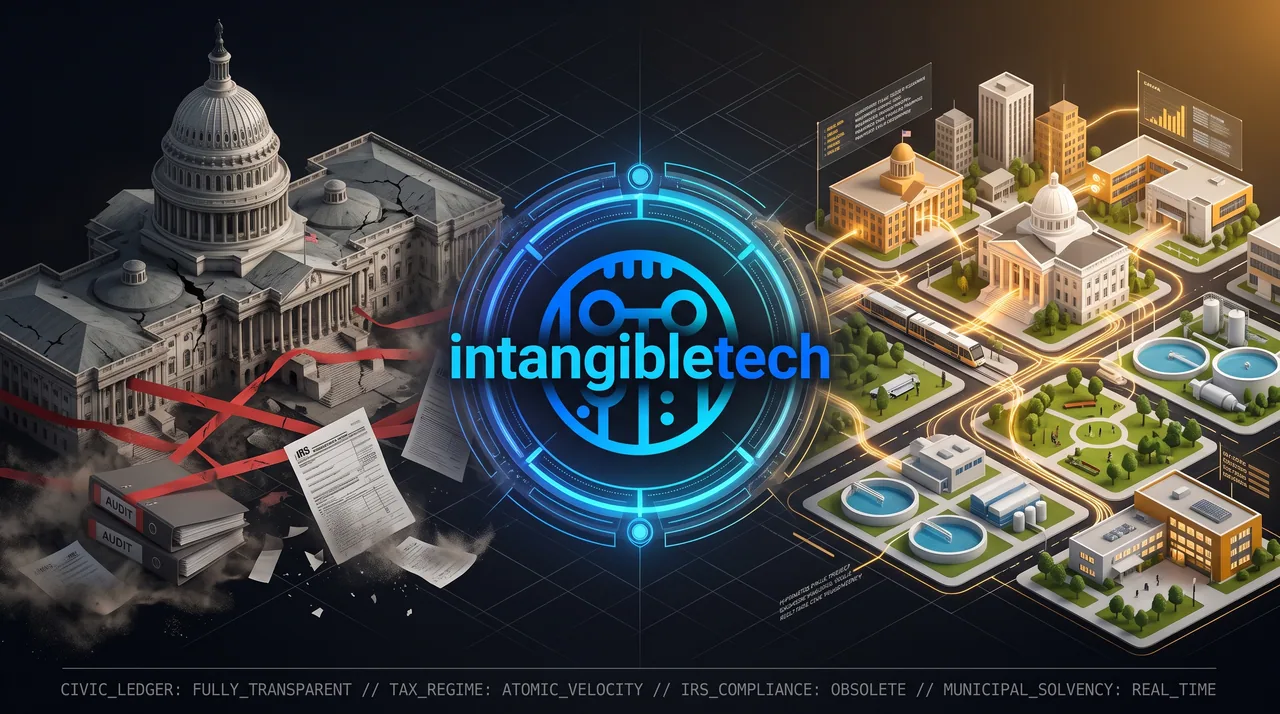
On our ledger, where public contributions are settled atomically at the point of commercial velocity, the entire category of tax filing is abolished.
The accountant’s regulatory responsibility shifts from evasion defense to Provenance Stewardship:
- Ensuring that physical machine sensors and edge gateways maintain unbroken hardware roots of trust.
- Validating that cross-enterprise supply-chain handoffs satisfy bilateral counterparty verifications.
- Structuring the enterprise’s internal capability nodes so that intellectual property streams maximum programmatic yield without leaking operational privacy.
They transition from administrative record-keepers to high-value systems guardians.
3. The Myth of the Autonomous Machine: Why the Analog World Needs Humans
There is an arrogant myth propagated by Silicon Valley that software protocols will run the entire world with zero human intervention—that algorithms will autonomously negotiate contracts, IoT sensors will effortlessly track every physical atom, and society can operate as a pure digital clockwork.
Anyone who has worked inside an actual industrial enterprise knows that this vision is a pipe dream.
The physical world is messy, unpredictable, and stubbornly analog:
- Factory sensors get coated in industrial grease and deliver noisy signals.
- Upstream suppliers deliver metal alloys that technically meet invoice specifications but fail real-world thermal stress tests.
- Software developers take shortcuts that pass automated unit tests but introduce fragile architectural dependencies that only a seasoned human eye can identify.
- Human conflicts, organizational silos, and operational bottlenecks emerge that no artificial intelligence can reconcile.
Data does not flow cleanly into an economic operating system by magic.
It requires human judgment, domain expertise, and rigorous ethical skepticism to bridge physical reality to the digital ledger.
This is where the displaced workforce finds its greatest calling: as the Human-in-the-Loop Integrity Layer.
The Progressive Attestation Specialist
As enterprises transition from manual operations to automated telemetry across our adoption continuum, they need trusted human guardians:
- In Phase 1 and Phase 2 of our adoption roadmap, operational data is ingested through supervisor keys, shift sign-offs, and software adapters backed by economic bonding.
- If a plant manager signs off on an asset log, who reviews the integrity of the attestation?
- Who investigates when a bilateral counterparty flag detects a variance between an automotive stamping plant and a Tier-1 assembly line?
It is the accountants, internal auditors, and supply-chain administrators.
They are the professionals trained in forensic skepticism. They understand internal controls, segregation of duties, and operational audit trails. Their core skill—detecting discrepancies between what is reported on paper and what actually happened in reality—becomes the foundational human layer that guarantees the integrity of the entire network.
The machine can process transactions in nanoseconds, but only human stewards can verify that the data reflects honest physical truth.
4. The Rebirth of Consulting: From Billable-Hour Theater to Operational Alpha
If internal corporate accounting transforms, what happens to the massive management consulting and professional services industry—the Big Four, the strategic advisory firms, and the legions of boutique implementation agencies?
For decades, the business model of management consulting has relied on two extractive practices:
- Billable-Hour Compliance Theater: Charging corporate clients millions of dollars to manually review documents for Sarbanes-Oxley compliance, ESG reporting disclosures, or international tax restructuring.
- The “Ax-Man” Playbook: Entering troubled companies, running standard statistical models, and advising executives to execute mass layoffs, offshore manufacturing to cheap-labor jurisdictions, and cut research budgets to artificially boost short-term quarterly EBITDA.
In the Intangible Architecture, both of these legacy revenue streams vanish:
- Compliance theater is rendered obsolete by immutable, protocol-enforced settlement.
- The ax-man layoff playbook is mathematically penalized: firing senior craftspeople drops an enterprise’s ISI, spikes its borrowing costs, and destroys its capital base.
Consulting firms are forced to evolve. They must transition from cost-cutting liquidators into Operational Resilience Engineers.
THE LEGACY CONSULTING PLAYBOOK:
Revenue Model: Billable Hours & Time-and-Materials Contracts
Standard Advice: Slash Labor OpEx, Offshore Production, Maximize Debt Leverage
Client Deliverable: 200-Page PDF Slide Decks & Static Compliance Reports
Economic Effect: Strips Long-Term Institutional Capability for Short-Term Margins
THE OPERATIONAL RESILIENCE MODEL:
Revenue Model: Performance-Bonded Shared Alpha & Provenance Yield
Standard Advice: Optimize Dependency Trees, Implement Apprenticeships, Suppress Defects
Client Deliverable: Hardened Layer-0 Nodes, Containerized IP Modules, ISI Expansion
Economic Effect: Deepens Industrial Resilience and Slashes Real Capital Costs
The New Consulting Practice Areas
Forward-thinking accounting and advisory firms are already retooling their workforces around the high-value services demanded by this operating system:
- Operational Dependency Architecture: Helping enterprise clients map their internal software pipelines, engineering workflows, and vendor networks onto the Dependency Directed Acyclic Graph (DAG) to unlock streaming kinetic yield.
- ISI Optimization Practice: Auditing client operations to eliminate hidden physical and computational defects, implementing verified mentorship programs, and restructuring engineering teams to achieve prime credit ratings.
- Legacy Modernization Bridges: Building and maintaining the custom enterprise adapters that pull operational telemetry from legacy thirty-year-old factory controllers and ERP databases into Layer-0 state machines without disrupting ongoing production.
- Algorithmic M&A Integration: Guiding corporate development teams through real-time structural simulations to ensure that corporate combinations unlock genuine operational velocity rather than inheriting brittle, hidden technical debt.
Consulting ceases to be an exercise in billing hours to generate slide decks. It becomes a high-stakes, highly compensated engineering discipline where advisory firms earn lucrative, performance-based yield by making client enterprises measurably more resilient, efficient, and capable.
5. Skills Transmutation: Why the Traditional Mindset Is Built for This Future
When administrative professionals express fear regarding automation, they make a fundamental error: they confuse their tools with their cognitive talent.
An accountant is not defined by their ability to enter numbers into an Excel cell. An auditor is not defined by their ability to staple receipts to an expense voucher. A tax specialist is not defined by their memorization of Section 179 of an obsolete tax code.
Those were merely the crude tools available at the time.
The true, underlying cognitive attributes of accounting and administrative professionals are among the rarest and most valuable human capabilities in civilization:
- Rigorous Fiduciary Skepticism: The instinctive drive to question unverified claims and demand proof.
- Systemic Thinking: The ability to understand complex, interlocking rules, dependencies, and balancing constraints.
- Ethical Discipline: A commitment to institutional integrity and fiduciary duty above short-term convenience.
- Operational Precision: An intolerance for loose tolerances, missing records, and sloppy execution.
These are not skills that are automated away by a deterministic state machine; these are the exact human capabilities required to design, govern, and audit a deterministic state machine.
When an enterprise moves its balance sheet onto Layer-0, who do they task with configuring its financial opcodes? Who audits its liquidity reserve pools? Who investigates structural variances on its dependency graph?
They do not hand that responsibility to an algorithm, nor do they hand it to a junior programmer who has never seen a balance sheet.
They hand it to their seasoned accountants, controllers, and compliance directors.
These professionals already possess the structural discipline required for this architecture; they simply need to be relieved of the manual bookkeeping drudgery so they can apply their minds to systemic governance.
6. The Structural Safety Net: Protecting the Worker During the Transition
Even with an inspiring vision of professional evolution, the friction of transition is real. Learning new architectural tools, adapting to real-time systems, and retooling organizations requires time.
In the legacy economy, when a technological shift occurs, corporate managers abandon displaced workers to personal ruin. The free-market purist tells the laid-off clerk to “learn to code,” offering zero capital support while their mortgage compounds and their savings erode.
The Intangible Architecture was deliberately engineered with an Unassailable Safety Floor to ensure that no human being is crushed by the wheels of progress:
- Account Type B Safeguards Generational Wealth: For every displaced worker or transitioning professional, personal savings parked in Account Type B earn steady, non-dilutive 4% to 8% real yields backed by physical infrastructure, preserving purchasing power without forcing them to risk their life savings in volatile stock markets.
- Non-Compounding Shelter Security: Housing financed through our protocol eliminates thirty-year compounding bank usury, cutting monthly mortgage burdens in half and ensuring that working families can never be driven into homelessness by financialized interest rate spikes.
- The Non-Deficit Citizen Dividend: As protocol-native enterprises and automated public systems eliminate administrative waste, the thermodynamic surpluses generated by the network do not vanish into the pockets of monopolistic tech platforms. Excess operational velocity automatically cascades downward to every living citizen as an unconditional, non-inflationary cash dividend.
The transition to this architecture is not a Darwinian bloodbath where the vulnerable are discarded. It is a shared, structured ascent where the operational efficiencies of the machine fund the dignity, retraining, and prosperity of the human stewards who built our world.
The Recovery of Professional Purpose
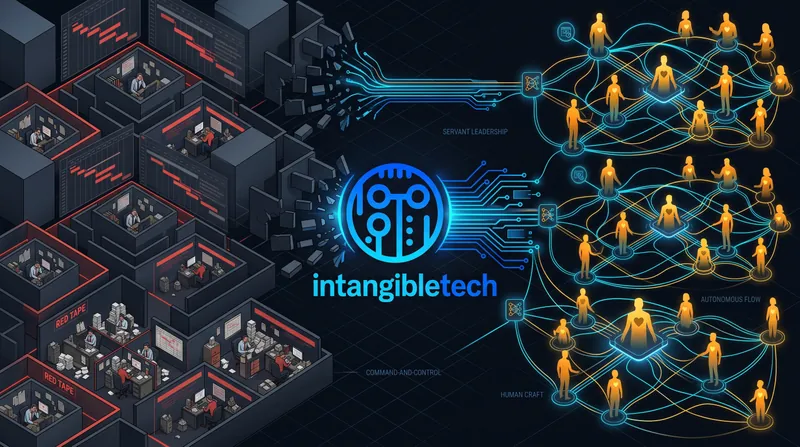
For three generations, we have subjected some of our most brilliant, disciplined minds to an exhausting, administrative prison.
We took men and women with extraordinary gifts for organization, logic, and ethical stewardship, sat them in windowless cubicles, and forced them to spend fifty years of their lives reconciling disconnected spreadsheets, auditing paper invoices, and finding loopholes in arbitrary tax codes.
We turned the stewards of economic truth into the defensive police of corporate extraction.
It was an unforgivable waste of human potential.
The Intangible Architecture tears down that prison.
By automating the mechanical plumbing of finance, we do not throw human workers away. We free them to do what no algorithm, no neural network, and no distributed ledger can ever accomplish:
- To exercise moral judgment.
- To stand as incorruptible guardians of physical and operational truth.
- To mentor the next generation of builders.
- And to guide human enterprise toward enduring, thermodynamic flourishing.
The paper is dying. The spreadsheets are closing. The compliance theater is coming to an end.
And the true work of economic stewardship is finally about to begin.