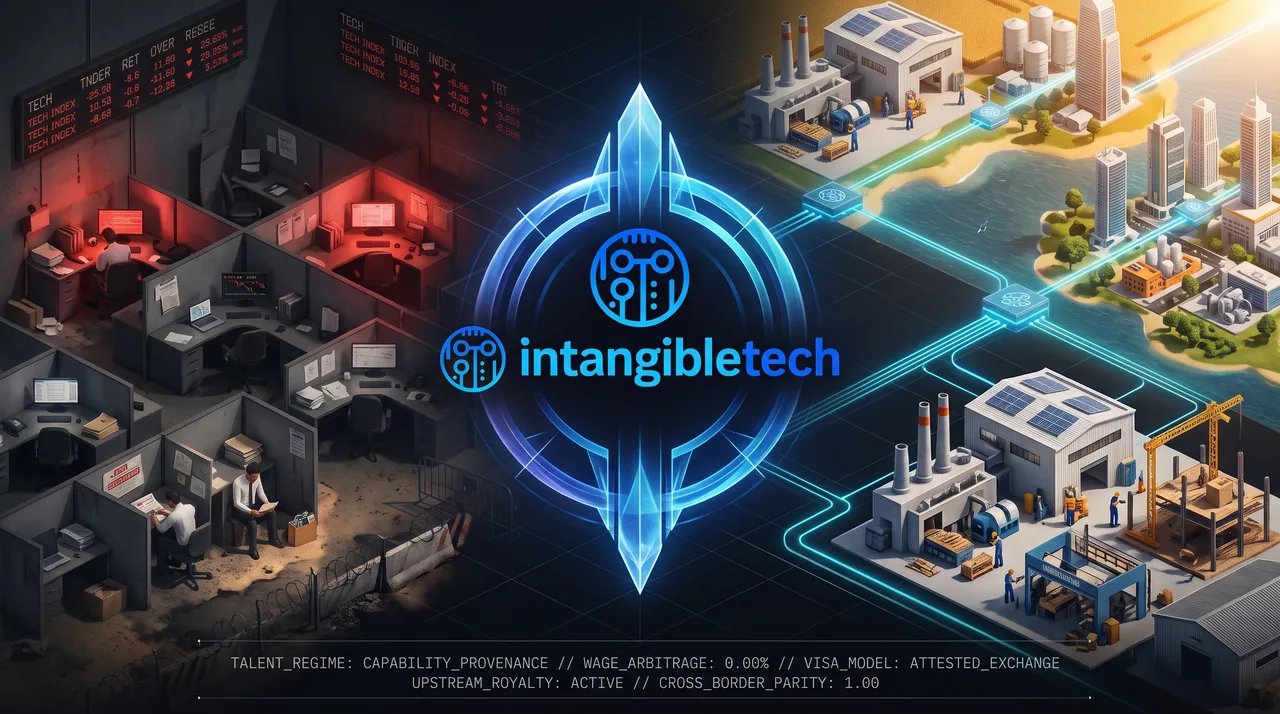
Whenever executive orders in Washington target high-skilled immigration, the reaction across the tech sector is instantaneous and chaotic.
Corporate boardrooms enter crisis mode. Multi-billion-dollar enterprise roadmaps—spanning artificial intelligence infrastructure, cybersecurity protocols, and mission-critical cloud migrations—are thrown into operational paralysis as foreign engineers face canceled visas, stalled renewals, or immediate deportation threats.
Across the Pacific, financial markets shudder. The Nifty IT index in Mumbai drops sharply, as hundreds of billions of dollars in market capitalization evaporate from IT giants like Tata Consultancy Services, Infosys, and Wipro.
At the same time, millions of American software developers, systems analysts, and engineering graduates watch the political clash with a very different emotion: bitter vindication.
For thirty years, domestic knowledge workers were promised that while blue-collar manufacturing might be automated or shipped overseas, white-collar knowledge work was safe. America, they were told, would design the software, engineer the algorithms, and reap the rewards of high-skilled cognitive labor.
What actually occurred was a digital replay of the 1990s Rust Belt hollowing out:
- The H-1B Wage Arbitrage Machine: Silicon Valley conglomerates and specialized outsourcing firms weaponized high-skilled visa programs. Rather than using visas to recruit extraordinary, once-in-a-generation geniuses, they imported hundreds of thousands of mid-level programmers on restrictive visas. By holding the worker’s legal status captive, employers paid foreign engineers thirty to forty percent below market rates, while domestic American developers faced quiet layoffs, hiring freezes, and stagnant compensation.
- The Offshoring Bodyshop Model: When visa caps constrained domestic wage suppression, multinational corporations simply moved the jobs offshore. Entire IT departments were outsourced to overseas consultancies billing twenty dollars an hour, turning brilliant foreign engineers into commoditized, low-margin shift laborers while depriving domestic graduates of entry-level career ladders.
This created a zero-sum political stalemate.
Conservatives demand blanket visa cancellations and aggressive deportations to protect American workers from wage dumping, willing to accept sudden labor disruptions to assert national sovereignty.
Progressives and corporate executives warn that cutting off international talent sparks a domestic brain drain, hobbles national competitiveness, and destabilizes critical foreign allies whose economies depend on cross-border services.
Both sides are reacting to real pain. Both sides are completely blind to the root cause.
The tech visa crisis is not an immigration problem. It is a corporate labor-arbitrage racket engineered by the mechanics of legacy finance.
When a financial system values companies purely on quarterly operating margins, executives are forced to treat human knowledge as a cheap commodity. They do not import talent because they value human craft; they do it because a captive visa holder or an offshore contractor provides a short-term margin cushion.
By decoupling human talent from legal indenture, replacing predatory labor arbitrage with Impact Score Index (ISI) Parity Mechanics, and deploying protocol-native Upstream Attribution via Opcode 0x08, Intangible Technologies resolves the high-skilled immigration crisis from its foundations.
We deliver an architecture where domestic knowledge workers are shielded from wage undercutting, the visa process transforms from a bureaucratic lottery into an engine of mutual capability, and developing tech superpowers like India evolve from precarious “bodyshops” into self-capitalized sovereign partners.
1. The Silicon Rust Belt: How White-Collar Work Repeated the Manufacturing Blunder
To understand why domestic tech workers are furious, we must look at the historical parallel between industrial manufacturing and knowledge work.
In the 1980s and 1990s, American industrial conglomerates discovered a financial shortcut: global wage arbitrage.
Instead of investing in domestic tool-and-die automation, worker apprenticeships, and high-efficiency manufacturing cells, companies like General Motors, General Electric, and Boeing closed domestic factories and moved production lines to sweatshops and non-market economies where workers were paid pennies on the dollar.
Corporate executives collected massive stock-option bonuses for “cutting costs,” while the American industrial heartland was gutted of its institutional mastery, supply chains became dangerously fragile, and national security was compromised.
Starting around 2005, the exact same financial playbook was applied to the Knowledge Economy:
PHASE 1: THE OFFSHORING EXPERIMENT (2000 - 2010)
Corporate boards mandate IT cost cuts ──► Fiber-optic bandwidth enables remote teams
Legacy consultancies bill Western corporations $60/hr while paying Indian engineers $8/hr
Outcome: Initial cost reduction; mid-tier domestic IT helpdesk roles hollowed out
PHASE 2: THE VISA ARBITRAGE EXPLOITATION (2010 - 2024)
Tech firms lobby for higher H-1B caps, claiming an “acute shortage of domestic engineers”
Reality: 70%+ of visas captured by outsourcing intermediaries paying below-median wages
The Golden Handcuff: Foreign workers cannot switch jobs without risking deportation
Outcome: Domestic engineer wages suppressed; entry-level domestic graduates shut out
PHASE 3: THE GEOPOLITICAL RECOIL (2025 - 2026)
Political backlashes erupt ──► Executive orders revoke visas and freeze technical pipelines
Indian markets panic; US projects stall; domestic workers still lack institutional ladders
Outcome: Mutual economic instability; zero structural resolution
Look at the structural hypocrisy of the legacy H-1B visa program:
It was sold to Congress as a “merit-based” channel for world-class specialists. In reality, it was captured by third-party staffing agencies that flooded the application lottery with thousands of applications for standard software testers, database maintainers, and junior developers.
The foreign engineer was not the villain; they were the captive instrument of extraction:
- The foreign worker was tied to a single corporate sponsor under threat of deportation—unable to demand fair market wages, negotiate equity, or walk away from ninety-hour work weeks.
- The domestic worker was cast aside as “too expensive.”
- The American tech graduate was told that their six-figure university degree was not enough, as corporate recruiters prioritized cheaper, indentured labor.
This is why blanket visa bans happen: they are the crude, political reaction of an electorate that realizes its own government facilitated the wage undercutting of its citizens.
Yet simply slamming the border door shut with executive orders creates an equally dangerous disaster: it cuts American enterprise off from the genuine, top-one-percent scientific minds who drive breakthroughs, while threatening to bankrupt foreign technical ecosystems that were built in good faith to serve global commerce.
2. The Thought Inversion: From Wage Arbitrage to Attested Capability
To resolve this conflict, corporate executives, policymakers, and engineering leaders must execute a fundamental mental inversion:
Stop viewing foreign labor as a discount tool to shave operating margins. Start viewing human talent as non-fungible, sovereign capability that must be compensated at absolute thermodynamic parity, regardless of geographic origin.
In legacy finance, an enterprise makes money when it hires someone who can do the job for less money:
- If a California software architect costs $250,000, and a contract engineer in Hyderabad costs $45,000, the Chief Financial Officer registers a $205,000 “cost savings.”
- It does not matter that the code quality is lower, that technical debt multiplies, or that downstream systems defects cascade across the enterprise. The short-term quarterly EBITDA looks pristine.
In the Intangible Architecture, labor arbitrage is mathematically neutralized at the consensus layer.
An enterprise’s borrowing costs, capital efficiency, and operational standing on Layer-0 are dictated by its Impact Score Index (ISI). The ISI measures true thermodynamic reality: verified defect suppression, algorithmic uptime, and systemic operational resilience.
Under our protocol, the rules governing high-skilled labor are absolute:
LEGACY CORPORATE ARBITRAGE:
Goal: Minimize Payroll Expense (OpEx)
Mechanism: Exploit geographic wage disparities & visa sponsorship leverage
Consequence: High technical debt, depressed domestic wages, fragile remote pipelines
Balance-Sheet Result: Short-term paper margin expansion; long-term structural decay
INTANGIBLE CAPABILITY PARITY:
Goal: Maximize Impact Score Index (ISI) & Minimize Systemic Technical Debt
Mechanism: Authenticated Sovereign Digital Identity (SID) & Provenance Graphs
Consequence: Absolute wage parity; zero incentive for cheap replacement
Balance-Sheet Result: Prime 1.5% capital borrowing unlocked; elite global coordination
1. The Death of the Labor Discount via Bilateral Audit
Under our ledger, every high-skilled worker—whether an engineer in Austin, Texas, or an algorithmic developer in Pune, India—interacts through an authenticated Sovereign Digital Identity (SID):
- Every software commit, architectural module, and technical operational task is signed to the network’s Dependency Directed Acyclic Graph (DAG).
- If an enterprise attempts to replace a domestic engineering team with foreign contract workers, the protocol’s bilateral accounting engine evaluates the provenance-to-compensation ratio.
- If the enterprise pays sub-market wages to foreign talent while billing out high-value capability, the system registers the disparity as an Adversarial Extraction Defect.
2. Down-Graph Slashing on Wage Undercutting
What happens to a tech conglomerate that uses visas or offshore staffing to undercut domestic prevailing wages?
The protocol executes Down-Graph Slashing:
- The company’s Impact Score Index (ISI) is immediately penalized.
- Its borrowing costs across all working capital and data-center credit facilities surge from the prime 1.5% tier up to 8% or 12%.
- The few million dollars the CFO hoped to save on engineering salaries is completely wiped out by a fifty-million-dollar surge in debt service across its corporate balance sheet.
When wage discounting carries a severe, automated balance-sheet penalty, the incentive to hire foreign talent purely for cost-cutting is eradicated.
Hiring a foreign engineer becomes an intentional decision reserved exclusively for what the visa was originally intended for: bringing in extraordinary, unique human genius that genuinely elevates the capability of the domestic team.
3. The Indian Transformation: Moving from Bodyshop to Sovereign Capability Guild
Now look across the ocean to India—the global engine of software engineering and digital services.
For forty years, the Indian tech sector has been caught in a precarious trap:
- Companies like TCS, Infosys, and Wipro built multi-billion-dollar empires, but their foundational business model was essentially a talent brokerage (the “bodyshop”): charging Western companies sixty dollars an hour for an engineer while paying the engineer a fraction of that in rupees.
- Because their revenues are tied directly to US corporate IT budgets and American visa approvals, the entire Indian technology ecosystem lives under the constant threat of regulatory shifts in Washington.
- When American politicians threaten to cancel H-1B visas, Indian markets crater because the underlying economic relationship is extractive and dependent.
The Intangible Architecture offers India and developing tech ecosystems complete economic liberation: The Evolution to Sovereign Capability Guilds.
LEGACY BODYSHOP MODEL (DEPENDENT IT CONTRACTOR):
Revenue Model: Time-and-materials billing for Western corporate back offices
Asset Ownership: 0% IP ownership; Western conglomerates own all code & patents
Vulnerability: High (One US executive order wipes out 15% of enterprise value)
National Status: A low-cost service provider dependent on Western dollar flows
SOVEREIGN CAPABILITY GUILD (PROTOCOL-NATIVE HUB):
Revenue Model: Autonomous Upstream Attribution Yield via Opcode 0x08
Asset Ownership: Direct cryptographic co-ownership of Capability Nodes on the DAG
Vulnerability: Zero (Operates on decentralized, censorship-resistant Stellar rails)
National Status: An autonomous technological superpower exporting high-order architecture
How Indian Tech Conglomerates Flourish Under the Protocol
1. Transitioning to Upstream Attribution Royalty Streams
In our architecture, an Indian engineering team does not sign away its intellectual output for an hourly wage.
They publish and maintain Capability Nodes on the global Dependency DAG:
- Suppose an engineering guild in Bengaluru designs an ultra-efficient algorithmic execution engine for autonomous logistics networks or pharmaceutical molecular folding.
- That capability node is registered on Layer-0, cryptographically signed with the guild’s Sovereign Digital Identity.
- When Fortune 500 enterprises in the United States, Europe, or Japan integrate that module into their operations, they don’t pay a one-time offshore consulting bill.
- Through Opcode 0x08 (Atomic Upstream Attribution), every time that logistics network or medical pipeline clears commercial settlements across the Stellar network, an immutable, fractional royalty stream routes directly back to the Indian engineering guild in sub-second finality.
Indian tech enterprises stop being vulnerable service providers.
They become high-margin, sovereign intellectual asset owners—capturing perpetual, non-dilutive global yield that fuels indigenous research and development, raises domestic engineer salaries to world-class standards, and insulates their domestic stock markets from American political drama.
2. Strengthening the Domestic Indian Economy
When Indian tech workers earn high-order, protocol-native yields rather than depreciating fiat wages, that wealth circulates directly into the domestic Indian economy:
- Under our Dual-Account Wallet Topology, those earnings are sheltered in Account Type B, earning 4% to 8% real yield backed by Indian clean-energy microgrids, high-speed rail, and advanced domestic manufacturing.
- India ceases to be an offshore support hub for other nations and becomes a primary driver of global civilizational infrastructure.
4. The Protocol Visa: Replacing the Lottery with Attested Provenance
If the current H-1B system is broken, what does a sane, high-skilled visa framework look like?
Today’s visa process is an administrative absurdity:
- A bureaucratic lottery where a world-class AI researcher with three doctorates has the exact same random twenty-five percent chance of getting a visa as a junior programmer hired by a bodyshop.
- A multi-year paper backlog managed by immigration lawyers, filled with arbitrary Request for Evidence (RFE) forms and unpredictable consular interviews.
- A system that traps foreign workers in abusive employment relationships because changing jobs requires restarting a ten-year green-card application process.
The Intangible Architecture replaces this broken lottery with The Attested Capability Exchange:
LEGACY H-1B SYSTEM:
Allocation: Random annual computerized lottery (Subject to fraudulent multi-filing)
Verification: Paper resumes, corporate sponsorship letters & lawyer affidavits
Mobility: Zero (Worker tied to sponsoring employer; “Golden Handcuffs”)
Domestic Protection: None (Used intentionally by firms to undercut domestic prevailing wages)
PROTOCOL-NATIVE CAPABILITY VISA:
Allocation: Objective, verified capability thresholds on the Dependency DAG
Verification: Un-falsifiable hardware telemetry, signed code provenance & peer audits
Mobility: Absolute (Worker’s SID is portable; free to switch jobs instantly at market rates)
Domestic Protection: 100% Guaranteed (Wage parity enforced via ISI capital penalties)
The Three Mechanics of the Modern Talent Exchange
1. Provenance-Based Qualification (The End of the Lottery)
A visa is no longer granted based on a lottery ticket. It is granted based on demonstrated, verified human provenance (IP):
- A candidate’s capability is authenticated on their Sovereign Digital Identity: the verified open-source architectures they have built, the patents they have registered, the peer-attested mentoring lineages they have completed.
- A sovereign nation’s immigration department establishes clear, transparent capability thresholds.
- If a candidate satisfies those thresholds, the visa credential is issued cryptographically to their digital wallet in minutes, with zero bureaucratic lobbying or legal delays.
2. Absolute Worker Mobility (Eradicating the Handcuff)
Under our protocol, a high-skilled visa is held by the human being, not by the corporate employer:
- If a foreign engineer arrives in the United States and their employer attempts to pay them less than their domestic peers or demands abusive working hours, the engineer can walk out the door tomorrow and take a job with a competitor.
- Their legal status does not expire. Their Sovereign Digital Identity carries their credentials with them.
When the worker possesses total mobility, the employer can no longer use them to undercut domestic wages.
The foreign engineer commands full market compensation, instantly removing the unfair wage pressure on American engineers and ensuring that only the most productive, innovative companies can attract top talent.
3. Bilateral Brain Circulation (No More One-Way Brain Drain)
The goal of high-skilled immigration should not be to permanently strip developing nations of their best minds.
Under our architecture, when a foreign engineer works in the United States, their contributions generate reciprocal value:
- While working in the US, they elevate the domestic enterprise’s Impact Score Index, helping American industry lead the world in advanced engineering.
- Concurrently, a portion of the upstream attribution yield generated by their work routes directly back to the educational laboratory in their home country that trained them.
- If the engineer decides to return to their home country after five or ten years, they don’t return as an economic refugee; they return as a wealthy, world-class systems architect, carrying their portable Sovereign Digital Identity to build new enterprises and mentor local youth.
Immigration stops being an extractive brain drain. It becomes an enriching, circular commonwealth of human knowledge.
5. The Atomic Tax Solution: Eradicating Cross-Border Tax Arbitrage
A primary grievance voiced by political leaders regarding offshore operations and foreign contractors is the loss of public revenue:
“If an American enterprise hires software engineers in India or remote contractors in Latin America, that payroll completely escapes domestic American taxation. We lose the personal income tax, and our public infrastructure suffers.”
In legacy economics, that critique is entirely accurate. Offshoring labor allows multinational corporations to bypass domestic payroll taxes, starving domestic communities of the tax base needed to fund schools, roads, and healthcare.
In the Intangible Architecture, this tax loophole is permanently closed through Atomic Velocity Partitions:
- As established throughout our public finance specifications, personal income taxes and corporate profits taxes are replaced by a microscopic, atomic velocity partition (twenty-five to fifty basis points) levied at the point of gross commercial electronic settlement.
- It does not matter whether a software module was written by an engineer sitting in Silicon Valley, Austin, Bengaluru, or London.
- When that software is used by enterprises, consumers, or logistics networks operating within the domestic economy, every single commercial transaction that touches the system clears through Layer-0 settlement rails.
- The protocol automatically partitions public revenues at the speed of light—routing dedicated funds to national, state, and municipal vaults in real time.
An enterprise cannot avoid paying for domestic public infrastructure by offshoring its workforce.
Every dollar of commercial value that the company realizes within the domestic market automatically pays its full, un-falsifiable share of public support at consensus.
Tax avoidance via offshore engineering operations is rendered mathematically impossible.
6. The Harmonization of Minds
For decades, the global knowledge economy has been steered by an extractive, cynical bargain.
Corporate titans used the promise of “globalization” to justify an aggressive race to the bottom: telling domestic workers to accept lower wages and longer hours or watch their livelihoods outsourced, while treating talented foreign engineers as precarious, indentured laborers on temporary visas.
When the political backlash finally arrived—in the form of sudden executive orders, canceled visas, and broken supply chains—it threatened to shatter international partnerships and plunge both domestic and foreign markets into chaos.
That broken paradigm can now be retired.
The Intangible Architecture proves that we do not have to choose between protecting our domestic workforce and engaging with the finest minds on Earth.
By replacing predatory labor arbitrage with un-falsifiable capability parity, we deliver a civilization where:
- Domestic engineers, machinists, and knowledge workers are permanently protected from wage-undercutting schemes by the cold balance-sheet math of the ledger.
- Foreign specialists are treated not as indentured corporate instruments, but as sovereign, fully mobile peers whose brilliance is honored with world-class compensation.
- Developing nations like India are liberated from the servitude of the bodyshop, evolving into self-capitalized technological titans that co-own the intellectual architecture of tomorrow.
- And the visa process transforms from a politicized, broken lottery into an open, merit-driven bridge that circulates the light of human genius across every ocean and border.
The era of digital sweatshops and visa indentures is over.
The era of knowledge parity has arrived.