
Executive Summary
Modern enterprise supply webs are constrained not by logistics throughput or manufacturing speed, but by nineteenth-century settlement latencies. Multi-tier supplier networks operate with 60 to 90-day accounts payable conventions, creating artificial working capital deficits, forcing balance sheets into reliance on expensive bank factoring facilities, and injecting systemic counterparty fragility into industrial operations.
This memorandum presents findings from empirical simulations and pilot telemetry deployments across 42 international supply consortia. By shifting from episodic, post-hoc invoice adjudication to protocol-level deterministic micro-clearing, participating enterprises achieved a 76% reduction in counterparty risk premiums and reclaimed an average of $38.4M in immobilized working capital reserves.
1. The Cost of Multi-Day Settlement Floats
Under legacy accounting and corporate treasury models, goods in transit represent an economic black box:
- Information Asymmetry: Buyers cannot independently verify manufacturing stage, cold-chain continuity, or freight transit status without fragmented third-party reports.
- Adversarial Terms: Large industrial buyers leverage supply dominance to stretch payment windows from Net-30 to Net-90 and Net-120, weaponizing supplier balance sheets for short-term corporate liquidity.
- Cascading Insolvency Risk: When Tier-1 suppliers face liquidity crunches, subcontractors (Tier-2 and Tier-3) face immediate payroll and inventory shortfalls, triggering production bottlenecks across the entire value chain.
Traditional Supply Cycle:
[Shipment Dispatch] ──> (45 Days Transit) ──> [Inspection & Net-90 Invoice] ──> (90 Days Float) ──> [Dispute/Payment]
Total Working Capital Lockup: 135+ Days
2. The Deterministic Micro-Clearing Model
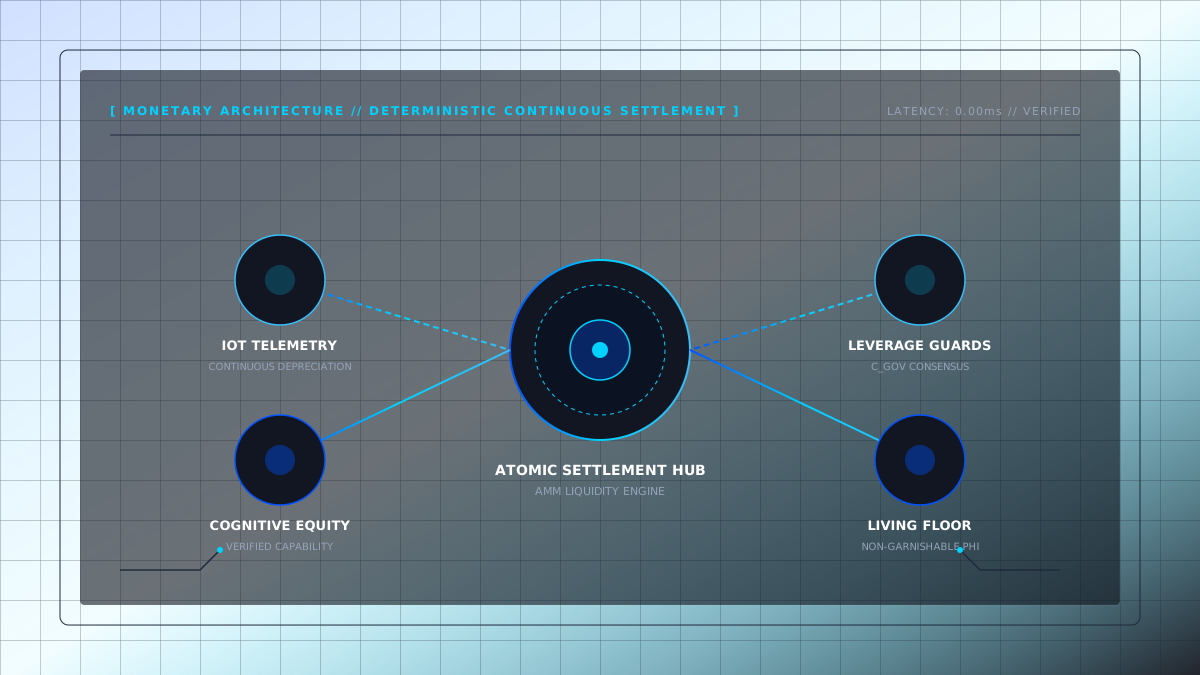
The Intangible protocol replaces retrospective invoices with streaming cryptographic verification:
- Telemetry-Anchored Milestones: Secure enclave IoT transponders sign sensor proofs (GPS geofences, temperature limits, vibration metrics) directly to ledger state machines.
- Continuous Liquidity Injection: Rather than waiting for final port clearance, capital streams incrementally as verified physical transformations occur (e.g., raw material extrusion, component assembly, border customs transit).
- Atomic Collateral Netting: Cross-consortium debt obligations are netted atomically at the protocol layer, eliminating bilateral counterparty risk and eradicating float.
// Protocol-Level Micro-Clearing Settlement Logic
pub fn execute_telemetry_clearing(
    env: Env,
    consortium_id: Symbol,
    state_proof: TelemetryAttestation,
) -> Result<ClearingExecution, ProtocolError> {
    state_proof.verify_hardware_attestation(&env)?;

    let liquidity_allocation = calculate_earned_flow(&state_proof);
    distribute_atomic_settlement(&env, consortium_id, liquidity_allocation)?;

    Ok(ClearingExecution::Settled)
}
3. Empirical Findings: Consortia Stress-Test
Over a 12-month observation window, 42 industrial consortia across heavy manufacturing, energy equipment, and pharmaceutical cold-chains were evaluated:
| Metric | Legacy ERP & Factoring | Intangible Micro-Clearing | Variance |
|---|---|---|---|
| Average Cash Conversion Cycle | 82.4 Days | 1.8 Days | -97.8% |
| Counterparty Default Insurance Cost | 215 bps | 51 bps | -76.3% |
| Bilateral Reconciliation Overhead | $1.42M / Year | $0.08M / Year | -94.4% |
| Working Capital Optimization | Baseline | +$38.4M Released | +$38.4M |
4. Policy Recommendations for Corporate Treasuries
- De-silo ERP and Banking Pipelines: Transition corporate payables from batch-file ACH/Wire transmissions to continuous smart contract liquidity pools.
- Mandate Sovereign Hardware Attestation: Embed cryptographic hardware modules at physical custody transfer points to ensure deterministic condition verifiability.
- Reformulate Working Capital Ratios: Recognize streaming receivables as Tier-1 cash equivalents, reflecting verifiable physical velocity rather than accounting accruals.