
For over a century, macroeconomic theory has been organized around an unobservable variable.
In 1911, Irving Fisher codified the foundational equation of monetary exchange: MV=PY.
The formula asserted that the money supply (M) multiplied by the velocity of money (V) must equal nominal national output (PY, or Gross Domestic Product). Yet, while central banks could count the static reserves sitting in commercial bank vaults (M), velocity (V) was physically impossible to measure.
Because cash circulated anonymously in physical pockets, and electronic deposits were locked inside thousands of isolated, proprietary commercial bank databases, economists had no way of knowing how frequently a single dollar moved through the physical economy. Bank of America’s relational database could not see JPMorgan Chase’s internal ledger; corporate ERPs operated on disconnected batch-accounting silos; and clearinghouses required three days to reconcile interbank balances.
Faced with a data void, economists transformed velocity into a theoretical ghost. Central banks simply measured estimated quarterly GDP ninety days after a quarter closed, divided it by an estimated broad money supply, and published a backward-looking statistical artifact.
Because velocity was an unobservable trailing average rather than an active operational variable, no financial instrument, commercial loan, or sovereign budget could ever be engineered to run on it. The global economy was forced to operate on a static, batch-processed accounting model invented by Venetian merchants in 1494.
That structural limitation is now obsolete.
By replacing retrospective double-entry SQL databases with an event-driven arithmetic state machine, velocity ceases to be an abstract economic calculation. It becomes an observable, millisecond-level telemetry scalar (Vt).
When transactional turnover is captured at consensus, the foundational physics of debt, taxation, and capital formation invert. Debt stops functioning as an extractive, compounding liability and becomes an auto-amortizing asset. Sovereign debt ceases to require perpetual inflationary rollover. And working-class households are permanently freed from the mathematics of compound usury.
1. The Architectural Bottleneck: Why Legacy Ledgers Broke Monetary Physics
The modern world attempts to run supersonic commerce, global supply chains, and sub-second communications on an accounting foundation designed for wooden sailing ships.
When Luca Pacioli formalized double-entry bookkeeping in 1494, it served a specific purpose: tallying static inventory and merchant obligations at the conclusion of multi-month maritime voyages. When banking computerized in the 1970s—via IBM mainframes, COBOL scripts, relational SQL databases, and the SWIFT messaging network—engineers simply digitized Pacioli’s parchment.
This static architecture introduced three catastrophic systemic bugs into global finance:
Bug 1: The Compounding Debt Divergence
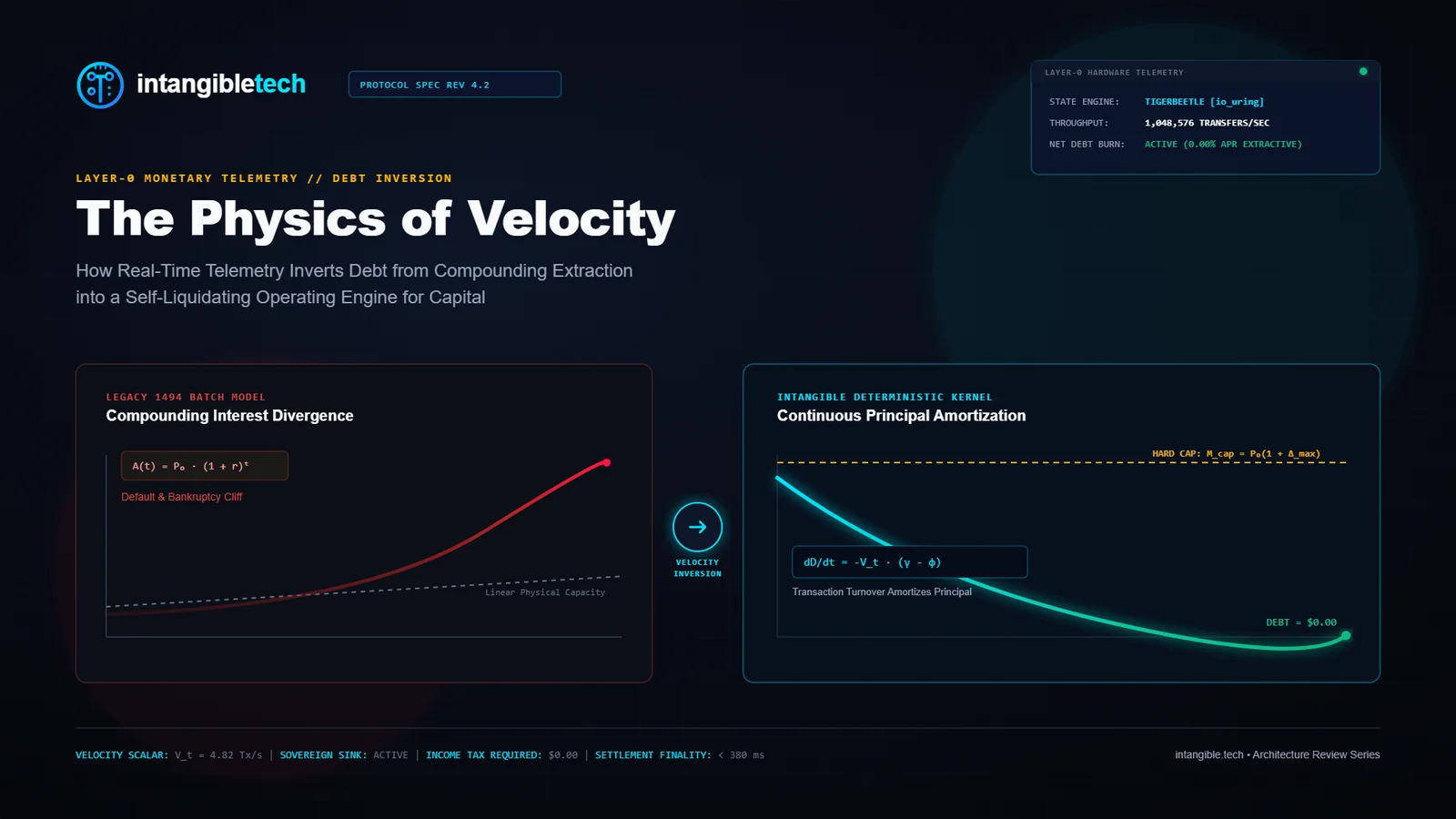
In the legacy system, money is created almost exclusively as interest-bearing debt issued by commercial banks. When a bank originates principal P0, it does not create the corresponding interest required to service that loan over time. The ledger demands the repayment of: A(t)=P0(1+r)t
Because physical thermodynamic reality—industrial production, energy generation, and human biological labor—grows linearly or modestly at 2% to 4% per year, an exponential debt claim (1+r)t compounding at 6% to 25% is mathematically guaranteed to outstrip the physical economy. Every 35 to 50 years, this divergence forces a catastrophic reckoning: either systemic default liquidations (1929, 2008) or runaway sovereign currency debasement (1971–present).
Bug 2: Velocity Blindness and the Hoarding Trap
On a legacy ledger, a dollar sitting completely dormant inside an offshore speculative tax shelter is recorded identically to a dollar actively circulating through an industrial supply chain paying machinists, welders, and engineers. Worse, because central banks pay risk-free interest on idle bank reserves (rfed>0), capital holders are actively rewarded for withholding liquidity from the physical economy. Stagnant liquidity starves Main Street factories of working capital while inflating paper asset bubbles.
Bug 3: Asynchronous Clearing Float
Because Bank A and Bank B maintain disconnected relational databases, a wire transfer does not move value; it sends an unverified text message promising to settle later. To insure against the multi-day clearing window, financial institutions must lock trillions of dollars in non-productive capital buffers, creating an immense liquidity drag that extracts up to 3% on every commercial interaction.
2. The Technical Breakthrough: Turning Velocity into a Live Protocol Input
To operationalize velocity, the underlying ledger must be rebuilt from the silicon up.
The Intangible Financial Architecture accomplishes this by decoupling execution from wide-area settlement across a Two-Tier Deterministic Stack.
Rather than running heavy, exploit-prone Turing-complete virtual machines (EVMs) that burn execution cycles on gas auctions and dynamic memory allocations, the Layer-0 accounting kernel executes on a specialized, bare-metal state machine modeled on TigerBeetle.
The 128-Byte Cache-Line Memory Architecture
Every account in the economy is structured as an immutable, 128-byte binary struct. Because modern processor architectures fetch RAM into L1/L2 cache in 64-byte chunks, a 128-byte account loads into exactly two CPU cache lines with zero pointer chasing and zero heap fragmentation.
Because account memory is static and pre-allocated at boot, a modern 4.0 GHz CPU core executing simple 128-bit vector arithmetic processes over 1,000,000 atomic balance transitions per second in L1 cache.
The Observable Velocity Telemetry Scalar (Vt)
With every account transition timestamped at the nanosecond level inside CPU cache, velocity ceases to be an estimate. The engine continuously computes the real-time velocity scalar across active settlement reserves.
Where:
- Transaction Volume is the gross verified commercial settlement passing through protocol Automated Market Maker (AMM) pools during epoch t.
- Active Reserve Liquidity is the primary reserve capital backing the clearing corridors.
Velocity is no longer an economic theory. It is a verified, live speedometer ticking on Layer 0.
3. The Debt Inversion: Converting Liabilities into Self-Liquidating Assets
Once velocity is an observable state variable, the fundamental relationship between a borrower, a creditor, and time can be completely re-engineered.
In the legacy banking system, a borrower takes out credit, receives cash, and is burdened with an adversarial contract. The interest rate accrues independently of enterprise success or factory uptime. If an economic shock pauses production, compounding interest continues to multiply, inevitably pushing the borrower into default and fire-sale liquidation.
Under this architecture, debt is transformed into Credit-as-an-Asset.
The Mathematics of Velocity Amortization
When a business draws working capital or equipment financing, the transaction issues an on-chain Velocity-Amortized Accounts Receivable Bond backed by liquid AMM reserves.
As general commerce circulates through the network, the protocol harvests an atomic liquidity turnover fee (0.3%). Deducting the transparent operational overhead of validator infrastructure (), the protocol derives the Net Debt Burn Rate.
The outstanding debt principal of borrower amortizes continuously in cadence with network commercial velocity.
Under balanced operating conditions, the debt decays exponentially toward zero.
The borrower does not pay compounding interest out of pocket.
Because the enterprise is an active node in the regional economy, producing real goods, paying wages, and purchasing raw materials, its daily operational velocity routes liquidity through the settlement pool. That turnover automatically burns down the principal balance. More economic activity equals faster debt retirement.
The Hard Cumulative Dollar Cap (Mcap)
To eliminate predatory debt traps forever, every loan struct on the Layer-0 ledger contains an immutable, non-negotiable parameter: the Cumulative Dollar Cap.
Under no circumstance can total cumulative repayments across all time ever exceed the dollar cap. Even if a global supply-chain catastrophe halts factory production for three years, interest accrual permanently freezes the moment cumulative fees reach the cap. The debt never runs away; it waits for physical production to resume.
4. Macroeconomic Solvency: Retiring Sovereign Debt Without Austerity
This mechanical inversion scales directly from a single factory floor to the global macroeconomic crisis of sovereign debt.
The United States currently carries over $40 trillion in national debt, with net annual interest payments surpassing $1.1 trillion—exceeding the entire national defense budget. Under the legacy paradigm, sovereign treasuries are trapped in an existential death loop: they cannot raise interest rates without bankrupting the state through debt service, and they cannot lower rates without re-igniting structural consumer inflation.
The policy establishment’s recent impulse by pushing US dollar stablecoins overseas to artificially force foreign digital wallets into buying US Treasury bills is a short-sighted palliative. It treats the digital frontier as an involuntary debt sponge for Washington’s fiscal deficits, freezing trillions in sterile paper assets that fund zero industrial factories, train zero apprentices, and export inflation to emerging markets.
The Velocity Sinking Fund
The Intangible Architecture resolves sovereign insolvency by shifting public finance from an invasive, retrospective income-tax model to an Atomic Point-of-Settlement Velocity Partition (Opcode 0x01).
Consider the sheer scale of the macroeconomic base:
- Legacy personal income tax extracts roughly $2.5 trillion annually from a narrow, exhausted base of domestic labor income, while consuming over $400 billion in compliance and legal friction.
- Concurrently, gross electronic payments across US commercial, B2B wholesale, and financial settlement corridors clear upwards of $1.5 quadrillion every year.
By capturing a microscopic, atomic velocity skim—just 0.25% to 0.50%—applied uniformly across all cleared electronic settlement volume (while exempting basic consumer living essentials at 0.00%), the protocol generates trillions in frictionless, zero-leakage public revenue.
A dedicated fraction of this continuous velocity stream routes directly into an un-raidable, consensus-enforced Sovereign Debt Sink. As legacy Treasury bonds mature, the Debt Sink redeems and burns the principal at 100% par value using un-leveraged commercial velocity.
The national debt is systematically retired over a 15-to-20-year horizon with zero income taxes, zero retrospective IRS audits, zero cuts to vital public services, and zero inflationary money printing.
5. Main Street Equilibrium: Eradicating Compounding Usury for American Households
While the macroeconomic mechanics solve sovereign debt, the human impact is felt directly at the kitchen table.
Under legacy finance, the bottom 60% of working families are subjected to relentless financial extraction: 24% APR compounding credit cards, $35 overdraft penalties, 400% payday loans, and 30-year mortgages where a family pays two-and-a-half times the purchase price of their home in compounding bank interest.
The Intangible Architecture establishes an unassailable financial safety floor through three interlocking consumer primitives:
1. The Dual-Account Wallet Topology
Every citizen wallet separates exchange velocity from capital preservation:
- Account Type A (Checking): Carries an unconditional Citizen Exemption Floor ($100,000**)**. Working balances below this floor experience 0.0% decay. Idle multi-million-dollar speculative cash hoards above the floor that refuse to circulate face continuous demurrage, with 100% of decayed units recycled directly into the Universal Citizen Dividend Pool.
- Account Type B (Savings & Retirement Vault): Balances have 0.0% decay and earn steady +4% to +8% real productive yield backed by physical machinery and infrastructure, permanently protecting disciplined middle-class savers from inflation without forcing them to gamble in the Wall Street stock market.
2. De-Financializing Family Shelter
Residential housing is stripped of its speculative premium by mathematically assigning raw land hoarding an Impact Score Index of zero (ISI=0.0). Primary residences are financed via Non-Compounding Sovereign Home Facilities.
On a standard $350,000 starter home, eliminating 30-year compounding bank usury cuts the total purchase cost from $838,000 down to $378,000—slashing a working family’s monthly housing payment by more than 55% overnight.
3. The Non-Deficit Citizen Dividend
Any capital accumulating inside municipal infrastructure vaults beyond statutory reserve targets automatically cascades downward to all liveness-verified citizens as an unconditional, non-inflationary Citizen Dividend.
The dividend is not printed out of thin air by a central bank committee. It is an algorithmic cash refund of the excess velocity generated by a hyper-efficient, low-defect local economy. Poverty is structurally eradicated not through bureaucratic welfare cliffs that punish work, but through the shared thermodynamic surplus of an automated operating system.
The Next Operational Horizon
For five hundred years, human civilization accepted compounding debt, chronic inflation, and periodic banking collapses as unalterable laws of economics.
They were not laws of economics. They were legacy software bugs.
They were the inevitable mathematical fallout of running global human cooperation on an asynchronous, double-entry batch ledger that could not see or capture the kinetic velocity of the physical world.
By deploying an event-driven arithmetic state machine grounded in bare-metal silicon, we make velocity visible, measurable, and programmable. In doing so, we invert debt from a weapon of extraction into an instrument of production. We deliver a financial operating system worthy of human ingenuity.