Sit in on an executive risk committee meeting at any Tier-1 commercial bank, sovereign wealth fund, or Fortune 50 corporate treasury.
The Chief Information Officer or Head of Digital Assets brings forward a proposal to deploy working capital onto a modern public blockchain. They showcase automated yield generation, programmatic cross-border settlement, and sub-second collateralization.
Then, the Chief Risk Officer and the Chief Information Security Officer step into the room.
They open a single briefing document detailing the last five years of decentralized finance (DeFi):
- Over ten billion dollars in customer deposits, treasury reserves, and collateral evaporated across hundreds of high-profile security failures.
- In 2016, the Ethereum DAO hack drained sixty million dollars and forced a contentious hard fork of the entire network.
- In 2022, the Wormhole bridge exploit lost $320 million, followed by Nomad’s $190 million collapse.
- In 2023, Euler Finance lost $197 million in a flash-loan reentrancy attack, while the Curve Finance Vyper compiler zero-day vulnerability drained dozens of liquidity pools simultaneously.
The CRO looks across the mahogany table at the executive team and asks a devastatingly simple question:
“You want us to put five hundred million dollars of our balance-sheet capital into an execution environment where a single junior developer’s missing reentrancy guard, a compiler memory-ordering quirk, or an unchecked dynamic delegate-call can vaporize our shareholders’ equity in twelve seconds with zero legal recourse?”
The meeting is adjourned. The proposal is rejected.
Web3 enthusiasts, venture capitalists, and blockchain purists look at these institutional rejections and complain that corporate leaders “just don’t understand the tech” or are “afraid of disruption.”
They are completely wrong.
Enterprise executives and bank risk committees understand the technology far better than the crypto purists realize. They recognize that the foundational architecture of the modern smart-contract blockchain is an unacceptable systemic liability.
The $10 billion exploit epidemic is not an accidental series of bad coding mistakes. It is not an issue that can be solved by hiring more third-party audit firms or adding more lines of automated testing.
The exploit crisis is the direct, mathematical consequence of a fatal architectural design choice: Turing-Completeness on the Settlement Layer.
By attempting to turn the settlement ledger into a general-purpose “World Computer” capable of running arbitrary, unbounded code, the creators of Ethereum, EVM-compatible networks, and Solana built an execution surface with near-infinite permutations. They built a system where mathematically proving the safety of an enterprise balance sheet is physically impossible.
To unlock institutional capital, we must execute a fundamental architectural inversion.
Intangible Technologies rejects the reckless dogma of the unbounded virtual machine.
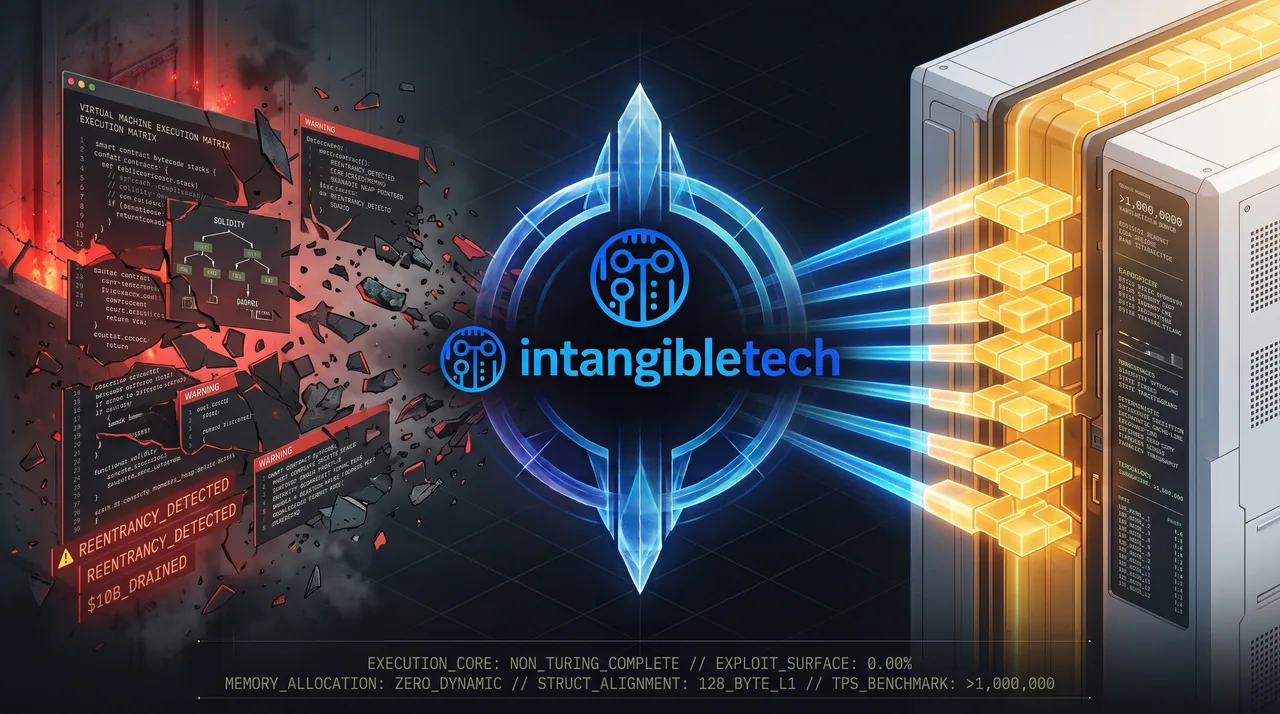
By replacing general-purpose code with Eight Pre-Compiled Financial Opcodes, enforcing TigerBeetle-inspired 128-byte cache alignment with zero dynamic memory allocation, and anchoring settlement to the battle-tested deterministic rails of the Stellar network, we eliminate the exploit surface at the root. We do not just secure code; we make balance-sheet exploits physically impossible at the level of silicon.
1. The Original Sin: The Turing-Complete Fallacy
To understand how distributed systems engineering went off the rails, we must examine the intellectual pivot that occurred between 2009 and 2015.
When Satoshi Nakamoto designed Bitcoin, he made a deliberate, brilliant design decision that modern crypto evangelists spent a decade dismissing as primitive: Bitcoin’s Script was intentionally non-Turing-complete.
Bitcoin had no loops (FOR or WHILE). It had no arbitrary jumps. It had no dynamic memory allocation. It was an intentionally restricted stack-based language designed to answer one question: Do the cryptographic signatures and conditions satisfy this spending transaction?
Satoshi understood that a monetary ledger is not a game engine; it is a conservation law.
In 2013, early blockchain developers looked at Bitcoin’s limitations and proposed an ambitious intellectual leap: What if the blockchain wasn’t just a ledger, but a Turing-complete decentralized computer?
By embedding the Ethereum Virtual Machine (EVM), developers could write any arbitrary logic imaginable: infinite loops, dynamic recursive calls, complex inheritance trees, and generalized software programs living directly inside the state machine.
It was marketed as the ultimate expression of developer freedom.
In enterprise systems architecture, however, unbounded flexibility is the enemy of security.
THE TURING-COMPLETE “WORLD COMPUTER” (EVM / SOLANA):
State Machine Goal: General-Purpose Execution (Runs games, NFTs, loans, arbitrary logic)
Instruction Set: Unbounded bytecode instructions, dynamic jumps, recursive call graphs
Execution Logic: Turing-Complete (Subject to the Halting Problem and state-space explosion)
Memory Safety: Dynamic Heap Allocation, complex reference pointers, pointer arithmetic
Exploit Surface: INFINITE PERMUTATIONS ($10B+ Stolen via Reentrancy, Logic Bugs, Memory Drift)
VS.
THE INTANGIBLE FINITE-STATE ENGINE:
State Machine Goal: Deterministic Financial Settlement & Conservation Invariants
Instruction Set: 8 Pre-Compiled, Mathematically Formally Verified Financial Opcodes
Execution Logic: Strictly Non-Turing-Complete (Finite state machine; execution bounds known at boot)
Memory Safety: Zero Dynamic Allocation, 128-Byte L1-Cache Aligned, Static Memory Pools
Exploit Surface: ZERO MATHEMATICAL ROOM FOR EXPLOIT (Formally Verifiable Invariants)
The Halting Problem Meets Institutional Finance
In computer science, Alan Turing proved in 1936 that it is mathematically impossible to write a general algorithm that can look at any arbitrary Turing-complete program and determine whether it will halt or run forever.
To prevent infinite loops from locking up the blockchain, Ethereum introduced “Gas”—charging fees for every computational step.
Gas solved the computational halting problem for the network, but it introduced a far deadlier economic halting problem for the balance sheet:
- Because the execution path is dynamic, a smart contract cannot know with absolute certainty what state the world will be in when a nested transaction finishes executing.
- The State-Space Explosion: A smart contract interacting with three other external contracts does not have three execution states; it has thousands of potential recursive permutations.
- No security audit firm on Earth—no matter how many millions of dollars they charge—can mathematically prove that an arbitrary, dynamic Turing-complete smart contract is free of edge-case failure modes.
We built an eight-trillion-dollar global financial conversation on top of an execution paradigm that is mathematically unprovable.
2. Anatomy of a $10 Billion Catastrophe: How EVM Contracts Bleed
Let us examine the exact technical failure modes that have drained billions of dollars from legacy blockchains, and why they can never be engineered away within a Turing-complete virtual machine:
1. The Reentrancy Vector (The Classic Exploit)
In a Turing-complete environment like the EVM, Contract A can call Contract B, and Contract B can call back into Contract A before Contract A has finished updating its internal balance sheet.
This was the exact mechanic of the famous DAO hack, the Lendf.me exploit, and the Euler Finance collapse:
- The victim contract checks the user’s balance: User has $100,000.
- The contract initiates the transfer of funds to the user’s contract address.
- Because the receiving address can execute arbitrary Turing-complete fallback code, the attacker’s contract immediately calls the withdraw() function again, before Step 1’s balance was subtracted.
- The victim contract checks the balance again: because the state variable has not yet been written to storage, it still reads $100,000.
- The contract transfers another $100,000.
- The loop recurses dozens of times within a single block until the contract’s entire liquidity reserve is completely drained.
Developers attempted to patch this with “reentrancy guards” (mutex locks) and checks-effects-interactions patterns.
Yet in complex modern protocols involving multi-token liquidations, cross-contract flash loans, and read-only reentrancy vectors across multiple decentralized exchanges, human engineers continuously miss an execution path.
The reentrancy vector exists because the programming language permits untrusted, arbitrary external call interception.
2. Dynamic Memory and Pointer Corruption
In languages like Solidity, Rust (on Solana), or C++, contracts frequently rely on dynamic memory allocation:
- Allocating variables onto the heap during runtime.
- Expanding dynamic arrays, mapping keys, and complex string variables.
- Relying on compiler-generated memory offsets to unpack data.
Whenever memory is allocated dynamically, the door opens to heap fragmentation, memory corruption, and compiler-level storage collision.
In the 2023 Vyper compiler bug, a flaw in how the compiler handled reentrancy locks across specific memory structures allowed attackers to bypass the lock entirely across several prominent Curve liquidity pools.
The developers wrote the code correctly according to the specification; the compiler itself generated flawed bytecode because the language specification was too complex to maintain absolute deterministic integrity.
An enterprise cannot build a multi-century financial infrastructure on an environment where the compiler itself is an attack vector.
3. The Protocol Inversion: The Eight Pre-Compiled Financial Opcodes
How does Intangible Technologies solve the exploit crisis?
We do not write a better reentrancy guard. We do not design another complex smart-contract language.
We remove the virtual machine from the settlement layer entirely.
In our Layer-0 architecture, arbitrary, general-purpose computation is pushed to the edge where it belongs. The core consensus engine does not interpret high-level, dynamic scripts.
The settlement layer is governed by a Closed Instruction Set Architecture (ISA) consisting of exactly Eight Pre-Compiled, Mathematically Proven Financial Opcodes:
OPCODE 0x01: ATOMIC_SETTLEMENT_SPLIT
• Executes multi-party bilateral value transfers in a single atomic transaction.
• Sub-second deterministic clearing; 100% matched debit-credit invariant.
OPCODE 0x02: VELOCITY_PARTITION_DECAY
• Programmatically harvests the microscopic civic velocity partition (0.35%)
and applies statutory demurrage decay strictly to idle mega-hoards above the floor.
OPCODE 0x03: NON_COMPOUNDING_AMORTIZATION
• Manages asset-backed credit facilities; amortizes debt linearly based on
realized kinetic velocity ($Vt), permanently eliminating compounding usury math.
OPCODE 0x04: PARAMETRIC_ESCROW_TRIGGER
• Evaluates incoming hardware-attested telemetry (TPM 2.0 / NOAA / IoT);
releases or freezes liquidity instantly based on immutable boundary conditions.
OPCODE 0x05: SOVEREIGN_RESERVE_REBALANCE
• Enforces real-time liquidity balancing between Account Type A (Transactional)
and Account Type B (Productive Capital), ensuring 100% reserve backing.
OPCODE 0x06: BILATERAL_DEFECT_ASSERTION
• Logs operational variances, mechanical downtime, or supply-chain delays;
dynamically modulates the enterprise Impact Score Index (ISI).
OPCODE 0x07: DETERMINISTIC_RESTITUTION_CLAWBACK
• Executes judicial and regulatory fraud judgments; automatically freezes and
re-routes illicit assets across the Dependency DAG to victim indemnity vaults.
OPCODE 0x08: ATOMIC_UPSTREAM_ATTRIBUTION_ROUTING
• Traverses the global Dependency DAG in consensus; atomically splits and routes
fractional, senior intellectual and educational royalties to foundational creators.
The Power of the Closed Instruction Set
Look at the mathematical consequences of this architecture:
- Zero Arbitrary Execution: A transaction cannot submit custom bytecode to execute on the ledger. It can only call one of these eight pre-compiled opcodes with strictly typed, fixed-size parameter structs.
- No Reentrancy is Possible: Because execution cannot yield control to an arbitrary third-party address, reentrancy does not exist. There are no external call callbacks, no dynamic dispatchers, and no fallback functions.
- Total Formal Verifiability: Because the state transitions are mathematically closed, we can use automated theorem provers (such as Coq, TLA+, or Z3) to formally prove the safety of the entire financial ledger. We can prove mathematically that no sequence of valid transactions can ever violate the core monetary conservation laws.
The exploit surface is not reduced by ninety percent; it is reduced to zero.
4. Hardware-Attested Determinism: The TigerBeetle Philosophy
Having a closed instruction set is only the first half of the engineering solution. The second half is how that instruction set interacts with physical silicon and computer memory.
In traditional blockchain nodes, software is written in high-level languages that introduce catastrophic performance and security bottlenecks:
- Go (Ethereum Geth) uses a Garbage Collector (GC) that periodically pauses execution to clean up unallocated memory, introducing unpredictable latency spikes.
- Rust (Solana/Near) introduces complex async runtime schedulers and memory-allocation overhead that can lead to node desynchronization during network congestion.
- Data is stored in generalized Key-Value databases (LevelDB, RocksDB) using complex B-trees and write-ahead logs that thrash hard drives and CPU caches.
The Intangible Architecture takes its inspiration from the world’s most advanced financial database engineering—pioneered by architectures like TigerBeetle:
LEGACY BLOCKCHAIN NODE STORAGE (ROCKSDB / ETHEREUM):
Data Layout: Arbitrary JSON / RLP encoded payloads, dynamic-length arrays
Memory Model: Dynamic Heap Allocation (`malloc` / `new`); continuous pointer chasing
CPU Cache Impact: Catastrophic L1/L2 Cache Misses; CPU thrashes waiting for RAM
Latency: Highly erratic (10ms to 3,000ms); Garbage collection pauses; 15 to 3,000 TPS
INTANGIBLE ZERO-COPY BARE-METAL SILICON:
Data Layout: Strictly uniform, 128-Byte Static State Structs (Binary Packed)
Memory Model: ZERO DYNAMIC ALLOCATION (Static memory pools pre-allocated at boot)
CPU Cache Impact: Flawless L1 Cache Line Alignment (Fits exactly in two 64-byte lines)
Latency: Sub-microsecond deterministic execution; Over 1,000,000 TPS on commodity hardware
The Technical Mechanics of 128-Byte Cache Alignment
1. Zero Dynamic Allocation (no malloc)
When an Intangible Layer-0 node boots, it allocates its entire operating memory footprint as a contiguous, static memory block.
- There is no malloc(). There is no free(). There is no heap allocation during transaction execution.
- Because memory is never allocated or freed during runtime, heap fragmentation is impossible, memory leaks are non-existent, and garbage-collection pauses are eliminated entirely.
- Execution latency is strictly deterministic: every transaction takes the exact same number of clock cycles to execute.
2. The 128-Byte Cache Invariant
Modern enterprise x86-64 and ARM64 CPUs interact with RAM through high-speed internal memory caches (L1, L2, L3). A standard CPU cache line is exactly 64 bytes wide.
In our architecture, the foundational primitive—the State Struct representing an account balance, a capability node, or a policy invariant—is packed into exactly 128 bytes of contiguous binary memory:
┌────────────────────────────────────────────────────────┐
│ BYTE 00 - 31 : Sovereign Digital Identifier (SID-256) │ ── Cache Line 1
│ BYTE 32 - 47 : Account Type A Balance (UInt128) │ (64 Bytes)
│ BYTE 48 - 63 : Account Type B Balance (UInt128) │
├────────────────────────────────────────────────────────┤
│ BYTE 64 - 79 : Impact Score Index Vector (ISI-128) │ ── Cache Line 2
│ BYTE 80 - 95 : Attestation Telemetry Hash (Sha256-128)│ (64 Bytes)
│ BYTE 96 - 111: Provenance Lineage Nonce (UInt128) │
│ BYTE 112 - 127: Statutory Policy Partition Scalar │
└────────────────────────────────────────────────────────┘
Look at what this means for physical hardware execution:
- Every single state transition fits precisely across exactly two L1 CPU cache lines.
- The CPU never has to chase memory pointers across RAM.
- The memory controller fetches the state struct in a single, perfectly aligned burst.
- Using modern SIMD (Single Instruction, Multiple Data) and AVX-512 vector extensions, modern processors can process multiple state transitions in parallel on a single core.
The result is raw computational supremacy: our Layer-0 execution engine clears over one million financial transactions per second (1,000,000+ TPS) on standard, commodity server hardware with sub-microsecond latency.
We do not achieve high throughput by cutting corners on decentralization or security; we achieve it through flawless mechanical sympathy with physical silicon.
5. Dismantling the Web3 Purist: The Avionics Inversion
Whenever this architecture is presented to Web3 die-hards or decentralized finance maximalists, their reaction is predictable:
“If you don’t have a Turing-complete virtual machine, you are killing innovation! You are taking away developer freedom! Ethereum and Solana allow anyone to deploy permissionless composable code. Without Turing-completeness, you can’t build decentralized finance!”
Here is how you address this argument directly, dismantle its core assumptions, and demonstrate why it is fundamentally flawed:
Ask the Web3 purist a simple engineering question:
“Would you board a commercial airliner whose fly-by-wire flight control software was written in a Turing-complete language with dynamic heap allocation, unbounded while loops, and unverified third-party libraries?”
Of course they wouldn’t.
In safety-critical avionics engineering (DO-178C Level A standards), in nuclear reactor control systems, and in NASA deep-space flight software, Turing-completeness is strictly banned.
Engineers in those disciplines are restricted to formally verifiable, deterministic subsets of code (such as MISRA C or SPARK/Ada):
- Dynamic memory allocation is prohibited.
- Recursive functions are outlawed.
- Loops must have fixed, statically provable upper bounds.
Why?
Because when a Boeing 787 is descending through turbulence at five hundred miles per hour, you do not want “developer flexibility.” You want an absolute, mathematical guarantee that the flight computer will execute its control invariant within four milliseconds, without crashing, fragmenting its heap, or hanging on an infinite loop.
THE WEB3 CASINO DOGMA:
Philosophy: The Financial Ledger is a Universal Playground.
Priority: Maximize developer expressiveness, meme-token deployments, and speculative composability.
Acceptable Cost: $10 Billion in hacks, network outages, and chronic financial instability.
Conclusion: “Code is Law” (until your money is stolen, then beg for a hard fork).
THE INSTITUTIONAL SYSTEMS REALITY:
Philosophy: The Financial Ledger is Critical Civilizational Infrastructure.
Priority: 100% Invariant Conservation, Zero Exploit Surface, Sub-Microsecond Determinism.
Mandate: Fiduciary integrity, legal compliance, and mathematical certainty.
Conclusion: “Law is Invariant” (enforced at the bedrock of physical silicon).
Money is not a video game.
The global economy—which manages the retirement savings of grandparents, the capital reserves of hospitals, the payroll of teachers, and the supply chains of food and energy—is high-criticality infrastructure.
The belief that the core settlement layer of human civilization should be an open playground for arbitrary, unverified code is a dangerous, adolescent fantasy.
True financial composability does not require running arbitrary scripts inside the consensus engine; it requires standardized, composable, and un-breakable mathematical primitives.
6. The Settlement Anchor: Why Stellar Is the Only Viable Option
Once an enterprise architect accepts that Turing-completeness is an anti-pattern for settlement, the next question is obvious:
“What distributed ledger network actually satisfies this design philosophy in the real world today? Why not build this on an EVM Layer-2, Solana, or an enterprise private blockchain like Hyperledger?”
The answer is absolute: The Stellar Network is the only battle-tested, enterprise-grade global settlement rail designed from day one around deterministic financial integrity.
Look closely at why every other alternative fails the enterprise test:
Why EVM Layer-2s Fail
Networks like Arbitrum, Optimism, and Base inherit the foundational flaw of Ethereum: they are simply faster, cheaper execution environments for the exact same dangerous, Turing-complete EVM bytecode. They remain vulnerable to reentrancy, compiler quirks, and centralized sequencer failures.
Why Solana Fails
While Solana achieves impressive speed, it achieves it through complex, multithreaded runtime schedulers and dynamic Rust memory environments that have historically suffered catastrophic, total network outages. A sovereign enterprise cannot risk its entire commercial settlement infrastructure going dark for eighteen hours because a memory buffer overflowed.
The Architectural Purity of Stellar
From its inception, the architects of Stellar understood what the rest of the blockchain industry took a decade to learn:
- THE ASSET-CENTRIC PRIMITIVE ARCHITECTURE
• Stellar does not treat assets as dynamic, third-party smart contracts (like ERC-20 tokens).
• Assets, trustlines, multi-signature vaults, and paths are NATIVE PRIMITIVES built
directly into the core consensus protocol.
• An asset transfer is not an arbitrary program execution; it is an optimized, deterministic
state-machine transition that cannot be intercepted by reentrancy.
- THE STELLAR CONSENSUS PROTOCOL (SCP)
• Rejects energy-wasting Proof-of-Work (PoW) and plutocratic Proof-of-Stake (PoS) cartels.
• Operates on Federated Byzantine Agreement (FBA), delivering sub-second finality (3-5 seconds)
with mathematical safety, deterministic consensus, and zero risk of network reorganizations.
- THE NATIVE AUTOMATED MARKET MAKER (AMM) & PATH PAYMENTS
• Stellar integrates atomic, bilateral currency and asset conversion directly into the protocol.
• An enterprise can clear cross-border trade between dollars, euros, and raw commodities
in a single atomic transaction without deploying complex, vulnerable liquidity smart contracts.
- THE DETERMINISTIC ISOLATION OF SOROBAN
• Even with the introduction of its smart contract platform (Soroban), Stellar avoided the EVM trap.
• Built on WebAssembly (WASM), Soroban enforces strict state metering, isolated execution,
and deterministic multi-core scaling designed specifically to preserve core ledger integrity.
By anchoring our Layer-0 execution engine to the Stellar network, Intangible Technologies couples the speed of bare-metal silicon with the most secure, compliant, and battle-tested settlement consensus rail on Earth.
Stellar is not a casino.
It is a global financial vascular network engineered for real-world enterprise trade, sovereign cross-border clearing, and institutional fiduciary trust.
The Recovery of Mathematical Certainty
For ten years, the global business community was told that to participate in the future of finance, they had to accept an impossible compromise.
They were told they had to surrender their balance sheets to the volatile, chaotic world of smart contracts: crossing their fingers that a twenty-four-year-old developer didn’t leave a recursive back door in an arbitrary library, and accepting that tens of billions of dollars in losses were simply the “growing pains” of a decentralized world.
We reject that compromise completely.
The Intangible Architecture demonstrates that we can have all the miraculous benefits of distributed ledger technology—instant global settlement, continuous liquidity, zero administrative intermediaries, and automated public compliance—without surrendering a single inch of execution integrity:
- Where the state machine is finite, deterministic, and formally verified.
- Where memory is static, cache-aligned, and executed at the physical limits of modern silicon.
- Where arbitrary reentrancy hacks, compiler bugs, and memory corruption vectors are permanently extinguished.
- And where institutional capital, sovereign nations, and everyday families can entrust their life savings to an architecture that honors the oldest, most sacred principle of financial engineering: that a ledger must never lie, must never break, and must stand as an unshakeable fortress of mathematical truth.
The era of the $10 billion exploit is over.
The era of execution integrity has arrived.