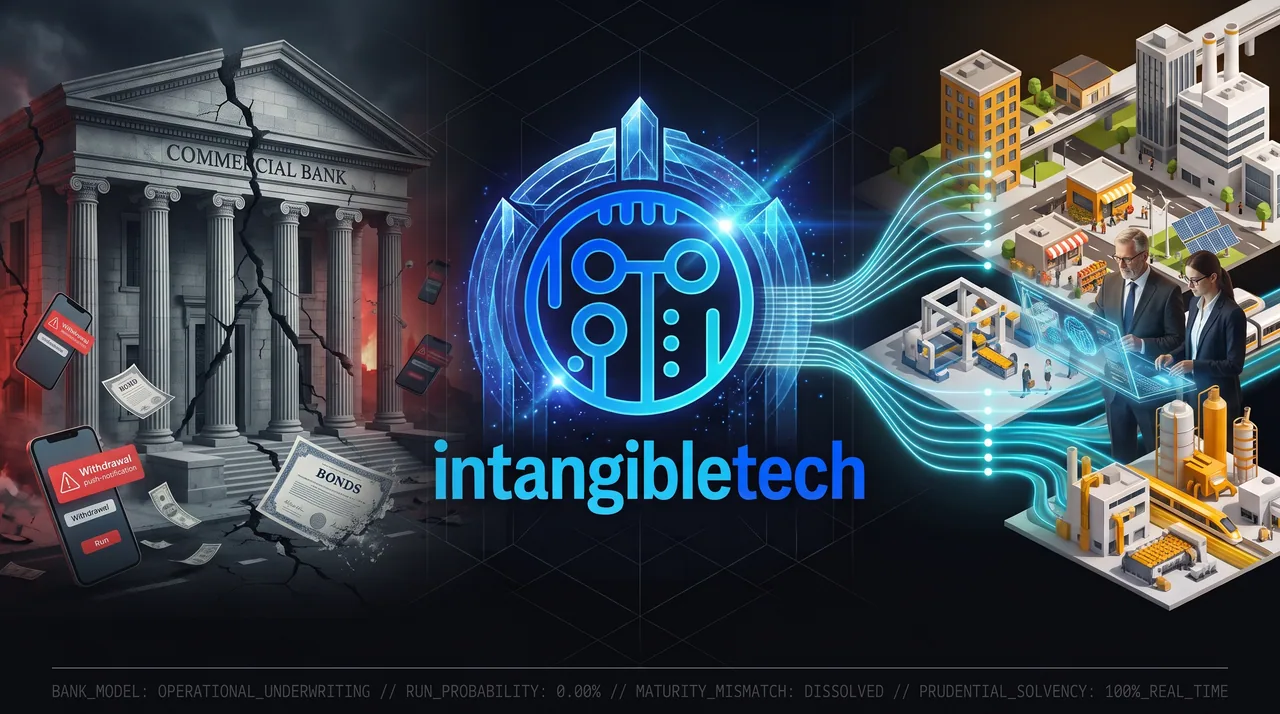
In March 2023, the global banking system peered directly into the abyss.
Within a span of forty-eight hours, Silicon Valley Bank—a forty-year-old institution with over two hundred billion dollars in assets—evaporated. Signature Bank collapsed days later. Across the Atlantic, Credit Suisse, a venerable pillar of European finance with a 167-year pedigree, suffered a terminal liquidity run and was forced into an emergency weekend shotgun wedding with UBS, backstopped by hundreds of billions in central bank guarantees.
The financial press described these events as unique anomalies—blaming poor interest rate risk management at SVB, social media panic, or rogue venture capital group chats.
Those explanations were comfortable diversions.
The collapse of those institutions was not an anomaly. It was the inevitable, mathematical expression of the fatal structural flaw embedded at the very foundation of modern commercial banking: Maturity Transformation.
Every traditional commercial bank on Earth operates on an inherent contradiction. It takes customer deposits that are promised to be available on demand—redeemable in cash at any second via an iPhone app or ATM—and lends that exact same capital out into illiquid, thirty-year mortgages, commercial real estate developments, and long-dated government bonds.
The banking sector calls this “liquidity creation.” An engineer calls it a systemic design flaw.
Commercial banks survive only on collective confidence. The moment depositors suspect that a bank’s long-term assets have lost value—even temporarily—a digital stampede begins.
In the 1930s, a bank run was limited by the physical speed of people standing in line outside a brick-and-mortar branch. In the modern era of smartphone banking and real-time wire transfers, forty-two billion dollars can flee a bank in ten hours.
Whenever this structural flaw threatens to collapse the system, the playbook is always the same: central banks rush in to suspend market discipline, print emergency liquidity facilities, socialize the losses onto everyday taxpayers, and paper over the cracks with hundreds of pages of new regulatory paperwork.
Then the cycle begins again.
Whenever a new financial architecture is proposed, bankers and regulators reflexively recoil. They assume that if you eliminate fractional-reserve banking and automate clearing on distributed rails, you are calling for the total destruction of commercial banks.
They imagine an anarchic, unregulated crypto world where code replaces human judgment, institutions are torn down, and thousands of dedicated loan officers, credit analysts, and compliance directors are discarded into unemployment.
Let us be completely unequivocal:
We are not crypto purists. We are not calling for the demise of commercial banking.
Commercial banks, regional lenders, and institutional asset managers provide vital, irreplaceable functions for human civilization: credit analysis, local community trust, capital syndication, and human fiduciary stewardship.
The Intangible Architecture does not destroy banking. It cures banking of its fatal illness.
By decoupling high-speed transactional clearing from patient capital allocation, we permanently eliminate the threat of the bank run. In doing so, we liberate regional banks from the quarterly terror of the deposit flight, evolve institutional giants like BlackRock and Vanguard into authentic infrastructure stewards, and elevate bankers from leveraged casino managers into the most respected, highly compensated operational architects in the modern economy.
1. The Myth of Maturity Transformation: Why Legacy Regulation Misses the Mark
To fix banking, we must first tell an unvarnished truth about why current financial regulation continuously fails.
For nearly a century, legislative bodies and regulatory agencies—the Federal Reserve, the FDIC, the OCC, and international bodies behind the Basel Accords (Basel I, II, III, and IV)—have attempted to manage fractional-reserve banking through an endless game of statistical defense:
- They mandate capital adequacy ratios (Tier 1 Common Equity).
- They enforce Liquidity Coverage Ratios (LCR) requiring banks to hold buffers of “High-Quality Liquid Assets.”
- They conduct annual “Stress Tests” that model hypothetical economic shocks.
Yet despite thousands of pages of regulations and armies of bank compliance officers, the system remains chronically brittle.
Why?
Because regulation attempts to police liquidity ratios while leaving the structural mismatch of maturity transformation completely intact.
THE ILLUSION:
Depositor enters branch: “My money is sitting safely in my checking account.”
Bank Balance Sheet Reality: The money is NOT there.
- 10% held in cash/central bank reserves.
- 90% locked in 30-year residential mortgages, 10-year Treasuries & commercial loans.
(Interest Rates Rise or Rumor Spreads)
THE CRASH:
Depositors initiate electronic withdrawals via mobile app.
Bank cannot liquidate 30-year mortgages at par in four seconds.
Bank forced to sell long-dated bonds at massive paper losses to raise cash.
Capital equity wiped out in 24 hours ──► FDIC Receiver Steps In ──► Taxpayer Bailout.
When you borrow short to lend long, you are engaging in an arbitrage between time horizons.
You are using other people’s daily transaction money to make long-term, illiquid bets. When market interest rates rise—as they did aggressively in 2022 and 2023—the market value of those long-term, fixed-rate loans plunges.
The bank becomes economically insolvent on a mark-to-market basis.
The moment depositors recognize this insolvency, running for the exit is not an irrational panic; it is the only rational action a depositor can take.
Under legacy banking, whoever moves their deposits first gets paid in full; whoever moves last loses their company payroll or life savings.
Regulators respond to this structural reality by attempting to regulate behavior: telling banks how much risk they can take, which assets qualify as safe, and how much equity cushion they must maintain.
It never works because no regulatory ratio can protect an institution when its liabilities can vanish in four seconds while its assets take thirty years to mature.
2. The Thought Inversion: Decoupling Clearing from Capital Allocation
To eliminate banking fragility forever, financial leaders, economists, and regulators must execute a fundamental mental inversion:
Stop bundling high-speed payment clearing and long-term capital allocation inside the same leveraged corporate balance sheet. Separate the two functions into distinct, protocol-native thermodynamic conduits.
In the physical world, an engineer does not route high-pressure drinking water and heavy industrial chemical sludge through the exact same pipe, hoping that a complex system of manual valves will keep the drinking water clean.
The engineer builds two separate, dedicated conduit systems.
In the Intangible Architecture, we resolve the banking paradox through our Dual-Account Topology:
CONDUIT 1: TRANSACTIONAL CLEARING (ACCOUNT TYPE A)
• Handled by Layer-0 bare-metal silicon and the Stellar network.
• 100% matched, sub-second deterministic finality.
• Governed by the Citizen Exemption Floor ($100k) and demurrage on idle mega-hoards.
• ZERO REHYPOTHECATION: Assets in clearing can NEVER be lent into 30-year illiquid loans.
• RESULT: The concept of a “bank run” is mathematically impossible. The funds are always there.
CONDUIT 2: PRODUCTIVE CAPITAL ALLOCATION (ACCOUNT TYPE B)
• Handled by commercial banks, regional underwriters, and institutional asset managers.
• Dedicated, long-term capital pools with matched investment horizons.
• 0.0% demurrage decay; 4% to 8% real senior yield backed by physical infrastructure.
• NO ON-DEMAND REDEMPTION MISMATCH: Capital is committed for defined operating cycles.
• RESULT: Solvency is completely decoupled from payment liquidity. Zero run risk.
Look at what occurs when you enforce this separation at the protocol consensus layer:
1. The Total Eradication of the Bank Run
In Account Type A, your transactional working capital—whether it is five thousand dollars for a family’s rent or fifty million dollars for an enterprise’s bi-weekly payroll—is not an unbacked IOU lent out to a real estate developer.
It is an authenticated reserve asset clearing across Layer-0 and the Stellar network.
If every participant on the network attempts to move their transactional funds at the exact same millisecond, every single transaction clears in under four seconds.
There are no lines outside bank branches. There are no emergency discount window loans. There are no FDIC emergency weekend meetings. The money cannot run because it was never loaned out from behind the depositor’s back.
2. Time-Matched Productive Capital
Where does long-term financing come from? It comes from Account Type B.
When an institutional investor, a corporate treasury, or a family allocates capital into Account Type B to earn four to eight percent real yield, they are consciously choosing to participate in productive capital allocation.
Their capital is matched to defined operational horizons: financing clean-energy microgrids, automated manufacturing cells, municipal water infrastructure, or non-compounding housing facilities.
The capital provider knows their liquidity terms, understands the underlying physical assets, and earns a senior yield generated by real-world kinetic velocity (Vt).
The bank run is not prevented by government guarantees or central bank printing presses; it is rendered mathematically obsolete by the architecture of the ledger.
3. The Regional Bank’s Evolution: The Operational Underwriting Node
The central question that every community bank president, regional bank director, and credit committee chair will immediately ask is:
“If our deposits are no longer lent out into long-term loans to capture net interest margin (NIM), how does our bank survive? How do we make money?”
Let us look honestly at the current reality of the regional bank: Regional banks are being slowly strangled to death by legacy finance.
Today, America’s four thousand community and regional banks live in a state of chronic vulnerability:
- They cannot compete with the “Too Big to Fail” mega-banks (JPMorgan Chase, Bank of America, Citigroup), which enjoy an unstated, permanent federal taxpayer bailout guarantee.
- Every time the Federal Reserve hikes interest rates, regional banks face catastrophic deposit flight as customers move cash into Wall Street money market funds.
- They spend up to thirty percent of their operating budgets on legacy IT maintenance, core-banking mainframe vendors, and mountains of bureaucratic compliance audits.
The Intangible Architecture does not destroy the regional bank; it unleashes its greatest historical competitive advantage: local operational knowledge.
In our architecture, regional banks evolve into Operational Underwriting Nodes and Local Validator Stewards.
THE LEGACY REGIONAL BANK:
Revenue Model: Net Interest Margin (Borrow at 1%, Lend at 6%, Pray Depositors Don’t Run)
Core Activity: Managing asset-liability duration mismatches & regulatory compliance
Competitive Threat: Crushed by Wall Street giants with implicit government bailouts
Operating Cost: Massive legacy core-banking vendor fees & manual audit paperwork
THE OPERATIONAL UNDERWRITING NODE:
Revenue Model: High-Margin Systems Auditing, ISI Optimization Fees & Node Staking Yield
Core Activity: Deploying Layer-0 edge hardware, verifying local telemetry, structuring pools
Competitive Advantage: Irreplaceable local relationships, physical due diligence, and trust
Operating Cost: Lean, high-speed DevOps infrastructure with automated compliance
The New Revenue Engines for Regional Banks
1. Impact Score Index (ISI) Optimization & Systems Auditing
In our architecture, local businesses—the tool-and-die shop, the regional dairy cooperative, the commercial contractor—need to optimize their Impact Score Index (ISI) to access prime borrowing rates between 1.0% and 1.5%.
Who helps them achieve this? The regional bank.
The bank’s loan officers and credit analysts do not disappear; they become Operational Systems Underwriters:
- The bank audits the local business’s physical operations, assists them in retrofitting machine tools with Layer-0 hardware roots of trust, and validates their supply-chain dependency trees.
- By helping the local business eliminate operational defects and prove its systemic resilience, the bank elevates the client’s ISI.
- The bank charges substantial, recurring advisory and underwriting fees for this high-value systems stewardship—generating far higher, safer margins than unpredictable interest-rate spreads.
2. Local Liquidity Pool Structuring
Regional banks become the primary architects of Account Type B Local Liquidity Pools:
- When a municipal utility needs fifty million dollars to build an automated water filtration facility, or a local medical clinic needs to expand its surgical suites, the regional bank structures the facility.
- The bank conducts the physical due diligence, verifies the engineering specifications, and packages the project into an authenticated Capability Node on the ledger.
- Institutional capital from across the globe, seeking safe 4% to 8% yield, flows into the regional bank’s pool because the bank’s reputation and local underwriting provenance are verified on-chain.
- The regional bank captures upfront syndication fees and ongoing programmatic servicing fees without ever taking the catastrophic duration risk onto its own balance sheet.
3. Local Validator Infrastructure & DevOps Security
Every regional bank operates an enterprise-tier Layer-0 validator node on the Stellar consensus network:
- The bank maintains the secure, hardware-isolated cryptographic infrastructure that processes local municipal settlements and commercial clearing.
- It provides managed Key Custody, Hardware Security Modules (HSMs), and Sovereign Digital Identity (SID) Verification for local businesses, schools, and civic institutions.
- The bank becomes the indispensable, trusted cyber-physical fortress of the local community.
The regional bank stops being an anxious financial intermediary praying for deposits to stay put.
It becomes the operational technology and credit underwriting nervous system of its region—highly profitable, deeply respected, and completely immune to bank runs.
4. Reassuring the Financial Workforce: The Bankers’ Renaissance
A vital, human question that every financial executive and bank employee must confront is:
“What happens to the millions of people who work in commercial banking? The loan officers, credit analysts, risk managers, branch managers, and operational staff? Are they replaced by algorithms?”
Let us dispel this anxiety directly: The banking workforce is not eliminated; it is liberated from clerical drudgery and restored to professional honor.
Today, working inside a commercial bank is often an exhausting, demoralizing experience:
- Credit underwriters spend seventy percent of their day manually copying data between legacy green-screen mainframes, PDFs, and Excel spreadsheets.
- Loan officers are turned into aggressive sales reps forced to push high-fee products, credit cards, and complex mortgages to meet quarterly quotas.
- Compliance officers spend their lives filling out subjective Bank Secrecy Act (BSA) and Anti-Money Laundering (AML) forms, running retrospective keyword searches on transactions that settled three weeks ago.
The Intangible Architecture executes an extraordinary Skills Transmutation:
LEGACY BANKING ROLE:
Loan Officer: Pushing credit cards and mortgages to meet retail branch quotas.
Credit Analyst: Manually copy-pasting tax returns and financial statements into spreadsheets.
Compliance Officer: Reviewing three-week-old SAR alerts; endless paper audit trails.
Branch Manager: Managing physical cash vaults, teller logistics, and overdraft disputes.
THE PROTOCOL BANKING PROFESSIONAL:
Systems Underwriter: Conducting on-site engineering audits; validating hardware telemetry.
Provenance Structurer: Mapping enterprise supply chains onto the Dependency DAG.
Real-Time Fiduciary Steward: Managing cryptographic view keys; monitoring automated compliance.
Civic Trust Architect: Guiding local entrepreneurs, municipal leaders, and families.
Why Banking Skills Are More Valuable Than Ever
The core attributes of a great banker are not data entry and spreadsheet formatting.
They are credit judgment, risk discernment, institutional skepticism, and human relationship management.
- A software algorithm cannot walk through a local manufacturing facility, look the factory owner in the eye, and evaluate whether the management team possesses the character, discipline, and grit to execute a turnaround.
- A distributed ledger cannot sit with a municipal council to design a thirty-year civic modernization program that meets the unique cultural needs of a local community.
These are deeply human capabilities.
Under our architecture, because the repetitive, clerical plumbing—wire clearing, check reconciliation, payment tracking, and tax calculations—is automated at consensus, the banker’s time is returned to high-value human stewardship.
Bankers become the trusted, highly compensated strategic partners who help businesses optimize their systems, guide families into non-compounding wealth, and ensure that the economic engine of their community operates with integrity.
6. Fixing the Regulatory Blind Spot: Beyond the Web3 Legislative Impasse
To make this transformation reality, we must address the current legislative and regulatory paralysis surrounding digital assets and banking.
For the past five years, the debate in Washington, London, and Brussels regarding “banking and crypto” has been a train wreck of confusion:
- On one side, crypto-anarchists promote unregulated Decentralized Finance (DeFi) platforms that reject all compliance, celebrate total anonymity, and create multi-billion-dollar wash-trading casinos vulnerable to catastrophic hacks.
- On the other side, banking regulators reflexively crack down, attempting to force twenty-first-century cryptographic systems into the rigid molds of the Securities Act of 1933 and the Bank Holding Company Act of 1956.
Both sides are completely missing the mark.
Current legislative efforts are trapped in three foundational regulatory errors:
Error 1: Confusing Speculative Tokens with Financial Plumbing
Regulators spend eighty percent of their energy debating whether volatile, speculative tokens are “securities” or “commodities.”
They fail to see that the real prize of distributed ledger technology is not trading speculative coins; it is the un-cheatable, deterministic modernization of interbank settlement plumbing.
Our architecture does not introduce a speculative token to replace the dollar; it uses the proven, enterprise-grade rails of the Stellar network to settle compliant, regulated digital fiat currencies and reserve assets in sub-second finality.
Error 2: The Myth of Anonymity vs. Compliance
Regulators fear that distributed ledgers will enable illicit finance, while crypto purists demand total anonymity.
The Intangible Architecture demonstrates that compliance and cryptographic privacy are not mutually exclusive:
- Every commercial participant operates through an authenticated Sovereign Digital Identity (SID) satisfying complete Know-Your-Customer (KYC) and Anti-Money Laundering (AML) standards.
- Yet operational privacy and competitive trade secrets are protected using Zero-Knowledge Validity Proofs.
- Regulators hold authenticated cryptographic Regulatory View Keys that provide real-time, mathematical proof that capital is solvent and anti-money laundering standards are satisfied—without requiring the government to construct an invasive surveillance panopticon over every citizen’s private life.
Error 3: The Obsession with Backward-Looking Capital Ratios
Regulators continue trying to prevent the next bank collapse by tweaking Basel III capital adequacy ratios by fifty basis points.
They are fighting the last war with broken weapons.
Under our ledger, regulators do not need to wait three months for banks to self-report their quarterly Call Reports:
- Regulators have Real-Time Prudential Observability.
- Every balance sheet asset, every liquidity pool, and every operational underwriting node is visible on the ledger every single second.
- Systemic risk, counterparty contagion, and liquidity bottlenecks are detected and mitigated algorithmically before they can metastasize into a crisis.
We do not ask regulators to surrender their authority; we hand them the most powerful, transparent supervisory microscope in the history of financial governance.
The Recovery of the Honorable Steward
For centuries, the banker was an honored pillar of human civilization.
The traditional community banker was not a financial engineer looking for ways to extract hidden fees, front-run clients, or gamble customer deposits on leveraged derivatives. The banker was a trusted neighbor. They were the person who understood local commerce, who backed the young entrepreneur with character, who guarded the community’s savings with fierce fiduciary honor, and who helped build the schools, farms, and factories that sustained civic life.
Over the last half-century, that noble profession was corrupted.
We forced our banks into an unholy bargain: we allowed them to manufacture money through fractional-reserve leverage, and in exchange, we subjected them to permanent, existential vulnerability. We turned them into leveraged casinos, watched them collapse in cascading liquidity panics, and bailed them out with taxpayer funds, turning public trust into cynical despair.
That tragic compromise has reached its end.
The Intangible Architecture ends the era of fractional-reserve fragility forever.
By separating transactional clearing from patient capital allocation, eliminating the mathematical impossibility of maturity transformation, and elevating banks into operational underwriting nodes of real-world capability, we return banking to its sacred origin:
- Where no depositor ever lies awake at night terrified of a bank run.
- Where community banks flourish on the strength of local relationships and physical due diligence.
- Where institutional capital builds the lasting, physical infrastructure of our world.
- And where the banker stands once again as they were always meant to stand: not as an extractive parasite, but as an honorable, respected, and indispensable steward of human progress.
The bank run is dead.
The era of honorable banking has begun.