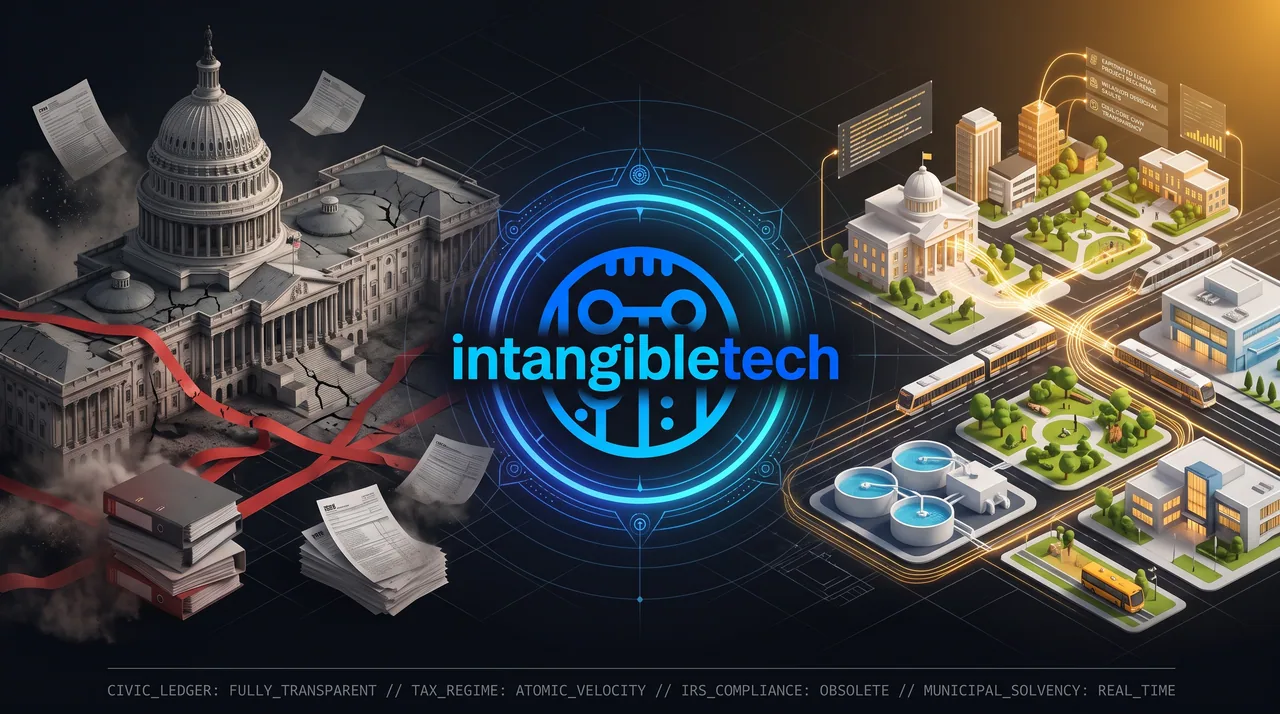
Every year as April approaches, a collective sense of dread descends upon the American public.
Across the nation, families sit at kitchen tables surrounded by shoe boxes of receipts, sorting through W-2s, 1099s, and confusing deduction worksheets. Small business owners put operations on hold for weeks, paying thousands of dollars to certified public accountants just to decipher whether their equipment purchases qualify for depreciation write-offs under thousands of pages of federal and state tax codes.
The economic waste is staggering. American citizens and businesses spend nearly seven billion hours every single year simply attempting to comply with the federal tax code. The direct out-of-pocket and productivity cost of this compliance exceeds five hundred billion dollars annually—an administrative drag larger than the entire annual revenue of most Fortune 500 corporations.
Yet what do citizens receive in exchange for this multi-billion-dollar compliance ordeal?
Our national debt surpasses forty trillion dollars, with net annual interest payments exceeding the entire national defense budget. Our interstate bridges rust, public transit systems face recurring fiscal cliffs, municipal water systems fail, and local schools struggle to buy basic supplies.
At the same time, trust in public leadership has cratered. Citizens across the political spectrum share a justifiable suspicion that their hard-earned dollars disappear into a bureaucratic black box—swallowed by administrative waste, political patronage, and opaque government contracting.
Conservatives are right when they argue that the current tax system is an extractive, invasive monstrosity that punishes hard work, funds bloated administrative bureaucracies, and stifles economic vitality.
Progressives are equally right when they argue that our public infrastructure is decaying, that working families bear an unfair share of the tax burden while multinational corporations exploit offshore loopholes, and that our society desperately needs world-class public transit, clean energy, and resilient communities.
The tragedy is that our political system has treated these two realities as an irreconcilable war. We are told we must choose between bankrupting our families with higher taxes to fund public goods, or starving our communities of basic services to achieve fiscal discipline.
It is a false choice.
The breakdown of our public institutions is not a moral failure of our citizens, nor is it an unresolvable ideological divide. It is an architectural failure of our accounting infrastructure.
By replacing the invasive, retrospective income-tax apparatus with protocol-native monetary physics, Intangible Technologies delivers an operating system where citizen taxes drop dramatically, public revenues become stable and predictable, local communities take back control of their destinies, and elected officials are held to the same unyielding operational standards as private enterprise.
1. The Great Tax Inversion: How Taxes Plummet While Public Revenue Expands
The primary question every constituent, mayor, and national policymaker asks is straightforward:
“How is it mathematically possible for citizen tax rates to drop to microscopic fractions of a percent while the government still collects enough revenue to fund public services and retire the national debt?”
The answer lies in understanding the difference between a Narrow, Exhausted Tax Base and an Expansive, High-Velocity Settlement Base.
The Old Regime: Squeezing the Narrow Base
The legacy tax system was designed in 1913, an era when most transactions were settled in physical cash and the only reliable way for a government to collect revenue was to intercept human labor at the point of the annual wage audit.
Because governments could not see the broader movement of commerce, they were forced to concentrate their tax demands on a narrow, fragile slice of the economy: domestic personal income and reported small-business profits.
To generate two and a half trillion dollars in federal income revenue, the state must extract between twenty and forty percent of a working family’s paycheck. This creates enormous friction: it disincentivizes extra work, penalizes overtime, demands invasive surveillance of personal bank accounts, and requires an army of auditing agents.
The New Architecture: Tapping the Kinetic Ocean
In the modern economy, personal labor income represents only a tiny fraction of the total money moving through digital networks.
The real volume of the modern economy is the immense, continuous river of electronic commercial settlements: business-to-business wholesale invoices, international supply-chain clearing, interbank liquidity settlements, and high-frequency automated trade. In the United States alone, gross electronic payments across these commercial corridors clear upwards of one and a half quadrillion dollars ($1,500,000,000,000,000) every single year.
Under the Intangible Architecture, we abolish the annual personal income tax return entirely. We replace it with the Atomic Point-of-Settlement Velocity Partition (Opcode 0x01).
Consider the arithmetic:
- When a manufacturer purchases ten million dollars in raw materials, or an enterprise settles a five-hundred-thousand-dollar logistics invoice, the transaction clears across Layer-0 rails and anchors to Stellar in milliseconds.
- The protocol automatically harvests a microscopic velocity partition of just twenty-five to fifty basis points (0.25% to 0.50%) at the moment of settlement.
- For the individual citizen, basic daily essentials—groceries, rent, healthcare, utility bills—are permanently protected by the Citizen Exemption Floor, clearing at an effective partition rate of zero percent.
Because the tax base is expanded from the narrow pool of domestic wages to the quadrillion-dollar ocean of gross commercial turnover, the effective tax burden on everyday working families drops to near zero.
There are no W-2 forms. There are no 1099 filings. There are no shoe boxes of receipts. The dread of April 15th is permanently eradicated. The public contribution is collected at the speed of light, with zero paperwork, zero tax evasion, and zero administrative drag.
2. Fair Federalism: How Revenue Flows to Cities, States, and the Nation
In a vast republic, one of the greatest sources of political corruption and civic resentment is the centralized collection and redistribution of taxpayer funds.
Today, local tax dollars flow from hometown communities into the federal treasury in Washington, D.C. There, the money passes through a multi-layered bureaucracy where political lobbyists and partisan committees slice off billions in administrative overhead. Eventually, a fraction of those dollars trickles back down to local communities in the form of federal grants—often burdened with hundreds of pages of federal mandates that restrict how mayors and city councils can solve local problems.
The Intangible Architecture restores True Economic Federalism through algorithmic, location-attested revenue routing:
Gross Commercial Settlement (Layer-0 / Stellar Rail)
│ (Captures 0.35% Atomic Velocity Partition)
▼
Protocol Civic Routing Hub (Deterministic Geographic Routing)
├── 40% Local Municipal Vault (Direct to Mayor/City Council: Parks, Water, Police)
├── 30% State Infrastructure Vault (Direct to State DOT: Interstates, Regional Grids)
└── 30% Sovereign Sinking Fund & Defense (Retiring National Debt at Par; Defense)
1. The Municipal Priority (40% Stays Local)
When a transaction occurs within a city—whether a commercial freight delivery at an industrial park or an enterprise software settlement between local offices—the local Layer-0 node uses cryptographic geographic attestation.
Forty percent of the harvested velocity partition flows directly into that municipality’s sovereign reserve vault in real time.
A mayor and city council do not have to beg state legislators or federal agencies for emergency funding to repair a leaking water main or repave an arterial road. The revenue generated by the local economy stays in the local community, flowing into municipal coffers every second as commerce circulates.
2. State Infrastructure Coordination (30% Regional Rail)
Thirty percent of the velocity partition routes directly to the state treasury.
These funds are dedicated to inter-city infrastructure that no single municipality can build alone: state highways, inter-county water reservoirs, regional power grids, and state university research labs.
Because the funding streams continuously, state departments of transportation can plan twenty-year capital improvement projects without worrying whether an upcoming legislative budget standoff will freeze their construction contracts.
3. The Sovereign Sinking Fund and Common Defense (30% National Pillar)
The remaining thirty percent routes to the national treasury, dedicated to two specific, constitutionally defined functions: funding national defense and capitalizing the Consensus-Enforced Sovereign Debt Sink.
As legacy federal debt bonds mature, the Debt Sink redeems and systematically burns the principal at par value using pure, un-leveraged commercial velocity. The national debt is retired over a fifteen-to-twenty-year horizon without raising income taxes, without cutting essential services, and without printing unbacked fiat currency.
Local revenue serves local needs; state revenue builds regional connectivity; national revenue secures the republic and retires historical liabilities. The system operates with absolute, mathematical fairness.
3. Holding Politicians Accountable: The Civic Impact Score Index
In the private sector, if an executive mismanages an enterprise, burns through capital reserves, and produces defective products, the market delivers swift discipline: the company’s borrowing costs spike, customers leave, and the business faces restructuring.
In public governance, the exact opposite occurs.
When a public works department spends five times its initial budget to build a subway extension, or an administration mismanages municipal water systems, elected officials rarely face operational consequences. They obscure the failure behind complex municipal bond offerings, kick the liabilities down the road to the next administration, and blame the opposing political party.
The Intangible Architecture changes this dynamic by applying the Impact Score Index (ISI) directly to public institutions and elected administrations.
Just as a private enterprise is evaluated on defect suppression and operational resilience, a city, state, or federal agency operates under a public, real-time Civic ISI:
1. Defect Suppression in Public Works
Under legacy accounting, if a city paves a road poorly and the asphalt develops potholes within twelve months, public spending goes up because the city must pay a contractor to patch it again. Under GDP and legacy municipal budgets, that failure looks like economic activity.
On our ledger, the physical lifespan and performance of public assets are signed into the system:
- If a public works department uses quality materials and expert craft to pave an arterial roadway that lasts a decade without structural degradation, the verified absence of defect maintenance expands the municipality’s Civic ISI.
- If an administration awards contracts to political allies who cut corners, resulting in premature infrastructure failures and service disruptions, the system registers the spike in operational defects. The city’s Civic ISI drops immediately.
2. Real-Time Budget Solvency vs. The Bond Trap
Today, corrupt or incompetent administrations hide fiscal distress by issuing complex, thirty-year municipal bonds with backloaded interest structures, leaving future generations of taxpayers with crushing debt.
Under the Intangible Architecture, public projects are financed through Protocol-Native Infrastructure Facilities:
- A city draws capital from protocol liquidity reserves to build a new public health clinic or water treatment plant.
- The borrowing rate the city pays is tied directly to its Civic ISI. An administration with a verified history of on-time project completion and low operational defects borrows at prime rates between 1.0% and 1.5%.
- If an administration exhibits reckless fiscal mismanagement or operational delays, its Civic ISI drops, and the cost of capital on new public initiatives rises automatically.
Elected officials cannot hide incompetence behind public relations campaigns or delayed bond audits.
The operational performance of their administration is visible on the public ledger every single day. When election season arrives, constituents do not have to rely on campaign promises; they can review the objective, un-falsifiable operational scorecard of the administration right from their personal sovereign wallets.
4. Political Malleability: A Protocol for Both Left and Right
One of the greatest hazards in governance technology is algorithmic rigidity: the danger of building a system that attempts to replace democratic debate with technocratic dictate.
The Intangible Architecture does not replace democracy. It establishes a clean, incorruptible foundation upon which democratic debate can occur.
The protocol enforces the unyielding laws of economic physics—preventing double-spending, stopping compounding debt divergence, and ensuring mathematical settlement. However, the statutory policy levers that guide the direction of the economy remain completely within the democratic authority of elected legislatures and local councils.
Whether an administration is led by conservatives, progressives, or an independent coalition, the protocol functions as a malleable, responsive instrument of the public will:
IMMUTABLE PROTOCOL PHYSICS (The Laws of the Road):
• Append-only state transitions; Zero double-spending; Real-time settlement
• Mathematical debt amortization; Hardware-attested physical telemetry
• Elimination of hidden monetary debasement and unbacked deficit printing
DEMOCRATIC POLICY LEVERS (The Steering Wheel - Set by Legislatures):
• Citizen Exemption Floor ($100k, $150k, or adjusted by local cost-of-living)
• Statutory Velocity Partition Rate (Adjustable within safe bounds: 0.20% to 0.50%)
• Priority Reserve Allocations (Directing public capital: Defense vs. Green Energy)
• Demurrage Decay Thresholds on Idle Wealth (Setting rates to incentivize circulation)
The Progressive Imperatives Achieved
For progressive leaders and constituents, the protocol achieves goals that modern social democracy has spent decades fighting for:
- True Universal Security: Working families are protected by an unassailable financial safety floor. The Citizen Exemption Floor ensures their daily wages are never touched by tax partitions, while Account Type B delivers 4% to 8% safe, non-stock-market yields for family savings.
- The Eradication of Offshore Tax Havens: The world’s largest multinational corporations and financial conglomerates can no longer use Cayman Island shell companies or transfer-pricing tricks to avoid contributing to society. Every dollar of corporate commerce contributes automatically at the point of settlement.
- Equitable, Green Infrastructure: Communities can finance clean public transit, renewable municipal grids, and environmental remediation through self-amortizing public facilities, directly incentivizing the reduction of ecological entropy.
The Conservative Imperatives Achieved
For conservative leaders and constituents, the protocol delivers structural victories that free-market economists have championed for generations:
- The Abolition of the IRS: The entire invasive federal income-tax apparatus—with its audits, arbitrary penalties, and snooping into personal bank accounts—is dismantled.
- Dramatically Lower Tax Burdens: By broadening the revenue base to the multi-quadrillion-dollar ocean of digital commerce, the effective tax rate on everyday businesses and individuals plunges to fractions of a percent.
- The Elimination of Government Debt and Waste: The national debt is systematically retired without borrowing new funds, and public deficits are mathematically bounded by protocol physics. Government can no longer print trillions of unbacked dollars to fuel inflation.
- Restoration of Local Control: Mayors and county commissioners are liberated from the dictates of federal regulatory agencies, retaining their local revenue to solve local problems on their own terms.
This is not a political compromise where both sides surrender their values. It is an architectural leap where the legitimate goals of both sides are achieved simultaneously because the friction of the broken status quo has been eliminated.
5. The Municipal Innovation Multiplier: Sharing Public Breakthroughs for Profit
Under the legacy system, if the city of Akron, Ohio, or the city of Austin, Texas, spends five million dollars developing an innovative, highly efficient software system to streamline housing permits, optimize municipal water pressure, or coordinate traffic lights, that breakthrough remains trapped inside that city’s municipal IT department.
If another city three hundred miles away wants to solve the exact same problem, it cannot simply adopt Akron’s system. Instead, it hires a legacy technology consulting conglomerate, spends another eight million dollars of taxpayer money, and builds the wheel all over again from scratch.
The Intangible Architecture turns every city in the nation into an active research-and-development laboratory that earns revenue by sharing progress.
The Municipal Dependency DAG
When a city develops a breakthrough civic innovation—whether an automated permitting pipeline, a low-cost stormwater filtration design, or an optimized local transit scheduling tool—it registers the architecture as a Public Capability Node on the network’s open Directed Acyclic Graph (DAG):
- Frictionless Adoption for Other Cities: Any other municipality across the country can deploy that containerized civic module into its own local Layer-0 operations with a single digital instruction. There are no expensive procurement contracts, no vendor lock-in, and no multi-year consulting engagements. The adopting city saves millions of dollars in upfront development costs overnight.
- Streaming Royalties for the Innovating City: Every time the adopting city runs the module to clear a permit, manage water flow, or schedule transit, a microscopic, protocol-enforced royalty stream flows across the settlement rails directly into the treasury of the city that invented it.
- The Civic Innovation Economy: A forward-thinking city with exceptional municipal engineers, data architects, and civic designers can generate millions of dollars in surplus non-tax revenue simply by solving difficult civic problems and sharing those open-source solutions with municipalities across the globe.
Cities stop being isolated cost centers that compete to squeeze their local taxpayers. They become collaborative nodes in an interconnected national network of civic excellence, where solving a problem locally creates enduring wealth for the entire community.
6. Transforming Public Service: Protecting Livelihoods While Shrinking Overhead
A vital, sensitive question that every elected official and public-sector leader must confront is the human workforce:
“If this protocol automates tax collection, eliminates regulatory paperwork, and streamlines public accounting, what happens to the millions of hard-working public employees who currently administer these legacy systems? Will this technology throw civil servants into unemployment?”
We must be unequivocal: The goal of this architecture is to eliminate useless administrative friction, not to destroy human livelihoods.
Today, millions of dedicated civil servants are trapped inside an exhausting, dehumanizing bureaucratic routine:
- Processing paper tax forms.
- Manually cross-referencing vendor invoices.
- Administering complex welfare means-testing rules that trap recipients in poverty.
- Reviewing redundant regulatory filings.
These workers did not enter public service because they had a passion for shuffling paper; they entered public service because they wanted to serve their communities.
The Intangible Architecture enables a Dignified Human Transition:
1. The Natural Attrition and Structural Shift
The transition to protocol-native public finance does not occur overnight through abrupt, catastrophic layoffs. It unfolds over a planned adoption continuum:
- The vast bureaucracy of tax auditing and form processing naturally winds down as older systems are deprecated.
- Routine administrative positions are phased out through natural career retirements and voluntary transitions, rather than sudden firings.
2. Transitioning from Paper Police to Infrastructure Stewards
The physical realities of our civilization desperately need human talent:
- We need skilled technicians to manage local clean-energy microgrids.
- We need data architects to optimize municipal logistics and public transit.
- We need experienced mentors to run civic apprenticeship programs for young workers.
- We need inspectors, conservation managers, and community health directors.
Public employees who previously spent their careers enforcing tax compliance and filing paperwork are provided with structured, funded pathways to transition into High-Provenance Operational Stewardship:
- Their personal Sovereign Digital Identities capture their experience and dedication.
- They step into vital operational roles where their work directly improves the physical condition of their cities.
- Because their efforts suppress operational defects and expand municipal resilience, their work directly elevates the city’s Civic ISI, unlocking better credit terms and creating tangible balance-sheet value for the community.
3. The Unconditional Safety Floor
Furthermore, public workers—like all citizens—benefit immediately from the protocol’s structural safety architecture:
- Their personal savings in Account Type B earn safe, non-speculative 4% to 8% yields, protecting their retirement without market volatility.
- Non-compounding home financing cuts their lifetime mortgage costs in half.
- As the overall local economy becomes hyper-efficient and generates operational surpluses, every citizen receives the unconditional, non-inflationary Citizen Dividend.
Civil servants are not discarded; they are emancipated from bureaucratic drudgery and empowered to become the respected, well-compensated builders of a thriving civic future.
The Restoration of the Republic
For more than a century, free societies have been governed by an unacknowledged cynicism.
We accepted that our tax system must be an adversarial, exhausting battle between citizens and the state. We accepted that our public finances must be shrouded in political opacity, that our national treasuries must be buried under compounding mountains of debt, and that our local communities must beg for scraps from distant centralized capitals.
We accepted these failures not because we lacked civic virtue, but because we were attempting to coordinate the public life of a great civilization using the blunt, blind instruments of a bygone era.
The Intangible Architecture demonstrates that a better way is here.
By anchoring public finance to the kinetic velocity of the real economy, automating revenue at the point of settlement, establishing real-time operational accountability for elected leaders, and transforming our cities into collaborative engines of innovation, we restore the foundational promise of self-governance.
We deliver a republic where:
- Government serves as an honest, transparent steward of the public trust.
- Citizens keep the fruits of their labor, free from the fear of arbitrary audits.
- Public infrastructure is built to endure for generations.
- And the sacred bond between the people and their government is once again anchored in truth, competence, and mutual flourishing.
The tools of the past have exhausted our patience and our wealth.
It is time we built an architecture worthy of a free people.