The United States spends four and a half trillion dollars on healthcare every single year.
That is nearly eighteen percent of the nation’s entire Gross Domestic Product. We spend twice as much per person on medical care as any other developed nation on Earth.
Yet what does that four-and-a-half-trillion-dollar expenditure purchase for the American people?
- Life expectancy across the United States has declined at rates unprecedented in peacetime modern history.
- Chronic illness—metabolic disease, cardiovascular failure, autoimmune disorders, and clinical depression—has exploded, with over six in ten American adults living with at least one chronic condition.
- Medical debt remains the leading cause of personal bankruptcy in the nation, destroying the life savings of hundreds of thousands of hard-working families every year who thought their insurance had them covered.
- Frontline physicians and nurses are abandoning the profession in numbers that resemble a wartime retreat, drowning in bureaucratic clerical work, fifteen-minute conveyor-belt patient visits, and moral injury.
Meanwhile, whenever the topic of reform arises in the halls of Congress or on national television, the public is subjected to the same deadlocked debate.
On one side, progressive advocates demand “Medicare for All,” pointing out that every other major industrialized democracy guarantees healthcare to its citizens as a basic human right.
On the other side, conservative and free-market leaders raise warnings: If you simply nationalize American healthcare under the legacy system, you will create a massive, tax-funded bureaucratic monopoly. You will explode the federal deficit by trillions of dollars, wait times to see a specialist will stretch to eight months like they do in Britain and Canada, innovation will dry up, and the quality of care will collapse.
Both sides are fundamentally right in what they diagnose, and both sides are completely trapped by the assumptions of the legacy financial paradigm.
Single-payer healthcare cannot work under the legacy financial architecture because trying to fund our current, hyper-inflated medical industry through traditional income taxes simply subsidizes an extractive, fee-for-service monopoly with a blank government check.
Conversely, the current corporate-managed “free market” is not a free market at all; it is a protected cartel of private insurers, pharmacy benefit managers (PBMs), hospital conglomerates, and pharmaceutical monopolies that profit by manufacturing sickness and denying care.
The crisis of healthcare is not a medical crisis. It is an information and incentive crisis.
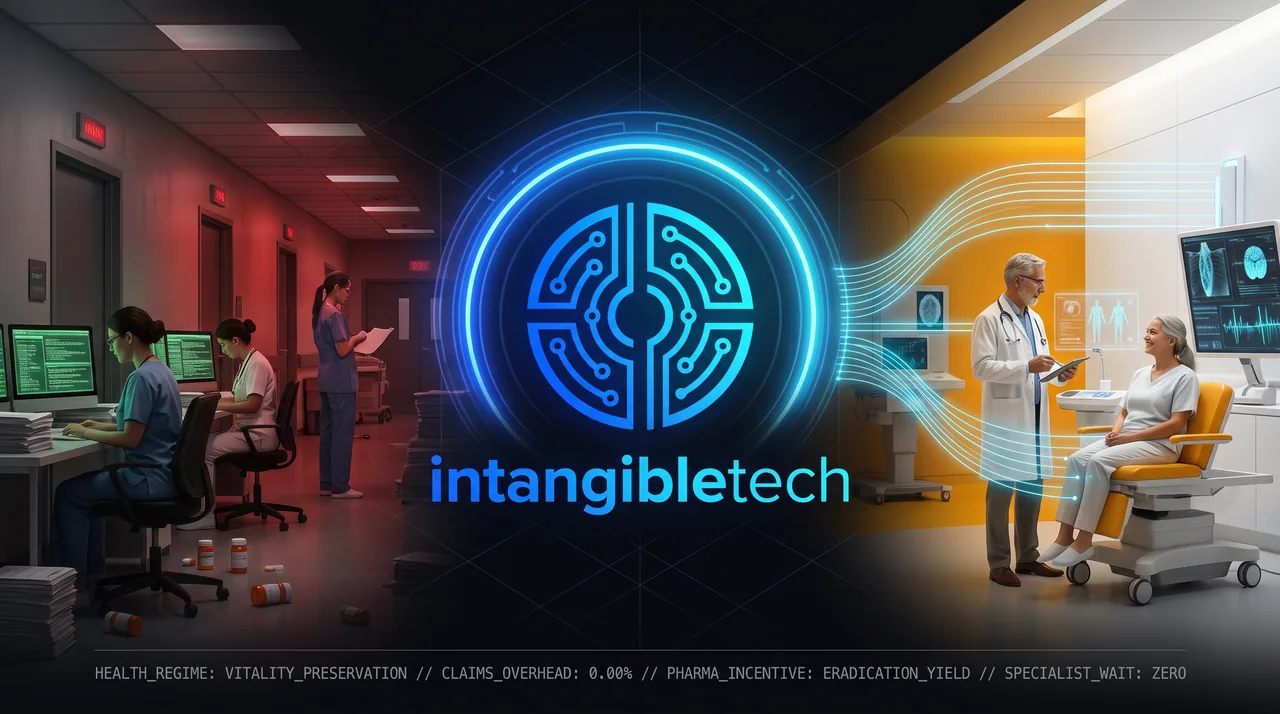
We have built a system that rewards the volume of disease rather than the preservation of vitality.
By deploying protocol-native accounting, replacing the extractive fee-for-service model with verified Defect Suppression Yield, and aligning the balance sheets of hospitals and pharmaceutical giants with the permanent eradication of pathology, Intangible Technologies delivers the architecture to make universal healthcare an unassailable, market-driven reality—slashing costs, preserving uncompromised clinical quality, and honoring the men and women who heal our world.
1. The Anatomy of the Racket: How We Built the Sick-Care Monopoly
To understand why American healthcare is near-impossible to fix within legacy finance, you have to examine how it was assembled.
Modern American healthcare was not designed by physicians; it was designed by wartime economic planners and tax attorneys.
During World War II, the United States government enacted the Stabilization Act of 1942, imposing strict federal wage caps to prevent wartime inflation. Desperate to compete for scarce domestic labor without violating wage controls, American corporations began offering a non-wage fringe benefit: employer-sponsored private health insurance.
The Internal Revenue Service codified this arrangement by making employer-paid health premiums completely tax-exempt.
What began as an emergency wartime loophole mutated into the foundational structural flaw of American society:
- The Employment Trap: Health coverage was tied to the corporate employer, turning access to basic medical care into a leash that restricts labor mobility and entrepreneurship.
- The Detachment of Price from Consumer: Because a third party (the insurance company) paid the bills, patients stopped asking what medical procedures actually cost, and providers stopped competing on price.
The Fee-For-Service Engine
Once price sensitivity was eliminated, the medical industry adopted the most perverse economic incentive in the history of capitalism: Fee-For-Service (FFS).
Under fee-for-service, a hospital system or medical clinic makes zero revenue when a human being is healthy, active, and thriving:
- If a primary care physician spends forty-five minutes working with a patient on nutrition, sleep, and lifestyle to reverse pre-diabetes before it causes damage, the clinic can bill only a meager, low-margin evaluation code.
- But if that same patient’s diabetes is allowed to progress—resulting in chronic kidney failure, cardiovascular disease, expensive daily insulin regimens, emergency room crises, and eventual limb amputation—the healthcare system generates hundreds of thousands of dollars in high-margin billing codes.
The legacy healthcare system is not a health system; it is an extractive sickness monetization engine.
Every hospital readmission, every failed surgery that requires a revision, every diagnostic scan ordered to protect against malpractice lawsuits, and every chronic prescription that must be taken every day for thirty years represents “growth” for the enterprise and expands Gross Domestic Product.
The Bureaucratic Parasite
To manage this monstrous billing engine, the legacy system created an army of administrative intermediaries:
Patient Visit ──► 15-Minute Rushed Clinical Interaction
Physician spends 2 Hours typing ICD-10 Billing Codes into EHR Software
Hospital Billing Department submits $15,000 Complex Commercial Claim
Insurance Company “Prior Authorization” Algorithm Flags & DENIES Claim
Appeals, Peer-to-Peer Calls, Independent Adjusters, Third-Party Billing Coders
Outcome: 40% of Every Healthcare Dollar Burned on Administrative Paperwork;
Physicians Burn Out; Patients Left with Incomprehensible Surprise Bills
Over thirty-five percent of every single dollar spent on American healthcare never touches a doctor, a nurse, a medication, or a surgical tool. It is consumed by billing coders, claims denial algorithms, prior-authorization bureaucrats, and pharmacy benefit managers whose entire economic existence is based on extracting friction from the system.
No society can achieve universal care when one-third of its resources is burned on administrative warfare.
2. The Mental Inversion: Health as an Appreciating Balance-Sheet Asset
To break this trap, healthcare executives, policy leaders, and citizens must execute a foundational conceptual inversion:
Stop viewing healthcare as an extractive consumer repair service billed by volume of sickness. Start viewing human biological vitality as an appreciating, high-order capital asset governed by the laws of Defect Suppression.
In the Intangible Architecture, we do not ask, “How many procedures did this hospital perform this quarter?”
We ask the thermodynamic question: “How much systemic biological entropy did this clinical team suppress, and how much physical vitality did they preserve across the human population?”
Human health is the foundational capital reserve upon which all real-world economic velocity depends. A human being who is free from chronic metabolic disease, clear of mind, and physically capable coordinates energy, builds infrastructure, mentors apprentices, and drives Kinetic Systemic Throughput (KST).
When that human being suffers an avoidable clinical failure—a misdiagnosed tumor, an untreated infection, an avoidable stroke, or a botched surgical procedure—it is not an economic opportunity to bill more services.
It is a catastrophic defect that drains kinetic capacity from civilization.
Under our operating system, the economics of medicine invert completely:
- An enterprise, a hospital system, or a regional clinic does not maximize its financial balance sheet by billing more procedures.
- It maximizes its balance sheet by capturing Defect Suppression Yield.
When a clinical team intervenes early, accurately diagnoses a condition, prevents an avoidable hospital readmission, or guides a patient out of chronic metabolic disease, the protocol calculates the actuarial loss that was prevented across the human lifespan.
That verified, prevented loss is not an abstract corporate marketing stat; it is quantized as Loss-Mitigation Yield, streaming liquid, non-dilutive protocol capital directly into the balance sheet of the clinical practice.
The incentives are permanently realigned: The healthier a medical system keeps its community, the more capital it earns.
3. Debunking the Socialized Rationing Myth: Why Quality and Speed Surge
The central objection from conservative leaders and free-market economists to universal healthcare is the specter of rationing:
“If you make healthcare universally accessible, you will destroy quality. People will wait eight months to see a cardiologist, diagnostic MRI machines will be rationed, elite surgeons will leave the profession, and the system will degrade into a slow, bureaucratic disaster like the British NHS or the Canadian single-payer system.”
This critique is valid when applied to legacy socialized healthcare models.
Traditional single-payer systems fail on wait times because they are built on a flawed financial mechanism: The Global Monopsony Budget.
In a legacy single-payer system:
- The national government collects tax revenues and sets a rigid, fixed annual budget for the healthcare ministry.
- Because the budget is fixed, the government cannot allow infinite medical consumption.
- To prevent the healthcare system from bankrupting the national treasury, the central bureaucracy must artificially constrain demand.
- And how does a bureaucracy constrain demand when services are “free”? By creating wait lists.
Wait times in legacy socialized medicine are not an accident; they are a deliberate rationing mechanism designed to keep the government’s cash budget from breaking.
The Intangible Architecture does not operate on a rigid, state-controlled monopsony budget. It operates on an open, dynamic liquidity corridor governed by velocity and performance:
LEGACY SOCIALIZED MEDICINE (THE MONOPSONY QUEUE):
Funding Mechanism: Fixed, Politicized State Annual Budget Cap
Demand Control: Bureaucratic Triage, Gatekeepers & 6-to-12 Month Wait Times
Physician Pay: Low-Tier Flat Civil Service Salaries (Zero Incentive for Speed)
Outcome: High Access Equity, but Severe Rationing, Specialist Delays & Brain Drain
INTANGIBLE UNIVERSAL ARCHITECTURE:
Funding Mechanism: Dynamic Protocol Liquidity Corridors via Atomic Velocity Partitions
Demand Control: Zero Gatekeeper Delay; Diagnostic Ingestion at Layer-0 Edge
Physician Pay: High Senior Kinetic Yield Tied to Diagnostic Accuracy & Rapid Recovery
Outcome: Instant Universal Access, Zero Wait Lists, Unprecedented Specialist Precision
Why do wait times disappear under our protocol?
1. The Immediate Elimination of Administrative Overhead
Today, American primary care doctors and specialists spend up to twenty hours a week filling out paperwork, arguing on the phone with insurance medical directors for prior authorizations, and navigating complex coding rules.
By eliminating claims forms, prior authorizations, and billing reconciliation via Layer-0 automated settlement, thousands of clinical hours per physician are returned to direct patient care overnight.
Clinical capacity across the nation expands by thirty to forty percent without needing to build a single new hospital or train a single new doctor.
2. Rewarding Diagnostic Speed and Resolution
In legacy fee-for-service, a specialist has no financial incentive to solve a patient’s problem in one visit; multiple consultations, repeated lab work, and follow-up procedures mean more billing events. In socialized medicine, the specialist earns the same flat salary whether they see ten patients or two.
On our ledger, a specialist’s compensation is tied to Diagnostic Velocity and Clinical Resolution:
- When a cardiologist accurately identifies an issue, coordinates with the primary care physician, and resolves the underlying condition without complications, the transaction clears with a high Impact Score Index (ISI).
- Fast, accurate, permanent clinical resolution maximizes the specialist’s personal provenance score, unlocking top-tier kinetic yield.
Specialists compete not to hoard patients or draw out treatments, but to provide the fastest, most effective, and definitive care possible.
4. Elevating the Frontline: Dignity and Wealth for Doctors and Nurses
At the heart of the modern healthcare collapse is the systematic degradation of our frontline caregivers: our nurses, primary care physicians, medical assistants, emergency technicians, and bedside staff.
Today, nurses are forced to manage dangerously high patient-to-nurse ratios because hospital management cuts staffing to protect operating margins. Doctors are subjected to fifteen-minute productivity quotas enforced by non-clinical private-equity administrators, turning a noble calling into an exhausting assembly line.
The Intangible Architecture ends this exploitation by establishing Sovereign Clinical Provenance:
LEGACY CORPORATE EXTRACTION:
Physician/Nurse Labor ──► Generates $10,000 Hospital Billing Revenue
│
├── 40% Extracted by Hospital Executive Overhead & PBMs
├── 35% Burned on Legal, Compliance & Insurance Defense
└── 25% Paid to Overworked Clinician as Taxable Wage
Outcome: Catastrophic Burnout, High Strike Rates, Massive Nursing Shortages
INTANGIBLE PROVENANCE ARCHITECTURE:
Clinical Execution ──► Hardware-Attested Care & Patient Defect Suppression
│
├── 0% Claims Overhead (Autonomous Layer-0 Settlement)
├── Senior Kinetic Yield Streams to Clinician’s Sovereign ID (SID)
└── Un-Diluted Institutional Capital to Care Facility
Outcome: Clinicians Capture True Value; Autonomy Restored; Shortage Eradicated
How Clinicians Are Compensated Under the Protocol
1. Uncoupling Labor from Hospital Bureaucracies
Under our architecture, a physician or nurse does not exist merely as an employee whose billing rights are owned by a hospital corporation.
They hold an independent, non-custodial Sovereign Digital Identity (SID) on Layer-0:
- Every verified clinical success—an intricate surgery executed with zero contamination, a patient successfully guided through postoperative rehabilitation, or a clinical protocol optimized to eliminate bedsores—is permanently recorded to their personal clinical lineage.
- Their compensation does not depend on a hospital administrator’s quarterly review; a dedicated stream of the Defect Suppression Yield generated by their care routes directly into their personal sovereign digital vault.
2. Resolving the Nursing Shortage Through Direct Value Capture
Why is there a catastrophic nursing shortage? Not because human beings do not want to care for the sick, but because nurses are treated as disposable, underpaid operating expenses by hospital balance sheets.
On our ledger, bedside nursing is recognized as the single most critical frontline defense against systemic biological entropy:
- Preventing hospital-acquired infections, catching medication administration variances, and delivering empathetic, timely bedside care are directly measurable through room telemetry and patient outcomes.
- Because preventing an ICU complication saves the network hundreds of thousands of dollars in systemic loss, the nurses responsible for that suppression capture senior, un-diluted yield.
A veteran nurse can earn six-figure compensation commensurate with the immense economic and human value they preserve, operating with the autonomy, respect, and institutional standing of a true healthcare partner.
3. Re-Aligning the Hospital: Profit Through Preservation
A natural concern from hospital board members, municipal leaders, and healthcare investors is:
“If you eliminate fee-for-service procedures and replace them with defect suppression, will hospitals go bankrupt? How do large medical centers, regional health systems, and neighborhood urgent care clinics survive and generate sustainable returns?”
Hospitals and healthcare systems do not go away. Their balance sheets are liberated from the threat of catastrophic bad debt and operational fragility.
Consider the financial reality of modern hospitals:
- Many regional and rural hospitals operate on razor-thin operating margins between one and two percent.
- They are burdened by billions of dollars in uncompensated emergency room care, catastrophic commercial insurance denials, and massive billing department payrolls.
- They are forced to build expensive, redundant specialized wings to chase high-margin orthopedic and cardiac surgeries just to cross-subsidize their money-losing basic emergency rooms.
Under the Intangible Architecture, hospitals undergo a structural transformation into Health Preservation Hubs:
1. Eradication of Bad Debt and Billing Drag
Under our universal coverage floor—funded by the microscopic, atomic velocity partition on gross commercial turnover—every single human being who walks through a hospital’s doors is an authenticated, solvent participant:
- There is no such thing as “uninsured care” or “bad debt write-offs.”
- There are no insurance claim denials that force hospitals to spend twelve months fighting for payment.
- Emergency care, trauma stabilization, and critical interventions settle in milliseconds on Layer-0, providing hospitals with unshakeable, predictable, day-one cash flow liquidity.
2. Profit via the Impact Score Index (ISI)
How does a large hospital system generate superior institutional returns? Through Capital Cost Compression.
In our architecture, an enterprise’s borrowing cost on its multi-million-dollar capital lines is governed by its Impact Score Index:
- A hospital system that achieves exceptional clinical outcomes—low post-operative infection rates, rapid recovery metrics, and verified human mentorship between senior surgeons and resident apprentices—achieves an elite, institutional-tier ISI.
- That top-tier ISI allows the hospital to borrow capital for advanced diagnostic equipment, surgical suites, and facility modernization at prime borrowing rates of 1.0% to 1.5%, compared to the 7% to 9% commercial bond rates they face today.
- Cutting five to seven percentage points off the financing of a five-hundred-million-dollar medical pavilion frees up tens of millions of dollars in annual cash flow, converting operational discipline directly into balance-sheet margin.
3. The Role of Urgent Cares and Community Clinics
Smaller clinics, neighborhood urgent cares, and direct primary care practices thrive as agile, frontline filters:
- They are rewarded by the protocol for resolving health issues before patients require expensive, acute emergency interventions.
- By capturing rapid, local kinetic velocity (Vt) and maintaining high personal provenance with local families, community clinics become high-margin, low-overhead centers of neighborhood health, operating with zero insurance claims bureaucracy.
6. The Big Pharma Inversion: Making the Cure More Lucrative Than the Pill
Nowhere is the perversion of legacy incentives more glaring than in the global pharmaceutical industry.
In 2018, an equity research analyst at Goldman Sachs published an infamous report on biotechnology investments, posing a chilling question to Wall Street investors: “Is curing patients a sustainable business model?”
The report pointed to Gilead Sciences, which had developed a cure for Hepatitis C with success rates exceeding ninety-five percent. The result? The company’s sales of the treatment peaked and then sharply declined as the disease was eradicated from the patient population.
The cold, market conclusion was undeniable: Under legacy corporate finance, curing a disease destroys your future customer base; treating a chronic disease indefinitely generates recurring quarterly revenue for thirty years.
Add to this the scandal of global drug pricing:
- American taxpayers fund the basic research and development through billions in National Institutes of Health (NIH) grants.
- Pharmaceutical giants patent the discoveries, surround them with hundreds of secondary “patent thickets” to block generic competition, and sell the drugs in the United States for five to ten times what they charge in Canada, Europe, or Japan.
- PBMs extract multi-billion-dollar backroom rebates, while working-class Americans are forced to ration their own insulin.
The Intangible Architecture does not destroy the pharmaceutical industry; it inverts its economic physics, transforming it from a chronic-treatment treadmill into an engine of biological eradication.
LEGACY PHARMA MODEL:
Research Focus: Chronic Symptom Management (Pills taken daily for 30 years)
IP Defense: Patent Thickets, Regulatory Delay, Block Generics, PBM Rebates
Pricing: Monopolistic Gouging in the US to cross-subsidize foreign markets
Outcome: “Curing patients is a bad business model”; Chronic Disease Explodes
INTANGIBLE DEPENDENCY ARCHITECTURE:
Research Focus: Curative Therapies, Gene Correction & Total Disease Eradication
IP Deployment: Open Capability Nodes on the Global Dependency DAG
Monetization: Programmatic Eradication Yield (Opcode 0x08 Upstream Streaming)
Outcome: Eradicating a pathology generates permanent, non-dilutive balance-sheet equity
The Mechanics of the Cure
1. The Cure as a Permanent Yield Stream on the Dependency DAG
How do you make a pharmaceutical company want to cure a disease rather than manage it?
You make curing it the most lucrative financial asset on the planet:
- When a pharmaceutical research enterprise develops a one-time gene therapy, a novel curative antibiotic, or an mRNA cancer vaccine that completely eradicates a pathology, it registers that breakthrough as an active Capability Node on the network’s Dependency DAG.
- The protocol’s actuarial engine evaluates the systemic thermodynamic damage that this disease would have caused to human civilization over the next fifty years—the hospitalizations, the lost productive labor, the disability care, the human suffering.
- Every time that curative therapy is deployed and a human being is permanently freed from the disease, the protocol calculates the verified systemic loss that was averted.
- Through Opcode 0x08 (Atomic Upstream Attribution), a senior, non-dilutive Eradication Yield streams directly and continuously into the pharmaceutical enterprise’s sovereign digital vault.
The pharma company does not need to extract fifty thousand dollars a year from a desperate family for thirty years.
By curing the patient once and for all, the enterprise captures an immediate, permanent share of the vast societal wealth created by that human being’s preserved vitality.
2. Resolving the Patent Cliff and the R&D Lottery
Under legacy patent law, pharmaceutical companies face the terrifying “Patent Cliff”:
- An enterprise spends a billion dollars developing a breakthrough.
- It enjoys twelve years of exclusive monopoly pricing.
- The moment the patent expires, revenues plunge by ninety percent as generic manufacturers copy the formula.
This creates immense corporate paranoia: it forces pharma companies to spend billions on legal maneuvers to tweak trivial aspects of a drug (like changing a delivery capsule) just to extend their patent by another five years.
On our ledger:
- When a therapy’s initial exclusivity period matures, the capability node transitions to open, generic manufacture.
- However, because the original discovery team’s Sovereign Digital Identity is permanently etched into the architecture’s causal provenance, the original inventors and research firm continue to receive an immutable, fractional attribution royalty on every single dose manufactured anywhere on Earth.
The company no longer faces a catastrophic revenue cliff. It builds a compounding, perpetual balance-sheet endowment of upstream royalty flows, providing the unassailable capital base needed to fund the next bold scientific frontier.
3. Why Pharma Executives and Lobbyists Will Back This
A seasoned pharmaceutical executive or lobbyist reading this will immediately recognize the immense corporate relief this architecture provides:
- The Death of PBM Extortion: Pharma companies currently surrender up to fifty percent of their gross drug prices in opaque “rebates” to pharmacy benefit managers just to get their medicines placed on insurance formularies. Our architecture eliminates PBMs entirely, returning that captured margin directly to the manufacturer.
- The Elimination of Consumer Advertising Waste: US pharmaceutical companies spend more money on direct-to-consumer television advertisements than they do on basic R&D. On our ledger, therapies are deployed through objective, protocol-verified clinical efficacy on Layer-0; the multi-billion-dollar marketing and television advertising spend is dissolved into pure operating margin.
- Permanent Public Legitimacy: Instead of being vilified by congressional committees, news media, and the public as predatory price-gougers, the pharmaceutical industry reclaims its rightful place in civilization: as the celebrated heroes and master scientific innovators who eradicate human suffering.
7. The Phased Implementation: The Three-Step National Transition
Transitioning a four-and-a-half-trillion-dollar industry cannot happen through an overnight legislative shock. Attempting to overturn American healthcare with a single congressional mandate would trigger systemic gridlock.
The transition to protocol-native universal health follows a disciplined, three-phase adoption continuum:
PHASE 1: DIRECT PRIMARY CARE & EMPLOYER CAPTIVES
• Self-insured employer pools, union health funds, and Direct Primary Care (DPC)
networks deploy Layer-0 settlement to eliminate insurance billing codes.
• Immediate 25% cost reduction; clinicians operate with 45-minute patient visits.
PHASE 2: REGIONAL HEALTH NETWORKS & MEDICAL SUPPLY CHAINS
• Regional hospital systems integrate hardware-attested clinical telemetry.
• Medical device manufacturers and generic pharmaceutical distribution clear
across Stellar corridors at sub-second parity, bypassing PBM markups.
• Hospital credit facilities link to the Impact Score Index (ISI).
PHASE 3: THE UNIVERSAL SOVEREIGN SANCTUARY
• Federal and state programs (Medicare, Medicaid, VA) unify under the
protocol’s Citizen Health Floor, funded by atomic velocity partitions.
• Medical bankruptcy is eradicated; private choice and specialist speed are fully preserved.
Phase 1: Self-Insured Employers and Direct Primary Care
The architecture enters through the private sector entities currently in the greatest pain: self-insured enterprise employers and independent physician associations.
Major employers—who already pay for their employees’ medical care out of their own corporate treasuries—adopt Layer-0 to bypass commercial insurance administrators.
They partner directly with Direct Primary Care (DPC) physician guilds, paying flat, protocol-settled monthly memberships. Employees get unlimited, unhurried access to doctors; physicians are liberated from insurance billing codes; and the enterprise slashes its corporate healthcare costs by twenty to thirty percent in year one.
Phase 2: Regional Systems and Supply-Chain Clearing
In the second phase, forward-thinking regional health systems and medical supply chains integrate:
- Surgical suites, imaging equipment, and pharmacy distribution channels adopt hardware roots of trust on Layer-0.
- Medical device procurement—such as pacemakers, artificial joints, and diagnostic reagents—clears across Stellar settlement rails at true cost parity, eliminating the forty-percent hospital markup.
- Hospital systems link their capital financing to their Impact Score Index, compressing their borrowing costs and reinvesting the millions saved into modernizing clinical facilities and raising nursing salaries.
Phase 3: The Universal Sovereign Floor
With the institutional plumbing battle-tested and millions of citizens already experiencing low-cost, un-rationed care, state and federal governments integrate public health programs:
- The administrative overhead of Medicare, Medicaid, and the Veterans Health Administration is dissolved into protocol-native execution.
- The universal health floor is established for every living citizen, funded by the microscopic twenty-five to fifty basis point velocity partition on gross commercial electronic settlements.
Medical bankruptcy becomes an ancient, obsolete relic of the past.
Every American citizen possesses guaranteed, unconditional clinical access, while the market mechanisms of physician autonomy, specialist competition, and private innovation remain fully intact and vibrant.
The Sacred Covenant of Healing
For thousands of years, the practice of medicine was recognized as a sacred calling.
When an ancient physician took the Hippocratic Oath, they swore to dedicate their lives to the service of human vulnerability. They swore to practice their art with purity, to enter the home of the suffering solely for the benefit of the sick, and to stand as an incorruptible guardian of human life.
Over the last fifty years, our economic system committed a profound desecration.
We took that sacred art and placed it inside a corporate extraction machine. We turned our physicians into hurried billing clerks, our nurses into exhausted shift laborers, our patients into profitable vectors of chronic disease, and our pharmaceutical scientists into guardians of patent thickets.
We built an empire of sickness, and we called it healthcare.
The Intangible Architecture ends that desecration forever.
By aligning the unyielding physics of the ledger with the physical vitality of the human body, we restore the practice of medicine to its divine purpose:
- Where the physician is free to heal, and the nurse is honored for their care.
- Where no mother or father ever lies awake at night terrified that a child’s fever will bankrupt the family.
- Where pharmaceutical brilliance is rewarded not for holding disease hostage, but for setting humanity free.
- And where every human being walks through this life protected by an unassailable sanctuary of health, dignity, and peace.
The sick-care racket has reached its end.
The era of true vitality has arrived.