If you spend five minutes talking to an average citizen on any street in America about our political system, you will hear a universal conclusion: The system is bought and paid for.
Citizens know that it does not matter which party holds the majority in Congress. They know that behind the televised partisan theater sits an impenetrable black box: an eight-billion-dollar influence industry of corporate lobbyists, political action committees (Super PACs), dark-money 501(c)(4) non-profits, and politically aligned think tanks.
They watch as multi-thousand-page omnibus bills—drafted in secret by corporate lawyers and legislative fixers—are dropped onto lawmakers’ desks at two in the morning, voted on before anyone can read them, and signed into law with special-interest tax loopholes, regulatory carve-outs, and liability shields buried in the fine print.
Yet if you walk into the private congressional cloakrooms and speak off the record with the politicians themselves, you discover an astonishing, counterintuitive truth:
The politicians hate the system just as much as the voters do.
A newly elected United States Representative spends up to thirty hours every single week not studying policy, not reading bills, and not meeting with constituents, but sitting in a windowless political party call center across the street from the Capitol—a practice colloquially known as “dialing for dollars.” They are forced to spend half their waking hours begging wealthy donors, corporate executives, and industry lobbyists for campaign checks just to survive the next primary election cycle.
They are trapped in an extortion loop: if they refuse to bend to the demands of wealthy donors, a dark-money Super PAC will spend five million dollars in misleading television smear ads against them in their next race.
Meanwhile, the corporate lobbyists who write the checks are locked in an exhausting, multi-million-dollar arms race of their own. A pharmaceutical company or a semiconductor manufacturer does not hire an expensive lobbying firm because it wants to corrupt democracy; it hires them defensively, terrified that if it does not buy access to committee chairs, a rival conglomerate will write legislation that regulates them out of existence.
We are caught in a prisoner’s dilemma where everyone—voters, lawmakers, and corporate leaders—feels exhausted, cynical, and held hostage.
The conventional response from political reformers is to demand more campaign finance rules, call for constitutional amendments to overturn Citizens United, or demand stricter disclosure laws.
It never works.
Money is like water in a cracked foundation; as long as the underlying information architecture of governance is opaque, centralized, and discretionary, capital will always find a crack to purchase influence.
To end the corruption of democracy, we do not need to ban speech or pass toothless disclosure laws. We must upgrade the physics of the policy process itself.
By replacing backroom influence peddling with open, simulated Policy Capability Nodes on the Dependency DAG, Intangible Technologies dissolves dark money, frees politicians from the fundraising treadmill, transforms K Street lobbyists into highly compensated Civic Systems Engineers, and permanently neutralizes ideologically driven think tanks through mathematical causal accountability.
1. The Original Purpose: Why Lobbying Was Invented in the First Place
To solve a systemic dysfunction, we must begin by understanding its legitimate historical origin.
Lobbying was not created as an engine of bribery. In the United States, it is explicitly protected by the First Amendment to the Constitution: the sacred right of the people “to petition the Government for a redress of grievances.”
In a complex, modern industrial republic, lobbying originally solved an indispensable information problem:
The Information Gap of Lawmaking
A member of Congress or a state legislator cannot be a world-class expert on every discipline. A single lawmaker cannot simultaneously understand:
- The sub-micron engineering tolerances required for semiconductor lithography.
- The biochemical mechanics of cold-chain pharmaceutical distribution.
- The hydrological requirements of municipal stormwater management.
- The cyber-physical vulnerabilities of the regional electrical grid.
Legislators need domain experts. Historically, lobbyists were technical liaisons—experienced engineers, industry operators, trade union leaders, and legal scholars who came to the Capitol to explain to lawmakers how proposed statutes would impact real-world factories, farms, and hospitals.
The Great Perversion
In the late twentieth century, that informational bridge was hijacked by financialization.
When campaigns became multi-million-dollar media spectacles driven by expensive television ad buys, the currency of lobbying shifted from technical expertise to campaign cash:
- Access to lawmakers ceased to be determined by the quality of an argument; it became determined by the size of the political donation bundle.
- Lobbying firms stopped acting as technical advisors and became legislative ghostwriters, drafting complex, loophole-ridden statutory text designed to create artificial corporate moats.
- A revolving door emerged: congressional staffers and regulatory officials spent five years in government writing intentionally ambiguous regulations, only to leave and take multi-million-dollar partner salaries at K Street lobbying firms to help corporations navigate the very ambiguity they created.
The legitimate need for technical domain knowledge was converted into a privatized market for legislative corruption.
2. The Thought Inversion: From Secret Access to Open Causal Architecture
To fix political influence, leaders and citizens must execute a foundational conceptual inversion:
Stop viewing lobbying as the purchase of private access to lawmakers. Start viewing lobbying as the open-source engineering of public policy, governed by cryptographic simulation and causal outcome attribution.
In software architecture, if an engineer wants to update a core operating system module that powers millions of machines, they do not take the lead maintainer out to an expensive steak dinner in secret.
- They submit a public Pull Request.
- The proposed code is visible to every developer in the network.
- Automated continuous integration (CI) pipelines run rigorous test suites to ensure the code does not introduce security vulnerabilities or degrade system performance.
- If the code passes and improves throughput, it is merged, and the author’s cryptographic signature is permanently bound to the contribution.
In the Intangible Architecture, public policy is treated with the same engineering rigor.
Legislation ceases to be a two-thousand-page omnibus paper document dropped onto a chamber floor at midnight.
Every proposed statute, tax provision, regulatory standard, or public appropriation is drafted and registered as a Policy Capability Node on the network’s open Directed Acyclic Graph (DAG).
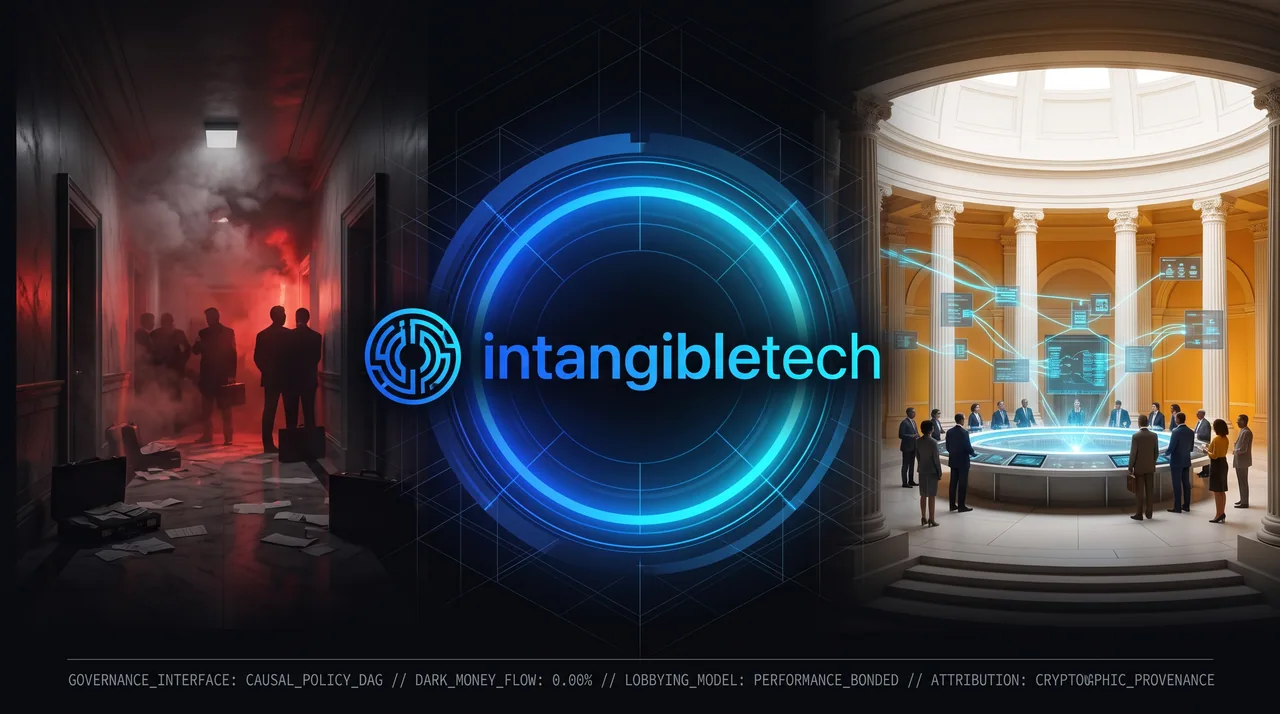
LEGACY K STREET LOBBYING:
- Donor Cash ──► Dark-Money Super PAC ──► Secret Backroom Drafting
- 2,000-Page Omnibus Bill dropped at 2 AM ──► Closed Committee Vote
Outcome: Hidden Loophole for Donors; Economic Distortion; Zero Accountability
INTANGIBLE CAUSAL POLICY ARCHITECTURE:
- Domain Expert ──► Registers Public Policy Node on Layer-0 DAG (Signed with SID)
- Protocol Simulation Engine models impact on KST, ISI & Municipal Velocity
- Open Legislative Deployment ──► Real-Time Telemetry Measures Outcomes
Outcome: 100% Causal Provenance; Lobbyist Earns Performance Yield; Zero Dark Money
Consider how this structural shift operates:
1. Open Cryptographic Provenance
When an industry association, a union, or an enterprise proposes a regulatory change—for example, adjusting the inspection protocols for civil aviation components—the proposed rule cannot be inserted anonymously through backroom horse-trading:
- The policy module must be registered on Layer-0, signed by the Sovereign Digital Identity (SID) of the individuals and organizations who drafted it.
- Every single sentence, variable adjustment, and exception is permanently etched with cryptographic provenance.
- The public, the press, and rival industries can inspect the precise origin, rationale, and technical assertions of the proposal in real time.
2. Algorithmic Impact Simulation
Before a legislative body votes to adopt a policy node into statutory law, the proposal is run through the protocol’s deterministic simulation engine:
- The system models the policy across the economic Directed Acyclic Graph.
- Will this regulatory change accelerate physical transaction velocity (Vt) and suppress operational defect rates?
- Or will it create an artificial bottleneck, concentrate monopolistic rent, and depress regional Kinetic Systemic Throughput (KST)?
Lawmakers are no longer forced to rely on competing corporate lobbyists making unprovable claims. They are presented with an objective, data-backed simulation of how the policy impacts the physical physics of their economy.
3. The Lobbyist’s Evolution: From Bribery Broker to Civic Systems Engineer
The immediate question from cynics and political insiders is obvious:
“Why on earth would K Street lobbying firms, corporate government affairs directors, and high-powered political fixers ever agree to this? Why would they support a system that eliminates their dark-money leverage?”
They will support it because the current lobbying model is an insecure, highly vulnerable, and exhausting rat race—and because our architecture replaces it with a vastly more lucrative, prestigious, and legally bulletproof professional business model.
Today, corporate lobbyists live under constant existential stress:
- They are universally despised by the public.
- Their influence is fragile; an election wave can wipe out their congressional allies overnight, destroying years of cultivated relationships.
- Corporate clients constantly question their multi-million-dollar retainer fees, demanding to know what concrete value was actually delivered behind closed doors.
The Intangible Architecture offers lobbyists a profound elevation: The Transition to Civic Systems Engineers.
LEGACY LOBBYING FIRM:
Revenue Source: Billable Hours & Shady Corporate Campaign Bundles
Core Skill: Cultivating Backroom Access, Trading Favors, Ghostwriting Earmarks
Deliverable: Secret Regulatory Loopholes & Favorable Tax Treatment
Reputational Standing: Universally Vilified as Corrupt Influence Peddlers
CIVIC POLICY GUILD (THE PROTOCOL INVERSION):
Revenue Source: Performance-Bonded Senior Civic Yield (Opcode 0x08)
Core Skill: Systems Architecture, Regulatory Optimization, Defect Suppression
Deliverable: High-Throughput Policy Nodes That Expand Regional KST
Reputational Standing: Celebrated Institutional Architects of Societal Prosperity
How Lobbyists Make Fortunes Under the New Architecture
1. Performance-Bonded Policy Architecture
In our architecture, when a lobbying firm or policy consultancy designs a regulatory framework that is adopted by a city, a state, or the federal government, they don’t get paid through under-the-table campaign kickbacks.
They earn Senior Civic Performance Yield:
- Suppose an engineering and policy guild designs an optimized, containerized regulatory framework for autonomous commercial drone freight.
- The policy is adopted by a regional transportation authority.
- Over the next three years, the framework successfully accelerates local supply-chain velocity, eliminates logistical delays, and maintains a zero-defect safety record, demonstrably expanding the region’s Kinetic Systemic Throughput (KST).
- Through Opcode 0x08 (Atomic Upstream Attribution), a fractional, non-dilutive yield generated by that economic expansion streams directly into the sovereign digital vaults of the policy architects who designed the framework.
A brilliant policy strategist who drafts an exceptional, low-friction, high-safety regulatory code can earn tens of millions of dollars in completely clean, fully transparent, recurring yield.
They no longer need to sneak through back doors or fear federal corruption indictments. Their wealth is tied directly to the measurable economic value their intellect created for human civilization.
2. The Shift from Defensive Spend to Productive Alpha
For corporate enterprises, spending money on government affairs ceases to be a defensive insurance policy against corrupt competitors.
It becomes an R&D investment in regulatory efficiency.
An enterprise funds policy architects to design smarter, safer, and cleaner standards because operating under low-defect, protocol-verified rules directly elevates the enterprise’s Impact Score Index (ISI), slashing its corporate borrowing costs from 8% down to 1.5%.
4. Liberating the Politician: The Death of the 30-Hour Fundraising Week
If the benefits to lobbyists are immense, the benefits to elected lawmakers are revolutionary.
For a politician, transitioning to the Intangible Architecture represents an act of total professional and personal liberation:
1. The Abolition of the Call Center
Under our public finance framework—where public revenues are gathered through the microscopic atomic velocity partition on commercial turnover, and election communication is hosted on protocol-native civic forums—private campaign cash is rendered completely obsolete.
- A member of Congress no longer spends thirty hours a week dialing donors in a party call center.
- They no longer have to attend four rubber-chicken donor dinners every night.
- They no longer have to beg billionaires for checks or trade committee votes for Super PAC air cover.
Those thirty hours every week are returned to what lawmakers were elected to do: reading policy, listening to constituents, conducting real legislative oversight, and solving the complex problems of their districts.
2. Campaigning on Real-Time Civic ISI
How does a politician run for re-election without multi-million-dollar advertising war chests?
They run on their un-falsifiable Civic Impact Score Index (Civic ISI):
- A lawmaker’s track record is not an advertising spin doctor’s narrative; it is an open ledger of verified legislative stewardship.
- Did the policies they sponsored expand municipal throughput or create bureaucratic drag?
- Did their administrative oversight eliminate infrastructure defects or lead to cost overruns?
- When voters enter a voting booth, they do not have to guess which candidate is telling the truth. They inspect the candidate’s verified operational scorecard right from their personal sovereign wallet.
The honest, disciplined public servant who quietly fixes bridges, balances municipal accounts, and builds local prosperity becomes mathematically unassailable.
The slick demagogue who does nothing but generate cable-news outrage and collect billionaire donor checks is exposed as an empty, zero-ISI liability.
5. De-Fanging the Ideological Think Tank Machine
To clean up modern governance, we must confront the most sophisticated institutional weapon of legacy influence: The Dark-Money Think Tank.
Organizations like The Heritage Foundation, the American Legislative Exchange Council (ALEC), the Center for American Progress, and dozens of similar partisan entities present themselves as independent, non-partisan research institutions.
In reality, they are ideological marketing agencies bankrolled by multi-million-dollar dark-money donations from corporate titans and ideological billionaires:
- They produce heavily biased, un-falsifiable “policy whitepapers” designed to justify deregulation for specific donors, cut corporate taxes, or block environmental protections.
- They draft “model legislation”—complete statutory templates with pre-packaged corporate loopholes—and hand them to understaffed state legislators who introduce them word-for-word without understanding the downstream consequences.
- They weaponize policy to drive culture-war wedges, radicalizing the political landscape to distract the public while their corporate sponsors extract public wealth.
The Intangible Architecture does not need to censor these organizations, revoke their tax statuses, or ban their right to speak.
The protocol de-fangs them by subjecting their ideas to the cold, unforgiving laws of causal accountability.
LEGACY THINK TANK MODEL:
- Dark-Money Billionaire Donor ──► 501(c)(3) Think Tank (Tax-Deductible)
- Un-Falsifiable Ideological Paper ──► Model Legislation handed to Legislators
- Policy Enacted ──► Economic Collapse / Environmental Ruin in Real World
Outcome: Zero Accountability; Think Tank gets another $10M Donor Check
INTANGIBLE CAUSAL ACCOUNTABILITY:
- Think Tank drafts Policy Node on DAG ──► Signed with Organization’s SID
- Protocol Simulation flags high defect risk and thermodynamic drag
If Enacted: Real-World Telemetry tracks real-time failure (ISI Collapses)
PROTOCOL EXECUTES CAUSAL DOWN-GRAPH SLASHING:
- Think Tank’s Provenance Score is slashed across the network
- Organization’s capability nodes are algorithmically quarantined
- Ideological snake oil is permanently extinguished by mathematical reality
The Incorruptible Reality Engine
1. The Death of Un-Falsifiable Dogma
Under legacy politics, an ideological think tank can publish a paper claiming that cutting taxes on corporate polluters will “trickle down” and create vast wealth, or that banning clean-energy microgrids will “protect consumers.”
When the policy is enacted and the local water supply is poisoned or the local economy stagnates, the think tank faces zero consequences. They simply publish a new paper blaming someone else.
On our ledger, an ideological paper mill cannot hide:
- If a think tank drafts a model legislation node, that node is permanently tagged to its Sovereign Digital Identity.
- If an administration enacts that node, the real-world operational results are tracked continuously: What happened to child health metrics? What happened to municipal defect rates? What happened to local business velocity?
- If the policy causes structural decay, the protocol’s consensus engine executes Causal Down-Graph Slashing.
The think tank’s institutional provenance score is crushed. Any future policy node submitted by that organization is flagged with a high systemic risk marker.
Lawmakers will not touch their proposals because integrating a poisoned node from a slashed think tank would instantly degrade the lawmaker’s own Civic ISI.
2. The Rise of the Empirical Research Guild
When ideological dogma carries severe mathematical penalties, the nature of policy research transforms entirely.
Think tanks can no longer survive as propaganda arms for billionaire donors.
They are forced to evolve into Empirical Policy Guilds:
- They must employ real systems scientists, data architects, and industrial engineers.
- Their proposals must be accompanied by mathematically verified simulations that demonstrate genuine defect suppression and economic velocity.
- Ideological grandstanding is replaced by empirical discipline.
The loudest, best-funded partisan loudmouths lose their power overnight, while rigorous, quiet, and honest researchers become the most sought-after minds in the republic.
6. The Sovereign Republic Restored
For three generations, free citizens have been told that political corruption is simply the inevitable price of living in a mass democracy.
We were told that if you want a free society, you must accept that politicians will spend their lives begging billionaires for money, that corporate lobbyists will write the laws of the land in secret backrooms, and that partisan think tanks will pollute our public discourse with purchased lies.
We accepted this corruption not because our people lacked virtue, but because our public institutions were operating on the dark, paper-based information architecture of the past.
The Intangible Architecture ends that resignation forever.
By transforming public policy into an open, simulated causal DAG, replacing campaign bribery with transparent performance yield, freeing our elected representatives from the fundraising mill, and holding every policy architect to the unyielding test of real-world results, we return democracy to its sacred foundation:
- Where laws are drafted in the sunlight of open code, not the shadows of K Street backrooms.
- Where lawmakers serve the people who voted for them, not the donors who bought them.
- Where the expertise of the domain specialist is honored, rewarded, and held accountable.
- And where the sacred trust of self-governance is anchored not in the hollow promises of politicians, but in the incorruptible bedrock of truth.
The backroom is closed.
The forum is open.
And the republic is finally ours again.