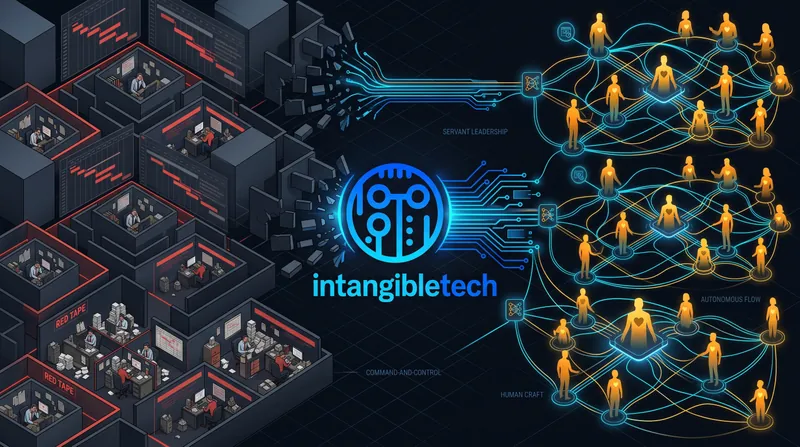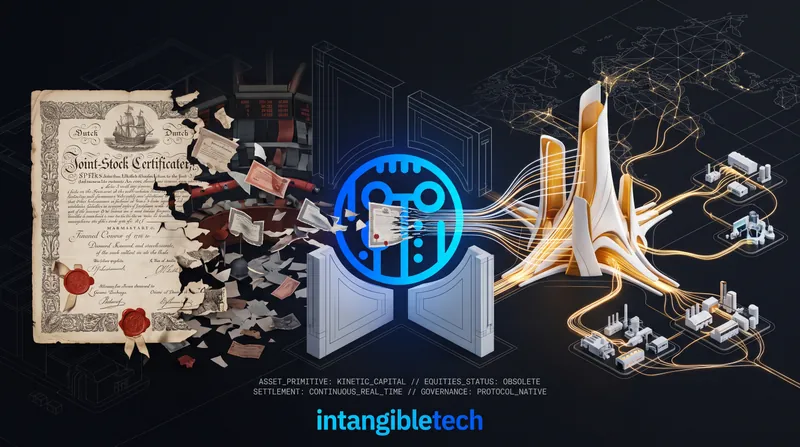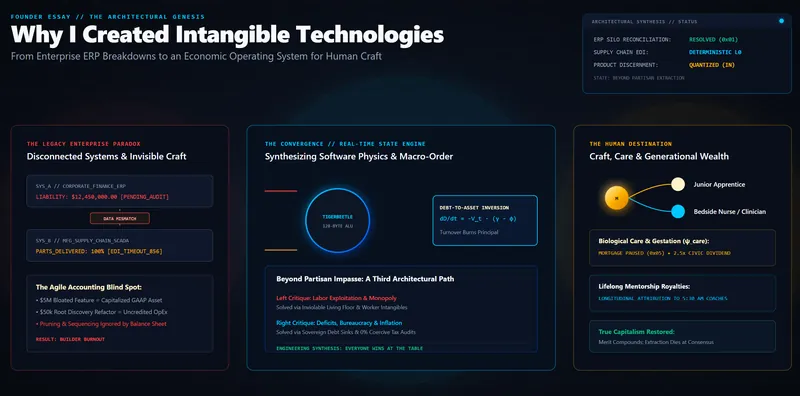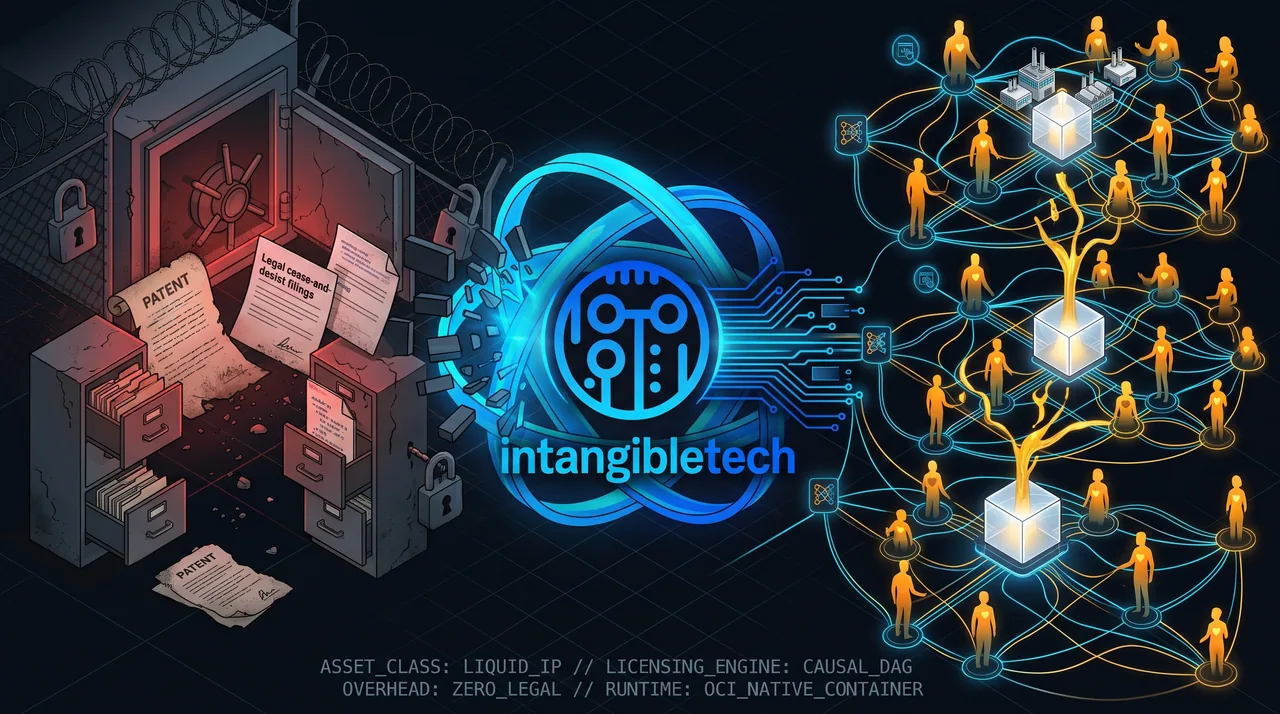
We live in a paradoxical era where the most valuable assets on Earth are treated as corporate state secrets, while the foundational infrastructure holding up the global digital economy is treated as volunteer charity.
On one side of the enterprise landscape, corporations spend hundreds of millions of dollars building defensive patent fortresses. They hire armies of specialized intellectual property attorneys, file thousands of overlapping patent claims, and wage multi-decade legal wars of attrition. The operational goal is rarely to build better tools; it is to construct an impenetrable legal moat that prevents anyone else from solving the same problem. Knowledge is locked inside a dark vault, guarded by non-disclosure agreements and restrictive proprietary licenses.
On the other side of the landscape sits modern software.
Over ninety percent of global enterprise software applications—running everything from air traffic control towers and nuclear power plants to global banking networks and hospital diagnostics—are built on open-source libraries. Yet the engineers who write and maintain this critical digital masonry are routinely unpaid, exhausted volunteers working late into the night.
Every few years, the fragility of this model detonates in public view:
- A solo developer gets burned out, deletes an eight-line Javascript library from a package registry, and breaks the build pipelines of half the Fortune 500.
- A ubiquitous, unmaintained logging utility like Log4j or an SSH compression tool like XZ Utils reveals a critical vulnerability that sends thousands of enterprise security teams into months of emergency triage.
The corporate world responds with empty platitudes, thanking open-source developers for their service while public software-as-a-service (SaaS) conglomerates wrap those exact same open libraries in cloud hosting wrappers, charge enterprise customers millions in recurring subscription tolls, and return precisely zero dollars to the original creators.
Why are we trapped in this dysfunctional dynamic?
Because modern finance and intellectual property law are built on an obsolete, four-hundred-year-old mental model: the assumption that ideas must be made artificially scarce to possess economic value.
When we designed the Intangible Architecture, we recognized that the path forward is not to build stronger legal walls or to beg corporations for open-source donations. The solution is to transform intellectual property from a locked, static legal claim into an autonomous, liquid economic asset.
1. The Historical Trap: How IP Law Became an Extractive Tollbooth
Intellectual property was not originally conceived as an instrument of permanent corporate obstruction.
When the Venetian Patent Act of 1474 and the English Statute of Monopolies of 1624 laid the foundations of modern patent law, they were attempting to solve a genuine disclosure problem. In the medieval guild system, master artisans guarded their trade secrets with their lives, taking techniques for glassblowing, metal forging, and clockmaking to the grave.
The early patent system was a grand social bargain: If an inventor publicly discloses the detailed inner workings of their machine so society can learn from it, the sovereign crown will grant them a temporary, exclusive monopoly to commercialize it.
The goal was disclosure; the monopoly was merely the incentive.
In the twentieth century, that social contract was completely corrupted by corporate financialization.
Patents mutated from tools of public disclosure into weapons of competitive suppression. Large conglomerates realized that filing thousands of vague, broad patents allowed them to create “patent thickets”—legal minefields designed to bankrupt smaller competitors through litigation costs alone, regardless of the underlying technical merit.
Simultaneously, the digital age shattered the physical assumptions of copyright.
When software emerged, copying a line of code or deploying an algorithm ceased to have any physical manufacturing cost. Unable to reconcile the zero-marginal-cost reality of software with physical property laws, the tech sector developed two extreme, polarized responses:
- The Proprietary SaaS Tollbooth: Software companies locked their code behind proprietary cloud walls, spending forty to fifty percent of their gross revenues on enterprise sales forces, billing operations, and legal compliance just to police access to a database.
- The Open-Source Charity Model: Ideological purists released their code to the world for free under licenses like MIT and Apache. They created immense societal value, but stripped themselves of any programmatic mechanism to capture economic sustainability.
Both approaches are broken. The proprietary model traps knowledge in artificial silos and burns capital on legal friction. The open-source model starves its builders and creates systemic operational vulnerabilities.
To solve this, we must execute a complete mental inversion.
2. The Mental Inversion: From Static Hoarding to Kinetic Fluidics
The foundational breakthrough of the Intangible Architecture is replacing the scarcity mindset of traditional IP with the physics of fluidic velocity.
In the legacy corporate world, the value of an idea is defined by exclusion:
- “My patent is valuable because I can legally prevent you from using it.”
- “My software is valuable because it is trapped behind my proprietary login portal.”
In the Intangible Architecture, the economic value of an idea is defined by kinetic ubiquity:
- The more systems that rely on your architecture, the higher the continuous transaction throughput flowing through your node.
- The more upstream dependencies you power, the greater the programmatic yield streaming into your sovereign vault.
LEGACY PROPRIETARY MODEL:
Value = Legal Exclusion & Artificial Scarcity
Mechanism: Patent Lawsuits, NDAs, Opaque Silos, Multi-Month Contract Redlines
Result: Knowledge Hoarded; High Legal Overhead; Innovation Strangled
INTANGIBLE KINETIC ARCHITECTURE:
Value = Structural Ubiquity & Causal Network Velocity
Mechanism: Open Dependency DAG, Silicon-Level Provenance, Atomic Settlement Splits
Result: Universal Sharing; Zero Overhead; Compounded Yield for Builders
Think of a piece of intellectual property—an optimized consensus algorithm, a precision aerospace toolpath, or an advanced clinical diagnostic model—not as a fenced-off plot of private land, but as a nozzle in a global pipeline.
If you build a locked fence around your nozzle, water sits stagnant. Nobody uses it, no energy moves, and you must pay armed guards (lawyers) to protect an empty plot.
If you connect that nozzle to the open global pipeline, thousands of enterprises route their daily operational fluids through your design. The protocol measures that flow in real time.
You do not need to sue anyone for copyright infringement; you do not need to negotiate complex licensing agreements; you do not need to send billing invoices. The very act of the economy utilizing your breakthrough triggers an atomic, protocol-enforced liquidity stream that pays you every time the system runs.
Sharing is no longer an act of naive charity. Sharing becomes the most aggressive, mathematically optimal wealth-generation strategy an inventor can execute.
3. The Mechanics of Liquid IP: Programmatic Licensing at Consensus
How does this work without relying on corporate goodwill or standard licensing contracts?
The Intangible Architecture replaces manual legal enforcement with Autonomous Dependency Directed Acyclic Graphs (DAGs) executed on Layer-0 bare-metal silicon and anchored to the Stellar network.
1. Cryptographic Registration of the Capability Node
When an engineer, researcher, or enterprise creates a novel piece of intellectual property, they register the module as an active Capability Node on the protocol’s Dependency DAG.
This registration is bound to their Sovereign Digital Identity (SID).
The module is registered alongside its formal interface specifications, its cryptographic checksums, and its upstream attestation lineages. The creator does not specify a legal contract with fifty pages of indemnification clauses; they define a protocol-native licensing parameter within the module’s 128-byte state struct.
2. Autonomous Upstream Routing via Opcode 0x08
When another enterprise builds a commercial product that incorporates that module—whether it is a logistics platform incorporating an optimized routing algorithm or a medical device utilizing a signal-processing library—the relationship is registered directly on the dependency graph.
There are no licensing audits, no royalty tracking firms, and no manual accounting reconciliations.
When an end-user pays for a service or a commercial supply-chain invoice clears:
- The commercial settlement clears across native Layer-0 Automated Market Maker (AMM) corridors in milliseconds.
- As the transaction settles, the protocol’s pre-compiled financial opcodes execute an Atomic Upstream Yield Distribution (Opcode 0x08).
- The system traverses the Dependency DAG in nanoseconds, programmatically splitting the transaction fee and routing microscopic, un-diluted royalties directly to every upstream module that contributed to the final execution.
If your code, your engineering tolerance, or your design was a structural link in the chain that produced real-world economic utility, you get paid at the exact millisecond of settlement.
3. De-Risking the Enterprise: The End of Patent Litigation
For enterprise leadership, this architecture permanently eliminates one of the greatest existential risks in business: unforeseen IP infringement litigation.
Today, an enterprise can spend five years building a breakthrough product, only to have a patent troll emerge from the shadows demanding hundreds of millions of dollars in damages because a vague patent granted fifteen years ago covers a similar concept.
On our ledger, this predatory extortion is impossible:
- All functional dependencies are transparent, unalterable, and visible on the public DAG.
- Licensing fees are non-discriminatory, protocol-enforced, and paid automatically at the point of turnover.
- An enterprise integrating an open capability node knows with mathematical certainty that its licensing obligations are settled atomically with every transaction.
The entire multi-billion-dollar legal apparatus of patent litigation, royalty auditing, and licensing arbitration is dissolved into protocol code.
4. Why Kubernetes and Containerization Are Now the Core Business Model
To understand how this architecture enters the real enterprise world, corporate leadership must look at a technology they have historically dismissed as low-level IT plumbing: containerization and Kubernetes.
For the past decade, Chief Executive Officers and Chief Financial Officers have viewed Docker containers and Kubernetes orchestration through a narrow technical lens. They viewed them as tools for cloud engineers to manage server infrastructure, reduce AWS hosting bills, and deploy code updates without downtime.
That perspective is obsolete.
In the Intangible Architecture, a standardized, containerized software pod is no longer a DevOps deployment mechanism; it is the fundamental economic unit of enterprise capital.
THE EVOLUTION OF THE CONTAINER
THE DEVOPS VIEW (2015 - PRESENT):
Application Code + Dependencies ──► OCI Container Image ──► Kubernetes Cluster
[Goal: Infrastructure Cost & Uptime]
THE INTANGIBLE ENTERPRISE VIEW:
Sovereign IP + Silicon Telemetry ──► OCI Economic Cell ──► Layer-0 DAG Execution
[Goal: Liquid Capital, Autonomous Yield,
Tamper-Proof Attribution & Real-Time Balance Sheet]
Why does containerization hold this profound economic power?
Because a standardized Open Container Initiative (OCI) image provides the exact physical boundaries required to measure, monetize, and protect intellectual capital:
1. The Container as an Encapsulated Balance-Sheet Asset
A container bundles the intellectual property, its exact runtime dependencies, its execution boundaries, and its cryptographic signatures into a single, immutable, bit-for-bit reproducible artifact.
When an enterprise packages a proprietary analytics model or a factory control system into a signed container, it has packaged a complete, self-contained economic organ. It can run in a private cloud, on a local factory edge server, or inside a hospital data center—while maintaining its exact cryptographic identity.
2. Silicon-Signed Execution Telemetry
When that container executes inside an environment secured by a Trusted Platform Module or secure enclave, its physical performance is measured without human intermediaries:
- How many microseconds did it take to process the data?
- Did it successfully eliminate errors and prevent downstream exceptions?
- Did it achieve the engineering tolerances required by the physical machinery?
The container’s operational execution is signed in hardware, providing the untamperable proof required to feed the enterprise’s Impact Score Index (ISI) and calculate its Defect Suppression Yield.
3. The Plug-and-Play Commercial Core
Because Kubernetes standardizes how these containers communicate across distributed networks, an enterprise can compose complex corporate applications by linking dozens of independent, containerized capability nodes like digital Lego blocks.
Each container acts as an autonomous economic cell. It consumes data, performs work, triggers micro-settlements for its upstream dependencies, and captures earned yield for its creator.
Container orchestration ceases to be a back-office technical detail. It becomes the primary architectural discipline of modern corporate strategy and capital allocation.
5. The Great Convergence: The Transformation of SaaS and Open Source
When intellectual property becomes liquid and containerized execution becomes the economic baseline, the two warring models of modern software—proprietary SaaS and open source—converge into a single, highly profitable reality.
The SaaS Liberation: Slashing the 50% Sales-and-Billing Tax
Modern SaaS companies are trapped in an operational quagmire.
They spend massive percentages of their operational budgets building complex customer identity systems, integrating third-party credit card billing processors, paying for multi-tenant data isolation security, and maintaining armies of enterprise sales representatives to negotiate multi-year contract renewals.
Under our architecture, a SaaS company can radically streamline its operations:
- It packages its core platform into modular, verifiable capability nodes.
- It distributes its modules openly across the network, encouraging global integration without requiring upfront credit card gates or sales calls.
- As enterprises integrate the modules into their own operational pipelines, usage settles automatically across Layer-0 rails.
The software firm eliminates its billing overhead, eliminates its multi-tenant hosting risks, and eliminates customer acquisition friction. It converts its business from an extractive subscription model into an ultra-high-margin, high-velocity infrastructure utility.
The Open Source Solution: From Volunteer Burnout to Protocol Sovereign
For the independent open-source creator, this architecture marks the end of historical exploitation.
Under the legacy system, if you wrote an open-source library that eighty percent of the Fortune 500 relied on, your options for financial survival were deeply flawed:
- Beg for donations via crowdfunding platforms.
- Abandon development to join a big-tech company that claims ownership over all your future intellectual output.
- Attempt to build a complex, venture-backed enterprise company around support contracts, turning yourself from an elite software builder into a corporate administrator.
In our operating framework, the builder retains their freedom and their craft:
- A solo developer registers their library as a Capability Node bound to their personal Sovereign Digital Identity.
- They license the module under an open, protocol-native commercial framework.
- Every time a major bank, a cloud platform, or an automotive manufacturer executes a transaction that touches that library in its dependency graph, a fractional micro-settlement routes directly to the builder’s sovereign vault.
A single developer who builds an exceptionally resilient, low-defect utility can earn sustainable, six-figure or seven-figure annual cash flows in spendable stablecoins—not through charity, but through the objective mathematical measurement of the economic utility their work provides to civilization.
6. The Firm Endures: Why Corporations Don’t Disappear
This brings us to a vital question that every serious executive and economist must ask:
“If a single developer or inventor can capture sovereign yield directly from an open protocol, does that mean the traditional company is dead? Will the economy dissolve into millions of isolated, freelance individuals?”
This is the naive fantasy championed by early decentralized autonomous organization (DAO) purists. It ignores the fundamental nature of transaction costs, risk management, and the organizational physics of the real world.
The corporation is not going away. The corporation is being restored to its true, indispensable purpose.
While an individual builder can create an extraordinary module of intellectual property, human individuals cannot replace the vital functions that only a unified corporate institution can provide:
1. Capital Buffering and Risk Absorption
Economic production is inherently volatile. Research and development requires months or years of intense effort before an intellectual breakthrough generates a single dollar of transaction velocity.
A solo developer or researcher faces personal bankruptcy during prolonged dry spells. A corporation acts as a vital capital shock absorber. It pools reserves, provides stable base compensation to its team, absorbs the market risks of exploratory research, and cushions its members against cyclical shocks.
2. Multi-Disciplinary Synthesis (The Power of the Assembly)
A brilliant algorithm is useless without physical manufacturing tools, global distribution agreements, intuitive user interfaces, and robust customer support.
An individual data architect cannot simultaneously manage physical freight logistics, maintain precision CNC machinery, and navigate international regulatory compliance.
The corporation is the coordination vehicle that unites dozens of complementary human talents—combining systems architecture, physical machining, operational logistics, and clinical expertise into a coherent whole.
3. Physical Execution and Hardware Anchors
The digital world does not exist in a vacuum; it sits on physical hardware.
Software algorithms do not mine lithium, fabricate microchips, build clean-energy transmission lines, or assemble surgical robots.
Corporations are necessary to own, maintain, and capitalize the heavy, physical machinery and industrial real estate that ground the digital economy in physical reality.
4. The Compounded Impact Score Index (ISI)
Under our protocol, capital allocation is governed by the Impact Score Index.
While an individual can possess a high personal provenance score, an isolated individual cannot achieve the systemic scale of a corporate entity:
- A corporation combines multiple senior mentors, junior apprentices, low-defect software modules, and physical hardware assets under a single operational umbrella.
- This comprehensive resilience allows the corporation to achieve an institutional-tier ISI that no single freelancer could ever match on their own.
- That elevated institutional score unlocks massive, multi-million-dollar credit facilities at prime rates between 1.0% and 2.0%, allowing the firm to finance large-scale industrial projects that are completely beyond the reach of an individual actor.
The modern corporation does not disappear.
Instead of operating as an extractive, paranoid fortress that hoards intellectual secrets behind legal threats, the corporation becomes a high-coordination launchpad.
It becomes an environment where elite craftspeople choose to work because the company provides superior physical tooling, shared risk buffers, institutional credit advantages, and the collaborative scale necessary to solve the most difficult challenges of human civilization.
The Liberation of Human Ingenuity
For four centuries, humanity has operated under a tragic compromise.
We accepted that to reward human creativity, we had to legally restrict its application. We accepted that to make knowledge valuable, we had to make it artificially scarce. We allowed our courtrooms to be clogged with patent lawsuits, our software infrastructure to rot from maintainer exhaustion, and our corporations to spend more time defending monopolies than building breakthroughs.
That compromise has run its course.
The Intangible Architecture ends the era of artificial scarcity.
By replacing the patent thicket with the open Dependency DAG, automating licensing at the silicon level, transforming containers into sovereign economic assets, and rewarding both the solo builder and the corporate enterprise for real-world kinetic utility, we have designed an economic operating system where the more you share, the more you build, and the more you empower others, the wealthier you become.
Human knowledge was never meant to be locked in a corporate vault.
It was meant to flow.