In the modern corporate landscape, mergers and acquisitions have largely ceased to be about industrial coordination. They have become exercises in financial vandalism.
Look at the parade of mega-mergers across the media, healthcare, and industrial sectors over the past decade. The pattern is depressingly uniform. Two massive conglomerates announce a transaction valued in the tens of billions of dollars, promising Wall Street hundreds of millions in operational “synergies.” Investment banks collect hundreds of millions in advisory and underwriting fees.
Then comes the hangover.
To finance the transaction, the newly formed entity is saddled with staggering mountains of commercial debt. Look no further than the catastrophic debt overhangs that have paralyzed legacy media—from the turbulent fallout of the WarnerMedia and Discovery merger, carrying over forty billion dollars in debt that forced the cancellation of finished artistic projects for tax write-offs, to the multi-billion-dollar debt shuffles seen in the Paramount and Skydance consolidations.
When compounding interest obligations collide with market reality, the corporate playbook never changes: executive management cuts research and development, institutes mass layoffs of experienced craftspeople, closes regional facilities, increases consumer prices, and degrades service quality.
Meanwhile, regulatory bodies like the Securities and Exchange Commission (SEC), the Federal Trade Commission (FTC), and the Department of Justice (DOJ) find themselves trapped in a reactive posture. Armed only with backward-looking ninety-day filings, opaque corporate disclosures, and crude market-share metrics invented in the mid-twentieth century, regulators spend years litigating transactions in court, often swayed by political cycles and high-priced corporate lobbying rather than empirical data.
Mergers and acquisitions do not have to be an engine of economic decay. At their best, corporate combinations should be an essential coordination mechanism for civilization: allowing small, innovative firms to scale their breakthroughs across global distribution channels, uniting complementary technologies, and rescuing distressed physical operations.
The failure is not in the concept of combination; it is in the information architecture and accounting physics that govern it.
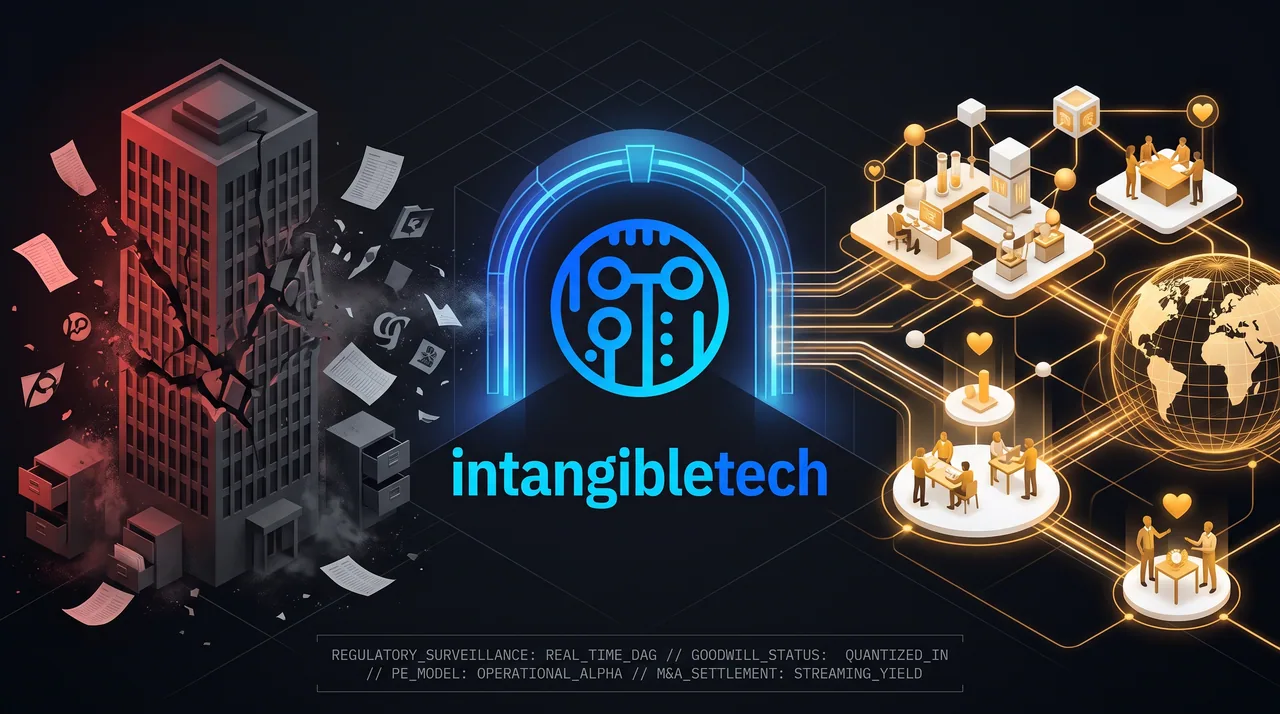
By introducing protocol-native transparency, replacing the accounting fiction of “Goodwill” with verified Intangible Capital, and inverting how capital moves in an acquisition, Intangible Technologies provides regulators, private equity sponsors, and founders with the tools to transform M&A into an engine of shared economic productivity.
1. The Fiction of “Goodwill”: Demolishing Corporate Accounting’s Greatest Lie
To understand why corporate acquisitions routinely destroy value, one must look at the single most manipulated line item on the corporate balance sheet: Goodwill.
Under legacy accounting standards (both GAAP and IFRS), when Company A buys Company B for ten billion dollars, but Company B only possesses three billion dollars in net tangible, physical assets (real estate, inventory, equipment), an immediate accounting crisis arises: What does the remaining seven billion dollars represent?
Because legacy double-entry bookkeeping cannot see or measure human capability, operational culture, or software craft, it dumps that unallocated seven billion dollars into a magical, catch-all bucket called Goodwill.
Goodwill is the financial establishment’s tacit admission of blindness. It is an arbitrary plug number that tells investors: “We spent billions of dollars on something valuable, but our ledgers are too primitive to tell you what it actually is.”
What happens next is an open secret on Wall Street:
- Management uses Goodwill to justify wildly inflated acquisition prices, inflating their corporate balance sheet with phantom equity.
- Three to five years later, when the acquired talent has fled and the expected synergies fail to materialize, the corporate board quietly announces a multi-billion-dollar “Goodwill Impairment Charge.”
- Billions of dollars in shareholder value vanish with the stroke of a pen. In 2002, AOL Time Warner wrote off ninety-nine billion dollars in impaired goodwill—the largest corporate write-down in human history. The same story repeats in every cycle across retail, tech, and entertainment.
THE DISSOLUTION OF GOODWILL
LEGACY ACCOUNTING (GAAP / IFRS):
Purchase Price: $10B ──► Net Tangible Assets: $3B
└──► GOODWILL PLUG: 7B (Unverified, subjective blackbox)
(3 to 5 Years Later) Catastrophic Impairment Write-Down ($0 Value)
INTANGIBLE ARCHITECTURE:
Purchase Price: $10B ──► Physical Capital: $3B (Hardware-attested runtime)
└──► VERIFIED INTANGIBLE CAPITAL: $7B
├── Quantitative Defect Suppression Yield
├── Dependency DAG Architecture Assets
└── Living Human Succession & Mentorship Lines
The Inversion: Real-Time Intangible Capitalization
In the Intangible Architecture, Goodwill is permanently abolished. It is replaced by quantized, verified, and continuously monitored Intangible Capital.
When an enterprise acquires another firm on our ledger, the non-physical premium is broken down into verifiable, protocol-native components:
- Architectural Dependency Value: The acquired firm’s proprietary software modules, engineering workflows, and system architectures are mapped as active nodes on the network’s Directed Acyclic Graph (DAG). Their value is measured by the verified velocity and transactional throughput that passes through them daily.
- Defect Suppression Yield: The acquired team’s proven capacity to lower operational error rates, suppress industrial defects, and maintain system uptime is calculated against actuarial industry baselines.
- Human Succession and Talent Provenance: The institutional knowledge of the engineering teams, data architects, and master craftspeople is recognized through their Sovereign Digital Identities (SIDs) and verified mentorship lineages.
Because these assets are tracked and evaluated continuously on-chain, an acquiring company cannot hide behind an opaque multi-billion-dollar accounting plug. If the acquiring firm mismanages the integration—if the software pipelines degrade, defect rates climb, or key engineers depart—the Intangible Capital score drops in real time.
The financial truth of the merger is visible to regulators, investors, and creditors every single second, completely eliminating the multi-year fraud of delayed goodwill write-downs.
2. A Real-Time Arsenal for Regulators: The End of Opaque Antitrust
For governing bodies like the SEC, the FTC, and international competition authorities, modern antitrust enforcement is a grueling, asymmetrical battle.
Regulators are forced to evaluate multi-billion-dollar mergers using twentieth-century tools:
- They rely on the Herfindahl-Hirschman Index (HHI), a crude calculation based on estimated market shares within arbitrarily defined geographical or product boundaries.
- They pore through millions of heavily redacted internal emails, discovery documents, and quarterly 10-K filings that provide only a lagging, retrospective view of corporate operations.
- The entire process becomes politicized, turning into a multi-year courtroom war of attrition where whichever party can spend more on economic consulting witnesses and legal retainers often prevails.
The Intangible Architecture arms regulatory bodies with an entirely new supervisory toolkit: Real-Time Structural Dependency Surveillance.
1. The Real-Time Systemic Dependency Graph
Because commercial operations, supply-chain handoffs, and software architectures clear across our Layer-0 state machine and anchor immutably to the Stellar network, the economic landscape forms an open, computable Directed Acyclic Graph (DAG).
Regulators no longer have to guess what a company’s market position looks like.
An FTC or SEC economist can query the protocol to inspect the real, physical, and computational dependencies of an industry:
- Which suppliers exclusively route through which buyers?
- Where do critical supply-chain bottlenecks exist?
- Which shared architectural modules represent systemic single-points-of-failure?
Antitrust analysis shifts from subjective corporate definitions to the objective physics of economic flow.
2. Algorithmic Merger Simulation
Before approving an acquisition, regulatory agencies can run deterministic simulations on the proposed corporate combination.
By modeling the merged entities within the protocol’s Dependency DAG, regulators can determine empirically:
- Will this merger streamline supply-chain velocity and lower systemic transaction friction (expanding Kinetic Systemic Throughput)?
- Or will it create an extractive bottleneck that suppresses counterparty velocity and artificially extracts unearned rent from downstream suppliers?
The decision to approve, challenge, or impose behavioral remedies on a merger ceases to be a subjective political debate. It becomes an empirical determination backed by cryptographic operational telemetry.
3. Continuous Post-Merger Covenant Enforcement
Historically, when antitrust regulators approve a merger with “conduct remedies”—such as requiring the merged entity to maintain open licensing for competitors or preserve domestic production facilities—enforcing those promises is nearly impossible. Companies quietly violate covenants, knowing that by the time regulators discover the breach years later, the market structure has already been permanently distorted.
Under our ledger, regulatory covenants can be compiled into Protocol-Native Smart Covenants:
- If an acquiring company promises to maintain specific operational capacities or continue supporting independent supply-chain nodes, those commitments are registered directly on the enterprise state vector.
- If the merged firm restricts access, drops operational throughput below statutory thresholds, or attempts to squeeze independent vendors, the protocol detects the variance automatically.
- Regulatory penalties are not litigated over five years in federal court; they trigger automated programmatic adjustments to the firm’s Impact Score Index (ISI), instantly elevating its borrowing costs across its credit facilities until compliance is restored.
3. Inverting Private Equity: From Asset-Stripping to Operational Mastery
In recent decades, the private equity industry has become synonymous with what tech critics have accurately termed corporate “enshittification.”
The traditional Leveraged Buyout (LBO) model functions not through operational improvement, but through pure financial extraction:
- A private equity sponsor purchases a healthy, cash-flow-positive business (a regional hospital network, a veterinary chain, a manufacturing supplier, or a beloved consumer brand).
- The PE sponsor funds eighty percent of the purchase price with high-interest commercial debt, but places that debt on the balance sheet of the acquired company, rather than on the fund’s own books.
- To service this massive debt load, the sponsor slashes operating costs: firing experienced senior staff, cutting wages, selling off the company’s real estate to lease it back at exorbitant rates, and skimping on equipment maintenance.
- The sponsor executes a “dividend recapitalization,” borrowing even more money against the company to pay itself a massive cash dividend.
- The hollowed-out corporate husk is either dumped onto public markets via an IPO or allowed to collapse into bankruptcy, leaving employees jobless, communities devastated, and bondholders holding the bag.
This is not capitalism; it is financial piracy enabled by broken accounting and asymmetric debt laws.
The Intangible Architecture does not destroy private equity. It inverts its incentives, transforming it from an engine of asset-stripping into a vehicle for operational excellence.
THE PRIVATE EQUITY INCENTIVE INVERSION
THE LEGACY LEVERAGED BUYOUT (LBO):
Action: Load Target with Compounding Debt ──► Slash Senior Staff & R&D
Sell Real Estate; Defer Tooling ──► Extract Cash Dividend Recap
Result: Short-Term PE Fund Payout ──► Company Bankrupt; Communities Hollowed
THE PROTOCOL-NATIVE BUYOUT:
Action: Non-Compounding Velocity Financing ──► Optimize Impact Score Index (ISI)
Retain & Mentor Craftspeople ──► Suppress Defect Rates & Thermodynamic Drag
Result: Lower Capital Costs ──► Compounded Kinetic Yield ──► Enduring Enterprise Value
The Structural Guardrails Against Exploitation
1. The Impossibility of Debt Offloading
Under our monetary physics, you cannot arbitrarily saddle an operating entity with compounding usury. Debt on our ledger is Credit-as-an-Asset, amortized continuously through the kinetic velocity of actual production.
A private equity firm cannot load an enterprise with debt that compounds independently of operations. If the PE firm halts factory production or reduces commercial sales, the debt does not multiply into an existential bankruptcy trap; its amortization simply waits for production to resume, while the firm’s capital lines are capped by strict protocol-level limits.
2. The Severe Financial Penalty of Talent Stripping
In the legacy world, firing senior staff is rewarded because accounting software records salaries as flat operating expenses, showing an immediate “cost reduction” that juices EBITDA.
On our ledger, firing experienced architects, clinical specialists, or master machinists triggers an immediate, catastrophic collapse in the enterprise’s Impact Score Index (ISI):
- The loss of verified human mentorship lineages and the resulting spike in operational defect rates drops the company’s composite resilience score.
- The moment the ISI drops, the protocol algorithmically increases the borrowing spread across the company’s credit lines from 1.5% to 8%.
- Any short-term savings achieved by cutting payroll are instantly wiped out by surging capital service costs across the balance sheet.
3. Rewarding the Real Turnaround
How does private equity generate massive financial returns in this new world? By becoming true operational builders.
When a forward-thinking private equity sponsor acquires a bloated, inefficient, or operationally distressed company, its path to alpha is clear:
- It introduces modern tooling, retrofits machinery with secure hardware roots of trust, and optimizes logistics workflows, directly suppressing physical defect rates.
- It institutes structured apprenticeship programs, expanding the company’s human succession metrics.
- As the target company’s operations stabilize, its composite ISI climbs rapidly.
- The company’s cost of capital plunges, its commercial turnover velocity accelerates, and the PE fund captures lucrative, senior Kinetic Yield generated by real-world productivity gains.
Private equity returns stop being derived from gutting companies for scrap. They become a direct reflection of an investment team’s ability to coordinate human ingenuity, eliminate operational waste, and build durable industrial institutions.
4. The Founder’s Exit: From the Corporate Abyss to Perpetual Vision Yield
For startup founders, scientific inventors, and master craftspeople, selling a company to a larger corporate acquirer is often a tragic bargain.
The founder spends a decade building a revolutionary product, cultivating an intentional company culture, and mentoring a brilliant team. Eventually, they hit a capital ceiling and agree to sell to a corporate giant.
The legacy acquisition mechanics are brutal:
- The Golden Handcuffs: The founder receives a combination of cash and restricted stock in the parent company, paired with a three-year non-compete agreement and an earn-out clause designed to trap them in a corporate middle-management role.
- The Corporate Abyss: Within twelve to eighteen months, the corporate parent’s marketing committees and product managers begin cannibalizing the acquired product. The original architecture is rewritten to conform to outdated corporate silos; the founding team’s culture is crushed by bureaucracy; the core developers quit; and the visionary product is quietly sunsetted.
- The Loss of Voice: The founder walks away wealthy in paper money, but watches the creative work of their life vanish into the corporate void.
Our architecture completely redesigns how acquisitions are settled and structured, ensuring that a founder’s vision is mathematically preserved and that capital moves in alignment with ongoing utility.
1. Velocity Yield Streaming vs. The Dilutive Lump Sum
In a protocol-native acquisition, the financial settlement does not rely on dumping a volatile lump sum of dilutive parent company stock into the founder’s lap, nor does it require taking on massive bank debt.
The acquisition transaction is structured through Continuous Velocity Yield Streaming:
- When the parent company integrates the founder’s technology, the acquired software pipeline, precision manufacturing tool, or clinical system is registered as an active, permanent capability node on the network’s Dependency DAG.
- As the parent company scales the technology across its global customer base, every commercial transaction, automated API call, and supply-chain handoff that utilizes the founder’s architecture passes through protocol-native Automated Market Maker (AMM) pools.
- The protocol automatically harvests the atomic liquidity turnover fee, streaming a dedicated, non-dilutive, senior Kinetic Yield directly into the sovereign digital vaults of the founder and their early employees.
The founders do not receive an arbitrary paper payout that depends on the parent company’s quarterly stock manipulations. They receive an enduring, liquid cash flow that reflects the true, expanding operational utility of what they built.
2. Architectural Immortality via Soulbound Provenance
The greatest fear of any visionary founder is that an acquiring conglomerate will gut their architecture and mistreat their team.
In the Intangible Architecture, the founder’s work is protected by protocol-enforced Soulbound Provenance:
- Immutable Causal Lineage: The architecture the founder built is permanently attributed to their Sovereign Digital Identity. The parent company cannot erase the founder’s name, rewrite history, or transfer the provenance of the intellectual creation to a corporate committee.
- Down-Graph Protection for the Team: The engineers and craftspeople who built the product retain their personal Impact Scores. If the corporate parent attempts to mistreat, sideline, or silence the acquired team, those individuals can exercise their Liquid Mobility Rights. Because their reputations and credentials are held sovereignly in their own wallets—rather than trapped in proprietary corporate HR files—they can depart with their verified provenance fully intact.
- Protocol-Enforced Architectural Integrity: If the parent company attempts to mutilate the underlying architecture—cutting corners on security tolerances or injecting extractive monetization loops that increase system error rates—the down-graph telemetry immediately flags the performance degradation. The parent company’s own ISI suffers, economically disincentivizing management from breaking what the founder built.
The founder’s vision is not subsumed by a corporate bureaucracy; it is immortalized in protocol code, operating as an enduring, revenue-generating organ within the broader economic machine.
5. M&A as Systemic Coordination: The Macroeconomic Imperative
When you step back from individual transactions and examine the macroeconomic landscape as a whole, the true promise of this architecture comes into focus.
Modern industrial civilization is facing coordination challenges of unprecedented scale:
- Transitioning global energy infrastructure from extractive fossil fuels to complex, decentralized clean-energy grids.
- Modernizing fragile, multi-continent supply chains to be resilient against geopolitical shocks.
- Integrating advanced artificial intelligence into physical robotics and clinical healthcare without creating catastrophic failure modes.
Solving these challenges requires massive, coordinated deployments of capital and capability. It requires companies to combine, share technologies, and orchestrate their supply chains with surgical precision.
Under the legacy financial regime, we cannot execute this coordination. Every major corporate combination is distorted by the demands of Wall Street financial engineering: debt loading, share buybacks, tax arbitrage, and the short-term quarterly earnings game.
The Intangible Architecture restores M&A to its true historical purpose: lowering systemic entropy and maximizing Kinetic Systemic Throughput (KST).
On our ledger:
- A merger is rewarded by the market not if it fires the most workers or takes on the cheapest leveraged debt, but if it suppresses systemic defects, accelerates physical supply-chain velocity, and deepens human institutional knowledge.
- Governing regulators possess the real-time supervisory vision to prevent corporate monopolies from strangling innovation, while confidently approving combinations that deliver genuine industrial efficiency.
- Private equity managers are liberated to be what they always claimed to be: disciplined, long-horizon stewards of operational capability.
- And the builders of our world—the founders, the engineers, the machinists, and the operators—can merge their efforts with larger platforms knowing that their craft will be honored, their voices preserved, and their contributions rewarded for generations to come.
We have spent half a century allowing financial predators to treat the industrial institutions of our civilization like disposable assets in a speculative casino.
It is time we built an economic operating system where joining forces makes us stronger, where trust is anchored in mathematical reality, and where the combination of human effort serves the enduring flourishing of all.