If a national security advisor were to ask where the United States is most vulnerable to losing a great-power conflict over the coming decade, the answer would not be found in our aircraft carrier strike groups, the courage of our pilots, or our theoretical superiority in artificial intelligence research.
The vulnerability is located in the machine shops of Tier-3 subcontractors in the American Midwest, the disconnected relational databases of our defense primes, and the thousands of paper audit trails that freeze our military-industrial complex in place.
For eight decades, the United States maintained global peace through the sheer technological and industrial dominance of the “Arsenal of Democracy.” Today, that arsenal is grinding to a halt under the weight of its own administrative and architectural bloat.
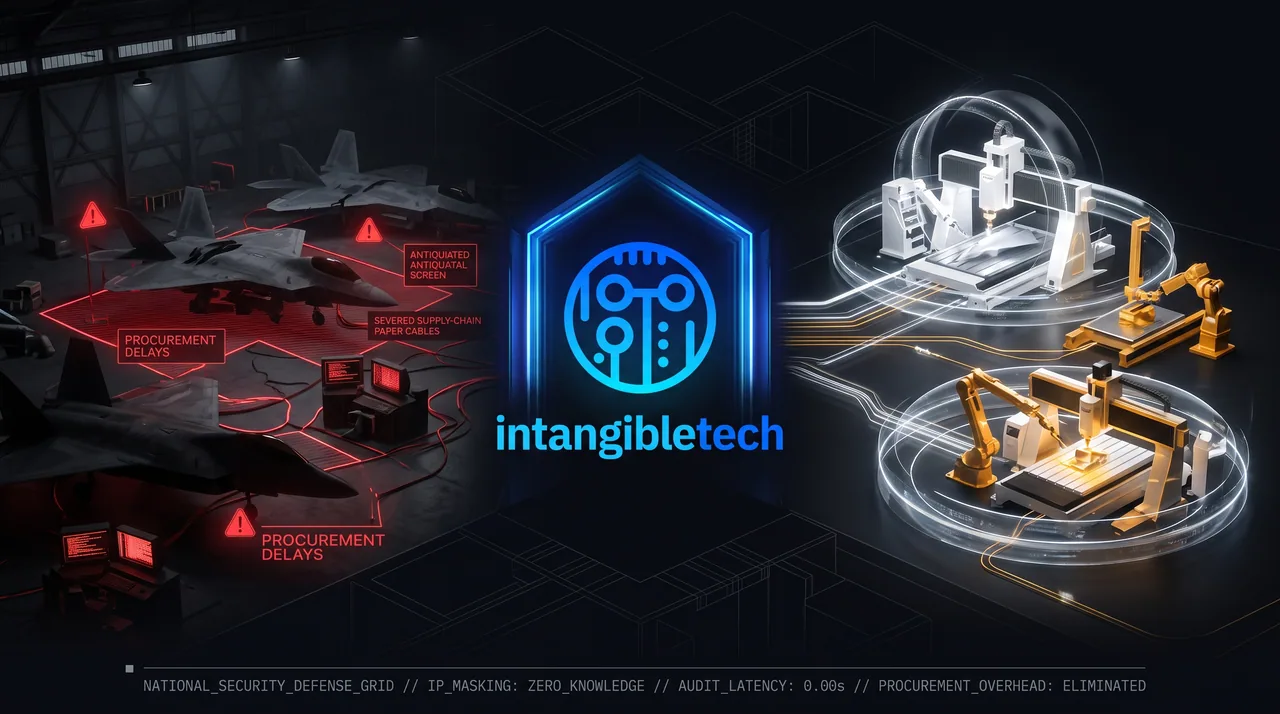
Consider the F-35 Lightning II program: the most technologically capable tactical aircraft ever engineered, and simultaneously the most damning indictment of modern defense procurement.
Conceived in the 1990s, the program is more than a decade behind its original fielding timelines, with total lifecycle cost estimates soaring past two trillion dollars. When an aircraft takes twenty-five years to move from initial requirement to full-rate production, the microprocessors and subsystem architectures specified at the start of the design cycle are obsolete before the aircraft ever lands on a carrier deck.
This is not the fault of our aerospace engineers or our military leadership. It is an architectural failure.
We are attempting to build fifth- and sixth-generation weapon systems using an administrative operating system designed for the Cold War: fragmented corporate databases, cost-plus contracting games, multi-year paper audits, and brittle perimeter-security models that treat every line of code and every machine tolerance as a classified silo.
Meanwhile, our primary strategic adversaries are not bound by these constraints.
The Adversary’s Advantage: The Autocratic Monolith
In Beijing, military modernization is executed through a doctrine of Military-Civil Fusion.
Because China operates under an authoritarian, state-directed command economy, its defense industrial base functions essentially as a single, consolidated enterprise resource planning (ERP) matrix. When the People’s Liberation Army initiates production of an advanced hypersonic glider, a naval surface combatant, or a stealth drone, the state directs the entire supply chain from a unified digital architecture.
Raw titanium extraction, state-owned semiconductor fabrication, machine-tool allocation, and shipyard assembly schedules are coordinated horizontally across a synchronized national data infrastructure.
China does not have to spend eighteen months negotiating data-rights firewalls between five competing commercial primes. Their state-backed facilities are not paralyzed by multi-year reconciliations between disconnected SAP instances, nor are their sub-tier suppliers drowning in thousands of pages of manual compliance forms just to stamp a single bracket.
The result is industrial cycle speed that should alarm every defense planner in the Pentagon:
- Chinese naval shipyards launch new surface combatants at three to four times the pace of American facilities.
- Advanced airframes move from wind-tunnel validation to active flight-line squadrons in a fraction of the time required by Western acquisition cycles.
- Their industrial base is physically unburdened by legacy 1980s database protocols, allowing them to iterate hardware at the speed of commercial electronics.
If the United States attempts to beat an autocratic monolith by copying its methods—through centralized government mandates and bureaucratic defense czars—we will fail. Central planning is fundamentally alien to our constitutional order and will only produce more paralysis.
The American advantage has always been decentralized innovation, commercial competition, and private initiative. But to unleash that advantage, we must give our market economy the modern digital rails it requires.
We do not need an authoritarian monolith. We need a decentralized, protocol-native defense operating system that delivers the speed and coordination of a consolidated network while preserving the sovereignty, competition, and resilience of a free society.
Lessons from the Frontlines: The GE Aerospace Initiative
This is not a theoretical exercise for me. I lived this battle inside the heart of the American defense industrial base.
Years ago, I had the privilege of leading and architecting the first enterprise blockchain initiative inside GE Aerospace.
Our mission was to address the core vulnerability of aerospace manufacturing: how to trace mission-critical engine components, guarantee provenance, verify strict metallurgical tolerances, and eliminate counterfeit parts across an extended, multi-tier defense supply chain without introducing security vulnerabilities.
Because we were dealing with advanced aerospace propulsion and sensitive military programs, our architecture was subjected to intense scrutiny. It went through extensive security evaluations by defense prime contractors, internal cybersecurity teams, and government clearance authorities.
We proved what the legacy establishment thought was impossible:
- The distributed architecture not only met top-secret security clearance baselines, it fundamentally improved upon existing defense attack vectors.
- By anchoring operational states to an append-only, cryptographic ledger, we eliminated the catastrophic vulnerability of single-point-of-failure corporate databases.
- A foreign adversary or malicious insider could no longer hack into a single central server and silently alter maintenance logs, material certifications, or CAD tolerances. The ledger made tampering mathematically impossible.
Yet, despite passing every technical test, proving superior security, and demonstrating millions of dollars in potential operational savings, the initiative was ultimately shelved.
Why?
It did not fail because of the technology. It stalled because of the suffocating institutional inertia of legacy enterprise beliefs.
The traditional defense contracting apparatus could not comprehend an architecture where data was verified cryptographically rather than certified by three separate consulting firms stamping paper binders. Enterprise risk officers, conditioned by thirty years of perimeter-defense thinking, were terrified of any system that did not rely on a centralized database behind a corporate firewall—even when we proved that those very databases were leaking IP and causing massive operational delays.
I walked away from that experience with an absolute conviction: our defense industrial base will not be saved by incremental software patches on legacy ERP systems.
It requires a fundamental upgrade to the underlying accounting and operational rails of the defense economy.
Zero-Knowledge Manufacturing: Protecting Classified IP at Machine Speed
The primary reason defense supply chains move slowly is the fear of intellectual property theft and classified intelligence leaks.
If an American aerospace prime designs an advanced radar-absorbent coating or a precision control actuator for a classified aircraft, it cannot simply email the CAD file and tolerance specifications to fifty small machine shops across the country. Foreign intelligence agencies routinely target Tier-3 and Tier-4 suppliers precisely because smaller machine shops lack the multi-million-dollar cybersecurity defenses of Lockheed Martin, Northrop Grumman, or General Dynamics.
To protect that information, defense acquisition relies on an excruciatingly slow process of facility clearances, physical courier transports, and air-gapped cleanrooms.
Our Layer-0 architecture resolves this security bottleneck through Zero-Knowledge Manufacturing:
1. The Machine-Level Zero-Knowledge Proof
In our architecture, the defense prime does not transmit unencrypted CAD blueprints or sensitive engineering tolerances to the supplier’s general IT network.
Instead, the engineering requirements are compiled into a mathematical constraint—a Zero-Knowledge Circuit. The supplier’s machine tool (a precision 5-axis mill or laser coordinate measuring machine) executes the fabrication inside an air-gapped cleanroom equipped with a Hardware Root of Trust (TPM 2.0 enclave).
When the part is machined, the inspection sensor evaluates the component. The enclave mathematically verifies that the physical component matches the classified specification to within sub-micron tolerances, and publishes a single, 32-byte cryptographic proof to the Layer-0 ledger.
2. Blinded Verification
The proof demonstrates beyond mathematical doubt that the part was cut to exact military specifications. Yet the proof contains:
- Zero geometric coordinates.
- Zero information about the component’s material composition.
- Zero clues regarding the aircraft or weapon system the component belongs to.
Even if a foreign adversary compromises the supplier’s corporate Wi-Fi or intercepts every byte moving across the network, they learn nothing. They see only a cryptographic confirmation that an anonymous component satisfied an undisclosed engineering equation.
We achieve total physical verification with zero operational leakage.
The Strategic Alliance Playbook: The Ukraine-Lockheed Precedent
This breakthrough becomes transformative when applied to international defense cooperation and rapid wartime mobilization.
Consider the ongoing strategic challenge in Ukraine. The United States and its allies need to supply Ukraine with thousands of precision-guided munitions—such as Patriot missile interceptors, artillery rockets, and advanced drone components—at a volume that exceeds the domestic manufacturing capacity of American factories.
The Pentagon faces a difficult strategic dilemma:
- If Lockheed Martin or Raytheon transfers complete technical data packages and proprietary manufacturing IP to overseas fabrication facilities in Eastern Europe, they risk having sensitive missile blueprints stolen, reverse-engineered, or intercepted by adversary intelligence services.
- But if we insist that every single missile interceptor be manufactured exclusively inside continental US facilities, our domestic production capacity falls years behind front-line battlefield consumption.
Our Layer-0 architecture solves this strategic problem completely:
Lockheed Martin / DoD (Sovereign IP Owner)
(Compiles Secret Guidance Tolerances into Zero-Knowledge Enclave Binary)
Allied Manufacturing Facility (Poland / Ukraine / NATO)
Secure Hardware Enclave executes tooling path on local 5-axis mill
Optical CMM scanner verifies tolerance without exposing raw CAD coordinates
Cryptographic Attestation Published to Layer-0 Ledger
Real-Time Proof of Physical Conformance (Sub-Micron Accuracy Verified)
100% Protection of Classified Patriot Rocket Motor & Guidance IP
Programmatic Settlement Clears: Lockheed Receives Automated IP Royalty
Under this model:
- IP Remains Pristine: Lockheed Martin loads its proprietary guidance fin and propulsion specifications into an encrypted enclave binary. The Ukrainian or Polish factory receives the binary, but their technicians and software administrators cannot extract or read the underlying engineering source files.
- Local Production at Scale: The allied facility stamps out rocket motors and guidance assemblies locally on its own industrial tooling, meeting exact sub-millimeter tolerances required for combat reliability.
- Automated, Risk-Free Licensing: The moment each rocket motor clears physical hardware inspection, the Layer-0 ledger atomically executes an automated settlement: the allied ministry of defense receives an attested interceptor, and Lockheed Martin’s balance sheet is credited an instant IP licensing royalty.
We can distribute the industrial production of our most advanced defense systems to trusted allies across the globe, scaling wartime manufacturing exponentially while providing absolute cryptographic protection for sovereign American intellectual property.
Dismantling the Defense Bloat Machine
Beyond technical security, the adoption of Layer-0 dismantles the economic disease that has crippled the Pentagon for half a century: the cost-plus procurement trap.
Under legacy defense acquisitions, major defense contractors are often incentivized to be inefficient. In a traditional cost-plus-award-fee contract, the government reimburses the contractor for all production expenses plus a guaranteed percentage of profit. The longer a project takes, the more engineering changes are processed, and the more administrative bureaucracy is hired, the larger the contractor’s gross revenue becomes.
This dynamic is reinforced by retrospective government audits. Because the Defense Contract Audit Agency (DCAA) must verify billions of dollars in historical expenses using manual paper trails, audits lag actual production by three to five years. By the time waste or accounting discrepancies are discovered, the money has been spent, the program is behind schedule, and Congress has no choice but to allocate more taxpayer funds to prevent the project from failing.
Layer-0 eliminates this dysfunction by shifting defense procurement from retrospective paper accounting to real-time, deterministic settlement:
- Ending the Three-Year Audit Lag: Every supply-chain milestone, material intake, and engineering handoff settles atomically via native financial opcodes. The audit is not an adversarial investigation executed five years later; the audit is completed at consensus and the exact second work is delivered.
- Loss-Mitigation and Defect Pricing: Defense contractors are no longer rewarded for building bloated systems that require endless repair cycles. By tying enterprise borrowing rates to the Impact Score Index (ISI), a defense contractor that systematically suppresses manufacturing defects and maintains high operational readiness across its fleets earns immediate balance-sheet credit, lowering its corporate cost of capital.
- Direct Alignment of Profit with Speed: Contractors earn their highest margins by delivering verified, defect-free hardware on accelerated schedules. The incentive structure of the defense economy inverts from administrative bloat to physical excellence.
The Strategic Mandate
The history of military conflict is unambiguous: tactics, bravery, and strategy matter, but the ultimate foundation of geopolitical deterrence is industrial capacity.
The United States did not win World War II merely because our generals were brilliant; we won because the American industrial machine produced an aircraft carrier every month, thousands of cargo ships, and tens of thousands of aircraft, overwhelming totalitarian adversaries through the relentless speed of democratic production.
Today, that industrial engine is throttled. It is choked not by a lack of American patriotism or engineering talent, but by obsolete information rails, fragile database silos, and administrative bureaucracy that consumes billions while delivering weapon systems decades behind schedule.
We cannot afford another F-35 cycle. We cannot afford to watch autocratic adversaries out-build our naval fleets and out-pace our missile production while our defense primes spend years reconciling invoices across incompatible enterprise software.
The technology to solve this crisis exists today:
- It has been tested and proven inside the highest security tiers of our premier aerospace enterprises.
- It respects the analog reality of existing machine shops while providing a clear bridge to automated silicon verification.
- It protects our most vital military secrets using unassailable mathematical proofs rather than bureaucratic promises.
It is time for the national security establishment to recognize that our data and accounting architecture is not a back-office administrative detail.
It is the strategic high ground.
If we have the courage to modernize the rails of the defense industrial base, we will unleash the full, compounding power of American innovation, restore our manufacturing primacy, and ensure that the Arsenal of Democracy remains the unshakeable shield of the free world for the next century.