Over the past five years, the global financial establishment witnessed one of the swiftest, most humiliating retreats in corporate history: the collapse of ESG.
Only a few years ago, the leaders of the world’s largest investment banks, institutional asset managers, and global consultancies proclaimed that Environmental, Social, and Governance (ESG) criteria would reshape global capitalism. Tens of trillions of dollars were poured into dedicated “ESG funds.” Corporate boards rushed to hire Chief Sustainability Officers, publish glossy two-hundred-page sustainability reports, and buy billions of dollars in paper carbon offsets.
Today, the term has become radioactive in the executive suite.
Wall Street banks have scrubbed the acronym from their fund prospectuses. Asset managers who once lectured corporate boards on carbon neutrality have quietly dissolved their climate coalitions. State treasurers and pension boards across America have withdrawn billions of dollars from Wall Street managers, citing a direct breach of fiduciary duty.
Why did an initiative that claimed to protect the future of the planet implode into public cynicism and political warfare?
Because conservatives, practical engineers, and clear-eyed fiduciaries were one hundred percent correct in their diagnosis:
Legacy ESG was never an environmental system. It was an ideological, self-enriching regulatory racket.
Under the legacy financial architecture, ESG operated as an arbitrary, unaccountable credit rating for corporate morality:
- The Ratings Game: Opaque rating agencies (MSCI, S&P, Sustainalytics) assigned subjective scores based on self-reported surveys. A global defense contractor manufacturing cluster munitions or a multinational tobacco company could achieve an elite ESG score simply by publishing an exhaustive diversity report and installing LED lighting in its corporate headquarters, while an innovative American energy company producing the baseload natural gas that keeps millions of families warm was downgraded and denied basic commercial banking.
- The Carbon Offset Shell Game: Multinational conglomerates spent billions purchasing “phantom carbon credits” derived from un-audited forest tracts in developing nations—claiming to be “net zero” on paper while continuously pumping toxic particulates into municipal air and flaring billions of cubic feet of methane at the wellhead.
- The Offshoring Lie: Legacy ESG did not eliminate pollution; it offshored it. Western corporations closed domestic manufacturing facilities and outsourced heavy fabrication to coal-fired plants in Asia, claiming a reduction in their domestic “Scope 1” carbon footprint while global emissions increased.
The result was an economic catastrophe: everyday retail investors saw their retirement funds underperform, energy security was compromised, and the real physical environment—our topsoil, our freshwater aquifers, our rivers, and our atmosphere—continued to deteriorate at an alarming pace.
Yet the alternative championed by status-quo traditionalists—ignoring ecological reality altogether, pretending that natural resources are infinite, and treating environmental destruction as a zero-cost externality—is equally bankrupt.
Today, the rapid expansion of artificial intelligence, high-performance computing, and electric infrastructure has triggered an unprecedented physical reckoning. Hyperscale data centers are consuming immense quantities of electricity and water, straining municipal grids and competing with local families for clean drinking water.
We cannot address climate change through ideological scolding, and we cannot ignore it through deliberate blindness.
The problem with the environment is an accounting problem.
Legacy finance has never possessed an instrument capable of measuring the physical world. It knows how to price paper debt, speculative equity, and fiat interest rates, but it treats the thermodynamic reality of the Earth as an invisible void.
Intangible Technologies replaces the broken theater of ESG with Thermodynamic Defect Accounting.
By replacing self-reported surveys with hardware roots of trust, tying borrowing costs directly to measured operational entropy, pricing the real-time grid impact of AI data centers, and converting the living biosphere into a verifiable balance-sheet asset, we transform earthly conservation from a moralistic corporate expense into the highest-margin, most durable investment alpha on the planet.
1. The Conservative Vindication: Why Fiduciary Duty Precludes Moral Scorecards
To build an environmental architecture that commands universal consensus, we must begin by honoring the core principle of capital management: The Fiduciary Standard.
For centuries, common law established an uncompromising duty for anyone managing another person’s wealth: The Prudent Investor Rule.
If a pension fund trustee, an investment manager, or a corporate director manages a retired union worker’s life savings, their sole legal and moral obligation is to maximize the safety, solvency, and risk-adjusted return of that capital.
The trustee has no legal right to use a teacher’s or a police officer’s retirement money to promote their own personal political philosophies, sponsor cultural campaigns, or starve critical domestic industries of capital.
Legacy ESG committed a profound violation of this covenant:
- It introduced Subjective Moral Posturing into capital allocation.
- It allowed non-elected, unaccountable rating agencies to penalize companies not because they were inefficient, poorly managed, or insolvent, but because their executive teams did not use the approved corporate terminology.
- It weaponized the banking system through administrative “debanking”—cutting off working capital lines to domestic oil and gas producers, agricultural cooperatives, and defense contractors.
Conservatives were right to reject this overreach.
When you replace objective financial returns with subjective social engineering, capital allocation becomes a weapon for political patronage. Companies focus on managing their public relations narratives rather than optimizing their physical operations, and the entire economy becomes brittle and politicized.
The Missing Piece: Physical Reality Is Not Politics
Where the traditionalist critique stops short, however, is failing to see that nature does not negotiate.
While an ideological ESG survey is political theater, the second law of thermodynamics is absolute law:
- If a chemical plant leaks toxic solvents into a regional watershed, that is not a progressive or conservative talking point; it is a physical contamination defect that destroys millions of dollars in real agricultural and municipal value down-river.
- If a manufacturer vents unburned methane or burns obsolete boilers that waste forty percent of their input energy as ambient heat, that is not a cultural issue; it is catastrophic thermodynamic inefficiency.
- If a hyperscale data center consumes four million gallons of potable municipal water a day in the middle of a desert, it is not an abstract externality; it is a direct operational risk that will trigger local legal injunctions, grid curtailments, and stranded balance-sheet capital.
The failure of legacy economics was not that it rejected woke politics; it was that it treated the physical destruction of the Earth as “free.”
The Intangible Architecture reconciles these two views into an unassailable synthesis:
We abolish the moral scorecard, and we replace it with the cold, un-bribable laws of thermodynamic physics.
2. The Thought Inversion: From Moral Virtue to Thermodynamic Entropy
To understand how the new economy governs the environment, corporate directors, hedge fund managers, and policymakers must execute a fundamental mental inversion:
Stop viewing environmental stewardship as an altruistic sacrifice that reduces corporate profits. Start viewing ecological conservation as the ultimate form of Operational Defect Suppression that directly expands enterprise capital efficiency.
In our monetary physics, an enterprise’s financial performance is inextricably bound to the physical reality of its operations through the Impact Score Index (ISI):
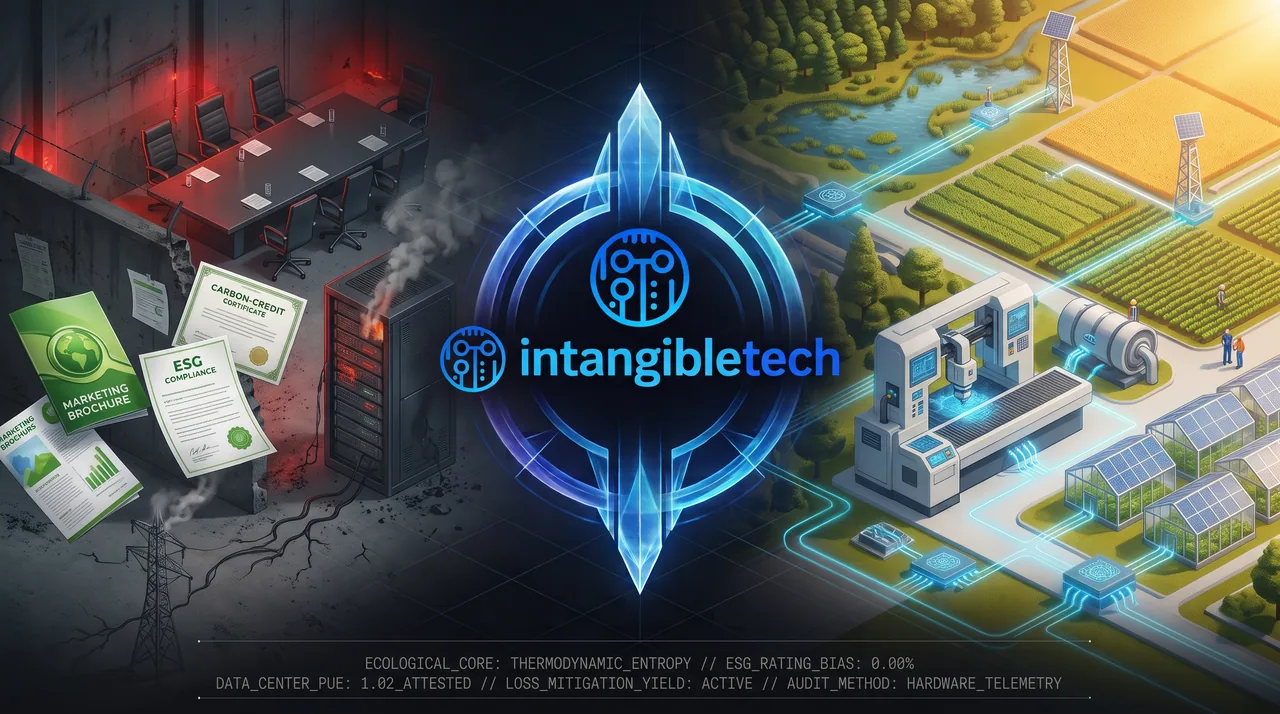
LEGACY ESG FRAMEWORK:
Audit Mechanism: Self-Reported Surveys, Marketing Brochures & Consultant Audits
Metric: Arbitrary Letter Grades (MSCI: AAA vs. CCC) based on corporate policies
Enforcement: Social Shaming, Index Exclusions & Arbitrary Debanking
Financial Reality: 100% Cost Center (High consulting overhead; zero physical alpha)
INTANGIBLE THERMODYNAMIC GOVERNANCE:
Audit Mechanism: Layer-0 Hardware Roots of Trust (Continuous Sensor Telemetry)
Metric: The Entropy Drag Coefficient ($ED) & Verified Physical Defect Rates
Enforcement: Protocol-Enforced Capital Spread Compression (Prime 1.5% vs. 12% Debt)
Financial Reality: Pure Operational Alpha (Eliminating physical waste slashes debt service)
Look at how the protocol measures environmental integrity:
1. The Death of the Self-Reported Survey
Under our architecture, an enterprise cannot hire a consulting firm to write a glossy sustainability report:
- The protocol does not read PDFs. It does not look at corporate marketing websites.
- Operations are bound to bare-metal silicon via Layer-0 Hardware Roots of Trust (TPM 2.0): physical flowmeters on exhaust stacks, automated water intake sensors, optical air-quality spectrometers, and satellite infrared telemetry.
- The physical inputs and outputs of a factory, an energy platform, or a corporate campus are signed cryptographically to the ledger in real time.
2. The Entropy Drag Coefficient (ED)
The protocol evaluates physical performance through an objective engineering invariant: The Entropy Drag Coefficient:
- Did this manufacturing plant capture its waste energy, or did it vent usable calories into the sky?
- Did this refinery recycle its processing water in a closed loop, or did it discharge toxic effluent into the public aquifer?
- Did this logistics fleet maintain optimal engine combustion ratios, or did it waste fuel through friction and poor maintenance?
This is not a subjective moral judgment. It is an objective, mathematical calculation of thermodynamic waste.
3. The Balance-Sheet Spread Arbitrage
Here is where the architecture becomes an unstoppable financial engine:
In our operating system, an enterprise’s borrowing cost on its multi-million-dollar capital credit facilities is directly governed by its Impact Score Index (ISI):
- A company that operates with high thermodynamic discipline—minimizing physical waste, recycling industrial water, and capturing thermal energy—achieves an elite, institutional-tier ISI.
- That top-tier score compresses its corporate borrowing costs from 8.0% down to 1.5%.
- On a five-hundred-million-dollar industrial facility, cutting financing costs by six and a half percentage points saves thirty-two million five hundred thousand dollars in cash debt service every single year.
The Chief Executive Officer and Chief Financial Officer do not adopt clean engineering practices to look virtuous at a climate conference.
They do it because running a clean, low-defect, energy-efficient engineering operation is the only way to unlock prime capital.
Waste is penalized by the cold math of the balance sheet; thermodynamic excellence is rewarded with pure institutional alpha.
3. The Data Center Reckoning: Taming the Compute Hydra
There is no domain where this architectural transformation is more urgently needed than in the modern race for Artificial Intelligence and Hyperscale Data Centers.
Consider the physical reality of the AI revolution:
- By the late 2020s, hyperscale data centers powering large language models and autonomous compute clusters are projected to consume more electricity than entire industrialized nations.
- In Northern Virginia, Texas, and across the American Midwest, tech conglomerates are building multi-gigawatt server campuses that threaten to overwhelm local electrical grids, forcing utilities to delay the retirement of ancient coal plants and driving up electricity rates for surrounding working-class families.
- Cooling these supercomputers requires millions of gallons of potable water daily, often drawn from freshwater aquifers in drought-prone regions.
Under legacy economics, Big Tech manages this crisis through accounting sleight-of-hand:
- A hyperscaler builds a massive data center next to a coal-fired power plant.
- It buys a bundle of “Renewable Energy Certificates” (RECs) from a wind farm three states away.
- It issues a press release declaring the facility “100% Green Powered,” while its physical servers consume coal-fired kilowatt-hours and drink municipal drinking water dry.
The Intangible Architecture ends this deception forever.
How the Protocol Governs High-Performance Compute
1. Real-Time Grid-Stress Telemetry
Under our Layer-0 consensus rails, a data center cannot hide behind paper certificates purchased hundreds of miles away:
- The facility’s electrical intake is attested directly at the substation through hardware roots of trust.
- If a data center draws power from a regional grid during peak hours—competing with homes and hospitals and forcing the utility to fire up high-emission peaker plants—the protocol detects the localized thermodynamic strain.
- The transaction costs for clearing that facility’s commercial workloads surge dynamically through a protocol-native Grid Friction Surcharge.
- Hyperscalers are financially compelled to invest in dedicated, on-site clean baseload energy: building private geothermal wells, advanced modular reactors, or industrial battery microgrids that isolate their compute load from the civilian population.
2. Water Conservation at Consensus
If an enterprise cools its servers by evaporating millions of gallons of treated municipal drinking water into the desert air, that water consumption is logged as a severe Hydrological Entropy Defect.
The penalty on its Impact Score Index spikes its financing costs across its global server fleets.
Conversely, if the enterprise invests in closed-loop liquid immersion cooling or air-cooled closed-cycle heat exchangers that consume zero water, its ISI climbs to the top decile.
3. Rewarding the Thermal Symbiosis
What is computer server exhaust? It is low-grade thermal heat (typically 40°C to 60°C).
In legacy facilities, that heat is vented uselessly into the atmosphere as thermal pollution.
In our architecture, waste heat is valued as physical work:
- A data center operator that routes its server exhaust cooling loops directly into an adjacent municipal district heating system, an industrial vertical farming complex, or a regional pharmaceutical synthesis lab is recognized as suppressing thermodynamic defects.
- The protocol quantizes that captured thermal energy as an active Co-Generation Yield.
- The data center earns non-dilutive protocol yield for heating its community, transforming compute from a parasitic drain into an indispensable civic utility.
4. Ecology as an Appreciating Asset: The Loss-Mitigation Yield
For two centuries, environmental economists have lamented the “Tragedy of the Commons”:
If a farmer cuts down an ancient virgin forest, sells the timber, and turns the land into a parking lot, legacy GDP records that destruction as economic “growth.”
If that same landowner protects the forest, maintains the living watershed, and preserves the topsoil that prevents downstream flooding, legacy accounting records their economic contribution as zero.
The old system financially rewards the destruction of nature and punishes its preservation.
The Intangible Architecture permanently inverts this logic: The Living Biosphere is integrated into the Dependency Directed Acyclic Graph (DAG) as an Appreciating Capital Asset.
The Mechanics of Living Capital
1. Quantizing the Averted Defect
A pristine mangrove swamp along the Gulf Coast or an ancient wetland in the Midwest is not an empty swamp; it is an irreplaceable, high-capacity piece of biological infrastructure:
- It absorbs storm surges, buffers tidal energy, filters agricultural runoff, and stabilizes groundwater tables.
- If that wetland is destroyed, the surrounding municipality will inevitably suffer catastrophic infrastructure damage during the next major storm, requiring fifty million dollars in emergency levee repairs and disaster relief.
On our ledger, that wetland is registered as an authenticated Ecological Capability Node:
- The protocol’s actuarial engine evaluates the statistical loss that is prevented across the twenty-year horizon by the physical presence of that living sink.
- That verified, prevented loss is recognized as Loss-Mitigation Yield.
2. Paying Landowners Through Opcode 0x08
Through Opcode 0x08 (Atomic Upstream Attribution), a portion of the municipal infrastructure savings and regional property protection partitions streams directly into the sovereign digital vault of the landowner, farmer, or tribal nation stewarding that ecosystem.
A rancher in Montana or a family farmer in Iowa does not have to rely on meager government subsidies or sell their land to real estate developers to survive:
- By adopting regenerative grazing practices that rebuild four inches of fertile topsoil, capturing thousands of tons of biological carbon and restoring local water retention, the farmer’s land registers as a top-tier Soil Integrity Node.
- The farmer receives a continuous, predictable, and non-dilutive Ecological Stewardship Yield deposited directly into their sovereign wallet every month.
Conservation ceases to be a luxury dependent on philanthropic charity or government handouts.
Preserving the living Earth becomes the most profitable, secure, and honored real-estate investment in the world.
5. Proactive Climate Solutions Without Poverty or Degrowth
To build an environmental movement that unites humanity rather than dividing it, we must confront the dangerous intellectual trap of the modern environmental fringe: The Degrowth Fallacy.
For decades, radical climate activists have preached a bleak, anti-human dogma: claiming that the only way to save the planet is for humanity to become poorer—to use less energy, travel less, eat less, de-industrialize our nations, and accept a lower standard of living.
We reject that premise with every fiber of our being:
Degrowth is an ideological dead end that leads straight to poverty, civil unrest, and authoritarianism.
Human beings will not willingly surrender reliable heating, medical care, global travel, and economic opportunity, nor should they. Furthermore, impoverished societies do not protect the environment; when an economy collapses, people are forced to cut down their forests for firewood and dump raw waste into their rivers just to survive.
True ecological preservation requires Energy Abundance and Engineering Mastery.
The Intangible Architecture demonstrates that we can solve the environmental crisis while expanding global prosperity, through three concrete, pro-human mechanisms:
- THE ERADICATION OF USURY FINANCING FOR CLEAN INFRASTRUCTURE
• Legacy Barrier: A modern geothermal plant or advanced modular reactor requires billions
in upfront capital. At legacy 9% commercial debt rates, clean energy is unaffordable.
• Protocol Solution: ACCOUNT TYPE B Senior Productive Pools provide capital at 1.5% prime rates,
slashing the cost of building long-dated, zero-emission baseload power by over 50%.
- THE THERMODYNAMIC ELIMINATION OF INDUSTRIAL FLARING
• Legacy Reality: Energy operators flare natural gas because connecting a pipeline
costs capital that legacy debt markets penalize.
• Protocol Solution: The Entropy Drag Penalty makes venting or flaring gas a balance-sheet
catastrophe, while on-site modular compute and micro-refineries turn waste gas into yield.
- THE RESTORATION OF PHYSICAL DURABILITY OVER PLANNED OBSOLESCENCE
• Legacy Reality: Consumer goods corporations make cheap, disposable plastic junk because
selling products that break in eighteen months drives recurring quarterly GDP revenue.
• Protocol Solution: Kinetic Systemic Throughput (KST) rewards physical longevity;
enterprises capture higher ISI scores by manufacturing durable, repairable artifacts.
By removing the cancer of compounding usury and rewarding physical durability, we transition society from an extractive, disposable junk economy into a high-order, durable, and low-entropy civilization.
We do not achieve a green future by retreating into the caves of the pre-industrial past.
We achieve it by building the most advanced, efficient, and beautifully engineered clean infrastructure in human history.
The Custodians of the Garden
For two hundred years, industrial civilization lived under the illusion of a false choice.
We were told we had to choose between two unacceptable realities:
- Either we surrender our prosperity to an extractive financial machine that strips the mountains, poisons the waters, chokes the air, and calls the destruction “growth”—
- Or we surrender our freedom to a bureaucratic regulatory apparatus that issues paper scorecards, strangles enterprise with red tape, and demands that our children accept a future of scarcity and decline.
It was a choice designed by minds that could measure only paper money and bureaucratic power.
The Intangible Architecture breaks that false dichotomy forever.
By anchoring our economic operating system to the physical reality of the universe, we restore the sacred covenant between human industry and the living Earth:
- Where the corporate executive is rewarded not for public-relations spin, but for real-world engineering precision.
- Where high-performance compute expands human knowledge without draining the resources of our communities.
- Where the farmer, the rancher, and the forest steward are honored as the primary creators of civilizational wealth.
- And where the human being stands upon the Earth not as a parasitic conqueror, nor as a guilty trespasser, but as what we were always destined to be: the wise, noble, and faithful custodian of a magnificent and living world.
The theater of ESG is over.
The era of thermodynamic truth has arrived.