
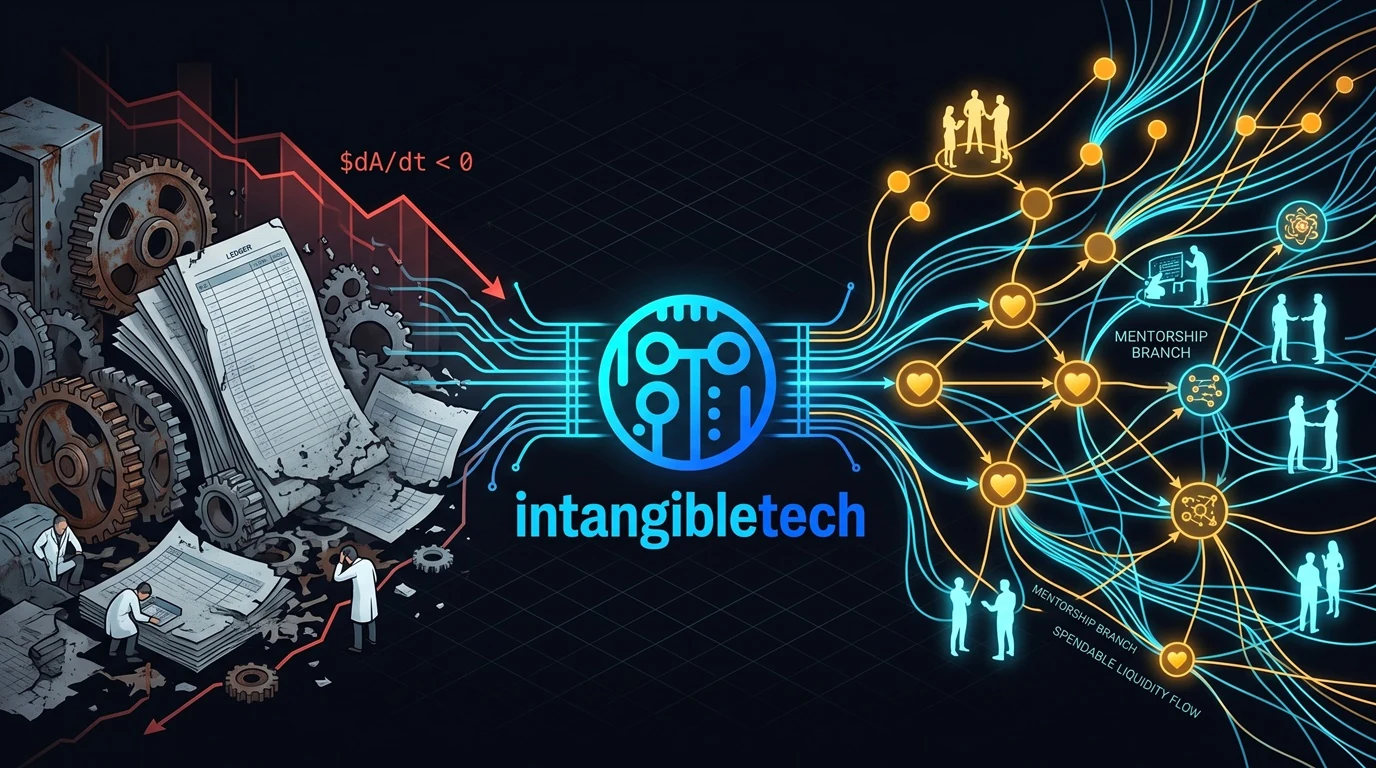
If you look at the balance sheet of an average S&P 500 company in 1975, roughly 80% of its recorded value was tangible: factories, real estate, physical inventory, warehouses, and machine tools.
If you examine an S&P 500 company today, that ratio has completely inverted. Over 90% of total enterprise value is intangible. It lives in software codebases, distributed data platform architectures, proprietary algorithms, brand trust, institutional workflows, and the collective diagnostic intuition of engineering and operational talent.
Now look at how our financial system accounts for that reality.
Under 530-year-old Generally Accepted Accounting Principles (GAAP), an enterprise can buy an industrial diesel generator for $2 million, place it on the balance sheet as a capitalized asset, and use it as collateral to borrow cheap working capital from commercial banks. That generator is treated as wealth, even while it slowly rusts and depreciates toward scrap metal.
Yet, if that same enterprise spends $2 million paying a world-class team of data architects and systems engineers to refactor a mission-critical pipeline—eliminating multi-million-dollar data mismatches and plugging silent cloud compute leaks—the corporate ledger treats that expenditure as deadweight loss.
GAAP rules decree that human ingenuity, systems architecture, and internal software engineering cannot sit on the corporate balance sheet as capital. Instead, it is written off as an Operating Expense (OpEx). At the stroke of midnight on December 31st, that value is zeroed out on the income statement as if it were an electric utility bill or a box of paper clips.
The only time legacy accounting acknowledges intangibles as assets is after an acquisition, when an acquiring company pays an inflated premium over the book value of a target firm and dumps the unallocated difference into a balance-sheet graveyard called “Goodwill.” Goodwill sits static, un-collateralizable, and un-spendable until corporate controllers inevitably announce an impairment write-down five years later.
We have constructed a $100 trillion global economy that runs almost entirely on intangible value, managed by an accounting architecture that is fundamentally blind to it.
At Intangible Technologies, we set out to solve the foundational challenge corporate finance has spent decades avoiding: How do we convert intangible human craft into verifiable, spendable, appreciating working capital—without inflating unbacked currency or diluting commercial balance sheets?
1. Redefining Capital: From Dead Cargo (1494) to Kinetic Coordination
To fix this, we have to start at first principles: What is capital?
In the legacy 1494 Venetian paradigm, capital was defined as a stock of physical property. It was a pile of gold coins, a warehouse of spices, or a fleet of wooden merchant ships. Because physical property is bounded by physical thermodynamics, physical capital suffers from entropy. If you leave a tractor, a warehouse, or a server rack untouched for a decade, it does not become more valuable; it rots, rusts, and decays.
In the Intangible Architecture, we discard the static view of wealth.
Capital is not a pile of inert matter; capital is the verified, living capacity to coordinate energy, physical throughput, and human ingenuity toward real-world utility.
When an enterprise possesses clean database schemas, disciplined product sequencing, and seasoned toolmakers, it can coordinate physical materials and compute cycles with near-zero operational friction. That capacity is the true wealth engine of civilization.
The breakthrough of our operating system is acknowledging a basic thermodynamic reality: while physical hardware depreciates under runtime wear, intangible capital has the unique physical property of compounding.
- A machine tool wears out the more parts it cuts.
- An elegant software architecture becomes more robust and more valuable the more downstream applications rely on it.
- A master engineer’s diagnostic intuition becomes sharper with every edge-case failure they resolve.
- A senior craftsman’s institutional knowledge multiplies when it is passed down to three young apprentices.
The legacy system treats the things that decay as assets, and the things that compound as costs (the core dilemma we trace in Agile Didn’t Fail. Our Accounting Did). We inverted that relationship.
2. The Core Mechanics: HOW Does an Intangible Actually Appreciate?
It is easy to make a poetic corporate claim that “our people are our greatest asset”. Corporate annual reports have printed that platitude for fifty years while treating payroll as the first expense to slash during a quarterly downturn.
On an engineering level, how do you make an intangible asset mathematically appreciate on an auditable ledger without relying on subjective HR reviews or speculative token hype?
We solved this through three coupled protocol mechanisms.
Mechanism 1: Longitudinal Dependency Trees (Shapley Attribution)
When an architect refactors an enterprise data ingestion schema, or an educator teaches foundational mathematics, that contribution is signed by their Sovereign Digital Identity (SID) as a root node on a Cryptographic Dependency Directed Acyclic Graph (DAG).
When downstream consumer checkouts, B2B manufacturing shipments, or software subscriptions clear years later, the protocol does not credit 100% of the value to whoever stands closest to the cash register.
The telemetry engine runs a causal variance decomposition (a Shapley-weighted allocation) across the dependency tree.
A mathematical fraction of the transaction’s verified velocity is attributed back to the foundational architecture that made the performance possible. Because that foundational node now collects attribution weight across dozens of expanding downstream projects, its Intangible Capital Score (IN) compounds over time (protected against sybil manipulation through the game-theoretic bounds explored in The Anti-Fragile Ledger). It appreciates because its downstream operational footprint expands.
Mechanism 2: Loss-Mitigation as Direct Capital Accumulation
In legacy accounting, if an undisciplined team spends $5 million building a bloated, fragile feature that customers hate, GAAP capitalizes it as an “Intangible Software Asset” and places $5 million on the balance sheet. If a disciplined architect executes deep discovery, kills the bad idea for $50,000, and refactors a broken database pipeline instead—preventing a $10 million silent data leak—they have created zero book value under GAAP.
Under our ledger, we quantize Loss-Mitigation Yield.
When an architectural decision suppresses operational defect rates (<0)—reducing cloud compute burns, eliminating API timeouts, or stopping manufacturing line shutdowns—the system measures the delta against actuarial baseline failure models.
Preventing systemic drag preserves the enterprise’s Operating Spread (). The ledger translates that preserved solvency directly into balance-sheet equity. The builder who engineers resilience sees their on-chain provenance score appreciate, because the protocol treats systemic de-risking as a capital injection.
Mechanism 3: The Mentorship Multiplier (The Anti-Extinction Metric)
In today’s corporate world, senior employees avoid mentoring juniors because every hour spent explaining architecture to an apprentice is an hour deducted from their own billable output or sprint tickets.
We altered the game theory. When a master engineer, nurse, or precision machinist links their sovereign ID to an apprentice node via an on-chain key-value pointer (KNOWLEDGE_PARENT), the junior’s verified output cascades a fractional, lifelong attribution stream back to the mentor.
Training your successor ceases to be an uncompensated corporate chore; it becomes an active investment that causes your personal Intangible Capital score to appreciate. Mentorship becomes one of the highest-yielding asset classes in the economy.
3. The Mechanics of the Paycheck: Disentangling AMM Velocity from Company Revenue
Whenever this architecture is presented to enterprise leadership, a justified question arises:
“If an intangible asset streams yield, does that mean my company’s direct customer revenue is being siphoned away to pay ex-employees who wrote code ten years ago? If my company sells a product for $100, do I get my $100?”
The answer is unambiguous: Your company keeps its customer revenue. The protocol does not dilute your commercial cash flows to pay ghosts from your past.
To understand why, we must examine the difference between Company Revenue and Protocol AMM Velocity.
The $100 Transaction Walkthrough
Consider what happens when a customer spends $100 on legacy payment rails versus the Intangible Architecture:
- Legacy Credit Card Rails (Today): The customer pays $100. Intermediary merchant acquiring banks, card networks (Visa/Mastercard), and payment gateways extract a fixed 0.30+2.9%interchangetoll(3.20). The company receives only $96.80, and that money is held in a clearing float for two to three business days. That $3.20 is pure extractive rent paid to 1970s mainframe plumbing.
- The Intangible Protocol Rails: The customer pays $100. The transaction clears across native Layer-0 Automated Market Maker (AMM) pools in sub-second blocks (leveraging the physics of real-time velocity to retire debt and settle value instantly).
-
-
The Company Operating Treasury receives the gross commercial proceeds (e.g., $99.70) (before statutory point-of-settlement sales tax splits). The company manufactured the product, took the commercial risk, and owns the sales revenue.
-
The Protocol captures only a microscopic liquidity turnover fee ($0.30).
-
Where Does the Yield Come From?
The yield that rewards intangible capital is funded entirely by kinetic turnover volume moving through protocol AMM liquidity reserves—NOT by confiscating company margins.
This bifurcates into two distinct operating models:
Model A: The Internal Enterprise Contributor (The Employment Model)
If an engineer or designer works as a salaried employee for an enterprise, their base output belongs to the company.
- When the company sells a product, an ex-employee who resigned five years ago does not siphon the company’s $99.70 sales proceeds.
- The company keeps its unencumbered revenue to maintain its operations and pay its active staff.
- The employee’s return for superior craft is realized through portable provenance, career seniority, and Enterprise Spread Arbitrage (detailed in Section 4).
Model B: Independent, Modular Intangibles (The Protocol Licensing Model)
Suppose an independent research institute, open-source consortium, or specialized engineering guild develops a standalone algorithm—such as an optimized logistics routing engine, a computer-vision inspection tool, or an educational STEM module.
- They register that tool on-chain with its own dedicated AMM reserve pool.
- When external enterprises voluntarily route transactions across that module, the continuous commercial throughput generates active velocity fees.
- The protocol routes that fractional velocity yield directly into the creators’ sovereign wallets. The cash comes from active market utilization of an external utility, settled atomically without billing clerks or collection agencies.
4. Base Wages Are Still OpEx (Humans Need Guaranteed Cash)
Let us dispense with tech-utopian fantasies: Intangible asset yields do not replace base living wages.
You cannot expect a software engineer, an aerospace machinist, a teacher, or a bedside nurse to pay their monthly mortgage and feed their children on variable, fluctuating transaction royalties. Human biological life requires certainty.
In the Intangible Architecture, base compensation remains a fundamental, guaranteed Operating Expense (OpEx):
VECTOR 1: PREDICTABLE BASE WAGE (Guaranteed Operating Expense)
- Negotiated hourly wage or annual salary
- Funded directly from company’s primary operating liquidity (OpEx)
- Streams into wallet continuously / daily as verified work is logged
- Completely insulated from market volatility
VECTOR 2: ACCRUING INTANGIBLE CAPITAL (Compounding Balance Sheet Asset)
- Portable provenance score bound to personal Sovereign Digital ID
- Expands personal credit capacity at consensus (0% usury)
- Unlocks massive salary premiums via Enterprise Spread Arbitrage
- Streams lifelong mentorship attribution dividends
The upgrade is not eliminating salaries; it is upgrading their delivery and removing intermediary float. Instead of waiting fourteen days for a payroll processing conglomerate to batch-process a paper direct deposit—earning interest on your money while you pay overdraft fees—earned base wages stream into the worker’s wallet continuously or daily as verified shifts are completed.
Base pay protects the human living floor. Intangible capital provides the compounding upside.
5. Immediate Spending Power: How Intangibles Become Liquid Dollars Today
A crucial question remains: “If an employee doesn’t skim corporate product invoices, and base wages cover daily living, how does an intangible asset have immediate, spendable purchasing power?”
An intangible asset converts into liquid purchasing power through two primary financial engines.
Engine 1: Algorithmic Credit Expansion (Credit-as-an-Asset)
In legacy banking, credit requires pledging dead physical matter: Do you own a house? Do you have commercial real estate? Do you have factory tooling we can auction off if you fail?
If you are a brilliant 28-year-old systems architect, a master toolmaker, or a dedicated educator with zero inherited real estate, commercial banks treat you as un-creditworthy, forcing you into 24% APR compounding credit cards.
On our ledger, your verified Intangible Capital Score (IN) serves as algorithmic collateral at consensus:
- Deterministic Credit Ceilings: Your verified history of defect suppression, systems uptime, and validated peer contributions algorithmically expands your personal or enterprise credit limit.
- Immediate Spendable Cash: You can draw down liquid, primary stablecoins directly against that facility to buy equipment, lease workspace, or finance an initiative.
- Velocity-Driven Amortization: You are not crushed by compounding usury. As you continue to work and circulate commercial velocity across the network, protocol turnover micro-fees systematically burn down your debt principal automatically (the kinetic engine that powers Account Type B’s real yield):
Your proven intangible capacity acts as the balance-sheet collateral that unlocks liquid spending power today, while active economic velocity amortizes the principal down to zero.
Engine 2: Enterprise Spread Arbitrage (The Day-One Talent Pricing Inversion)
What happens when a senior engineer, data architect, or operations director leaves Company A and moves to Company B?
- Company A stops paying them immediately. Base salary ends on Day Zero. Company A does not owe them a pension on future invoice sales.
- Company B pays their salary on Day One.
Why would Company B happily pay this person $500,000 or $700,000 in guaranteed base cash? Not out of corporate generosity, but because of Spread Arbitrage.
Look at the corporate balance sheet: By onboarding that master architect, Company B’s borrowing rate across its $50 million credit facility drops from 9.5% to 1.5%.
The CFO just freed up $4,000,000 in unencumbered cash every single year.
That $4 million in annual interest savings is real money. A portion flows into new hardware tooling, a portion expands company reserves, and a substantial portion goes directly into funding the architect’s premium base salary on Day One.
Company B does not pay the architect top-tier cash out of executive kindness; they pay it because the architect’s verified intangible score is an immediate balance-sheet optimization that saves the enterprise millions.
Human craft ceases to be a cost center to be minimized, and becomes the most valuable capital asset a company can acquire—a shift that fundamentally rebuilds work, family, and community from the ground up.
Restoring Meritocracy to Free Enterprise
For over a century, corporate financialization masqueraded as capitalism while systematically gutting its foundational principles.
It claimed to champion private property, yet confiscated the lifetime craft and knowledge of workers as uncompensated corporate property. It claimed to reward merit, yet incentivized CEOs to fire senior engineering teams, cut apprentice training, and let factories decay simply to juice quarterly Earnings Per Share for stock buybacks. It constructed a distorted financial playground where manipulating paper liabilities yielded fortunes, while physical toolmaking, biological caregiving, and classroom education were driven into financial exhaustion.
Intangible Technologies restores true market meritocracy:
- The manufacturer that builds 25-year durable machinery captures the lowest cost of capital.
- The enterprise that mentors the next generation unlocks the deepest institutional liquidity.
- The company protects 100% of its hard-earned sales revenues.
- The worker retains an unassailable, guaranteed base living wage.
- And the master builder, the dedicated teacher, and the foundational architect finally receive the compounding, spendable capital their craft has generated all along.
For five hundred years, civilization has treated decaying physical matter as its primary store of wealth.
It is time our financial operating system learned to value the living.