
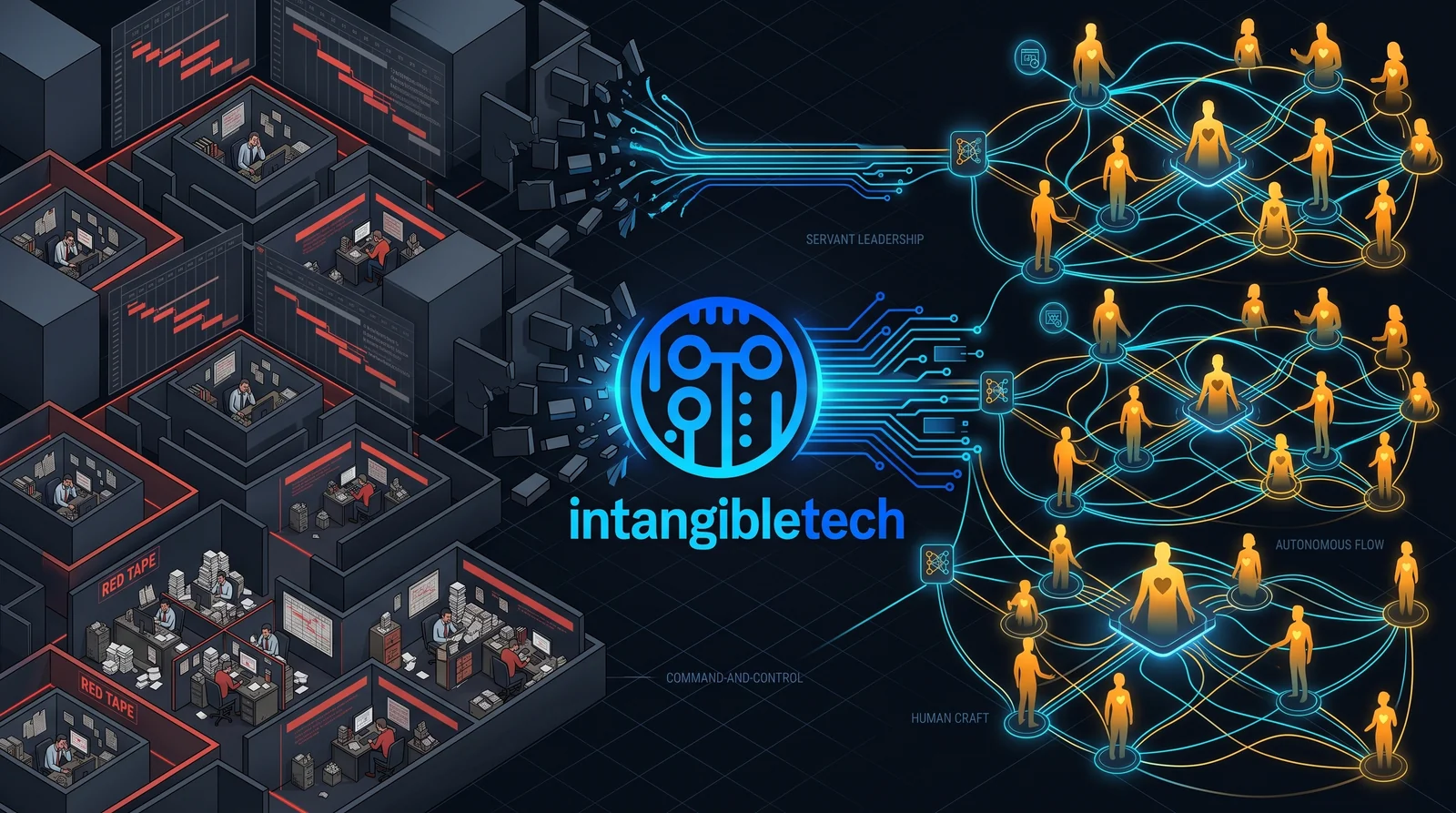
Throughout my career, I have been on the front lines of Digital Transformation inside some of the largest enterprises in the world. I’ve had the privilege of helping usher in breakthrough products and working shoulder-to-shoulder with extraordinarily gifted engineers, operators, and architects.
And in that process, I repeatedly burned myself out.
For a long time, I blamed myself. I thought I just needed more emotional resilience, better boundary setting, or sharper executive diplomacy. But when you look closely at the battlefield of enterprise transformation, you realize this isn’t an isolated personal failure. Across every major industry, the most dedicated, forward-thinking change agents, the ones who genuinely care about the mission and the people doing the work, are hitting a brick wall and walking away exhausted.
I traced that burnout back to a single question: How does an organization value the humans who make progress possible?
The tech world loves to debate whether “Agile is dead.” But Agile didn’t fail. Agile was crushed by an archaic corporate accounting architecture that was never engineered to understand human craft.
The Illusion of Servant Leadership
Modern business education is built on the theology of control. From the first semester of an MBA program, management is framed as asserting dominion over people and processes to extract predictable, quarterly yields. Good management, in the traditional sense, means holding the reins, protecting your headcount, and policing your department’s perimeter.
Agile was conceived as the radical antithesis to that mindset.
True agility is about yielding control to those doing the work. It fundamentally inverts the corporate hierarchy: instead of executive suites issuing prescriptive commands about what must be done and how it must be built, leadership becomes an act of service. You trust your teams to look at reality, experiment, establish their own cadence, and dictate the technical execution. The leader’s role shifts from a taskmaster to a facilitator whose primary job is removing organizational friction.
That transition is already excruciatingly difficult on its own. Yielding control goes against every reflex of traditional corporate culture. It requires enormous emotional intelligence, constant active listening, and the humility to let the people closest to the problem steer the solution. Being an authentic servant leader is a demanding, full-time emotional commitment.
Where it becomes an engine for burnout is when an organization attempts an “Agile transformation” without genuine executive buy-in.
When middle leaders yield control to their teams, but executive leadership continues to demand 1980s top-down command-and-control, the change agent is caught in the gears. You are forced to become a human shock absorber. You are working overtime trying to protect your team’s autonomy while simultaneously absorbing the pressure of top-down mandates that lack the authority to flex. You are trapped in an exhausting paradox: constantly forced to choose between going against your team’s best judgment or defying the status quo of executive demands.
“You’re Trying to Steal My Job”
In one of the most pronounced instances of burnout in my career, I was leading a team at a major enterprise trying to resolve chronic, cross-functional problems that were suffocating operational momentum.
I found myself in a confrontation with a senior manager who had built their entire career through traditional Waterfall project management. In a heated meeting, this person looked at me and accused me of trying to steal their job.
I was stunned. I wasn’t trying to expand my empire or take credit for their team’s deliverables; I was trying to facilitate my team’s desire to work across arbitrary domain boundaries to fix broken data pipelines that were impacting everyone.
This leader felt threatened because the team was attempting to dictate what needed to be solved based on operational reality, rather than waiting for management to hand down a project charter. To this manager, protecting their silo was more important than fixing the organization’s most prevalent problems. If a critical problem spanned across departments, it was viewed as a jurisdictional boundary dispute rather than an opportunity for collective progress.
This dynamic didn’t just demoralize the team; it destroyed our ability to use capital efficiently.
Imagine coming to work every single day, raising legitimate, verified architectural and operational flaws, bringing solutions that save money, and having management tell you: “That’s not your problem. Stay in your project lane.”
That is not just bureaucratic inertia. It is an environment that actively punishes collaborative leadership and pits peers against each other in zero-sum fights over territorial ownership.
The Root Cause: Why Agile Breaks Against the Balance Sheet
For years, I viewed this purely as a cultural dysfunction. But as I moved deeper into systems architecture, auditing enterprise ERP mismatches at GE and managing supply-chain data breakdowns across partner ecosystems. I realized the true villain was hiding in plain sight: The accounting ledger.
Why do managers hoard projects and defend silos? Because under 500-year-old Generally Accepted Accounting Principles (GAAP), organizations fund static “Projects,” not “Problems.”
In legacy enterprise finance, budgets are locked twelve to eighteen months in advance as monolithic Capital Expenditures (CapEx). A manager’s career prestige, salary, and headcount are tied to the size of the project budget they control.
If a bad product manager spends $5 million building a bloated, fragile feature that fails to deliver value, GAAP capitalizes that software as an “Intangible Asset” and places $5 million of value on the corporate balance sheet.
Conversely, when a servant leader practices true agile discernment:
- Pruning: Killing an ill-conceived feature before it burns engineering runway.
- Sequencing: Cleaning up messy data plumbing before building a flashy UI.
- Collaboration: Reaching across the aisle to help another department resolve an unowned bottleneck.
That work is lumped into uncapitalized operational overhead (OpEx). It is treated by corporate finance as a cost center to be minimized.
Agile failed inside legacy enterprises because you cannot run an empathetic, collaborative, servant-led human workflow on top of an accounting system designed by 15th-century Venetian merchants to tally dead cargo on wooden ships (a systemic breakdown we mathematically reconstruct in The Geometry of Human Value).
The ledger rewards the empire builder who ships capitalized waste, and starves the servant leader who clears the road.
Shifting from Projects to Problems
To fix this, we have to change what organizations own and reward.
Healthy leadership is not about managing a static “project” behind a walled perimeter. It is about aligning human capability against real-world outcomes. When you shift an organization’s ownership model from static project Charters to dynamic Problem Domains, the silos begin to dissolve:
- Overlap Ceases to Be a Threat: When leaders are evaluated on whether a systemic problem is solved, overlapping domains are no longer viewed as turf theft. Leaders are incentivized to pool engineering and operational talent because shared victories expand organizational throughput.
- Executive Leadership as Facilitators: Senior executives are freed from playing politics with 18-month forecasts. They enter a real-time feedback loop with the front lines, deploying capital dynamically to wherever systemic friction is highest.
- Quantizing Human Craft: Positive leadership must be recognized for what it actually is: an appreciating intangible asset. Knowledge accumulation, psychological safety, code maintainability, and team retention are not soft, dispensable luxuries; they are the invisible engine that dictates whether an organization survives (and why protocol telemetry must replace extractive SaaS vendor lock-in).
Why I Built Intangible Technologies
Millions of people are walking away from corporate environments not because they are lazy, but because they are tired of working inside machines that refuse to see their humanity.
I built Intangible Technologies because I realized that lecturing corporate cultures on empathy without changing the financial ledger is an exercise in futility (the personal journey I recount in Why I Created Intangible Technologies). Culture follows incentives, and incentives are hardcoded into the accounting plumbing.
We engineered a deterministic, event-driven financial operating system that replaces retrospective project-budget silos with continuous, real-time settlement. An operating system where:
- Cost-avoidance and architectural pruning are recognized as positive balance-sheet equity.
- Teams that collaborate across silos are credited through shared dependency trees rather than pitted against each other over territorial ownership.
- Servant leadership is no longer a path to burnout, but the most mathematically rewarded strategy on the ledger.
Agile didn’t fail. The human capacity to build, care, and solve problems remains the most powerful force in civilization. It’s time we built an economic infrastructure that honors it.