
There is a particular kind of exhaustion that only people who have worked inside massive enterprise machines truly understand.
It isn’t the clean fatigue that comes from a hard day of physical labor, or the rewarding exhaustion of shipping something meaningful with a small, focused team. It is the slow, soul-crushing friction of watching brilliant people spend forty hours a week babysitting broken systems, fighting political turf wars over spreadsheets, and watching the real value they create vanish into corporate accounting voids.
I spent years inside that machine. I worked across complex enterprise environments tackling some of the thorniest data, infrastructure, and compliance challenges for global institutions like General Electric, Procter & Gamble and Ernst & Young.
On paper, I was doing well. I discovered that I had a natural knack for bridging the divide between business strategy and deep technical architecture. But under the surface, I was burning out.
I wasn’t burning out because the work was hard. I was burning out because I was fighting a ghost. And the longer I looked at that ghost, the more I realized it wasn’t just haunting Fortune 500 server rooms, it was haunting the entire global economy.
The Glitch in the Machine
The turning point for me began with a discrepancy on a screen.
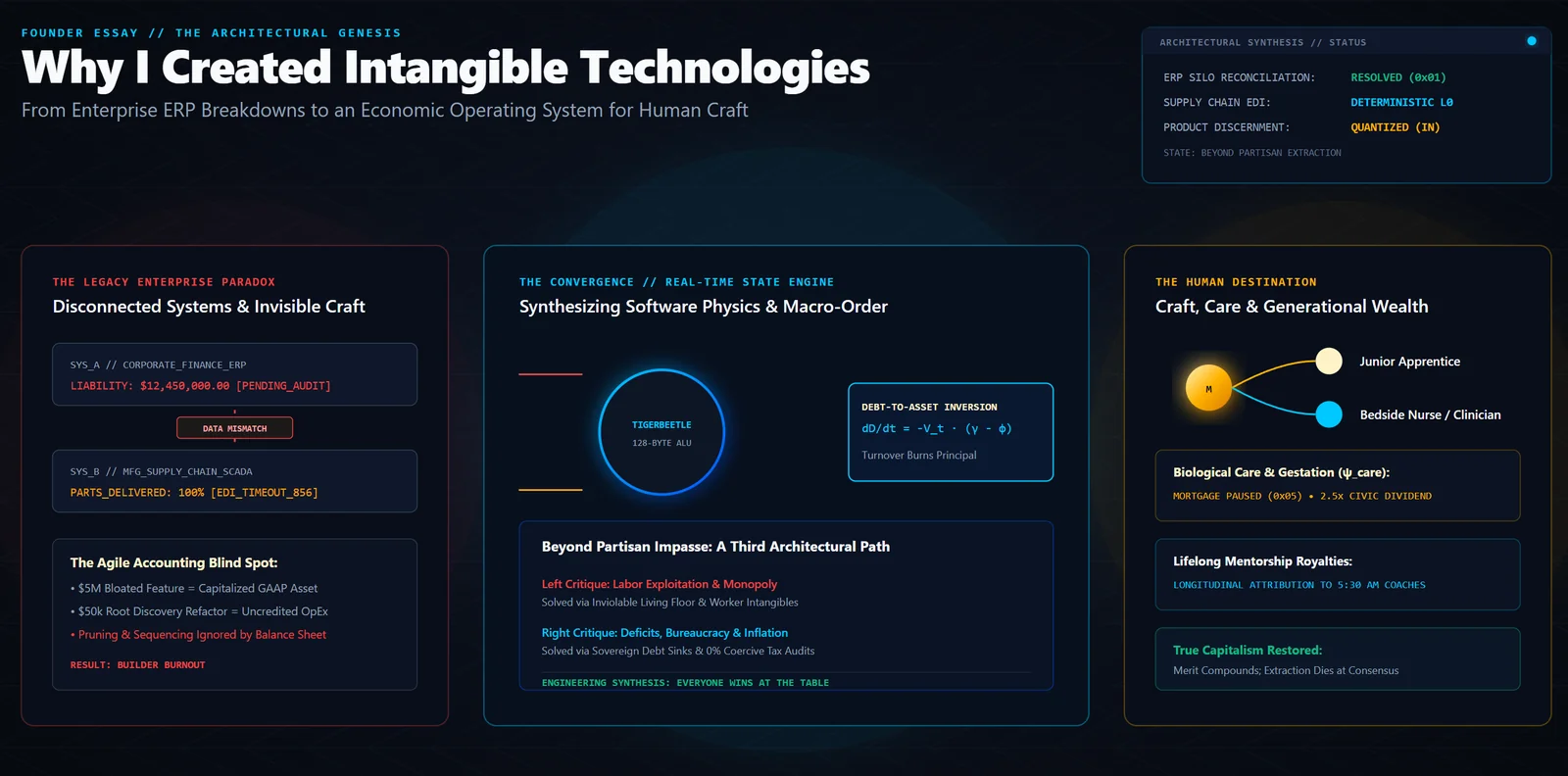
During an audit of primary financial and operational systems at GE, I uncovered a significant financial irregularity. A multi-million-dollar mismatch buried quietly between enterprise resource planning (ERP) databases.
I don’t think it was criminal embezzlement or malicious. It was something far more insidious because it was completely normal: mission-critical software systems within the same enterprise simply could not agree on reality.
One database said parts had shipped; another said inventory was pending; a third had booked a liability that had already been resolved. Because these multi-million-dollar systems didn’t share a single deterministic source of truth, human beings had to spend months doing forensic accounting autopsies just to balance the books.
Around the same time, I was knee-deep in supply-chain integration, trying to solve chronic logistics breakdowns between GE and its external manufacturing partners. The tool the world relied on to coordinate hundreds of billions of dollars in industrial manufacturing was Electronic Data Interchange (EDI). A messaging standard conceived during the Berlin Airlift and formalized in the 1970s.
Day after day, suppliers couldn’t reliably transmit data. Advanced shipping notices dropped into digital voids. Facilities waited on parts that were stuck in transit because an EDI batch job failed overnight, or because an inventory tag had drifted between three different corporate silos. Millions of dollars in capital sat frozen as collateral float just to insure against the uncertainty of whether data would arrive.
I remember sitting in front of my monitors late one evening, looking at the tangled mess of batch scripts, CSV reconciliations, and mismatched ERP rows, and thinking:
We are trying to build supersonic jet engines and planetary energy grids on digital duct tape.
The Product Manager’s Dilemma
Desperate to find a better way to coordinate human effort, I threw myself into the discipline of modern Product Management and Agile methodologies.
I fell in love with the craft. True product management isn’t about running Jira tickets or holding sprint ceremonies; it is the art of discernment.
It is having the courage to practice Pruning, killing a pet executive project before twenty engineers spend an entire year building a bloated feature nobody wants. It is the discipline of Sequencing, knowing that if you don’t clean up the foundational data plumbing first, building a flashy user interface on top will guarantee a catastrophic rewrite in eighteen months. It is the rhythm of Cadence, giving teams two-week feedback loops to test hypotheses against real-world reality rather than guessing eighteen months in advance.
In the physical reality of a team, that discernment saves companies millions of dollars and preserves human sanity.
But then I watched what corporate accounting did to it.
Under 500-year-old Generally Accepted Accounting Principles (GAAP), the highest-leverage work a product manager or engineer does is completely invisible. If a mediocre product manager spends $5 million building a fragile, useless feature that bogs down the platform, corporate accounting capitalizes that software as an “Intangible Asset” and books $5 million of value on the balance sheet.
Yet, if a disciplined product manager spends two weeks doing deep discovery, proves the feature will fail, kills it for $50,000, and refactors a broken database pipeline instead it prevents multi-million-dollar outages and silent cloud infrastructure leaks. The company’s ledger records almost nothing.
Their cost-avoidance, risk mitigation, and architectural stabilization are lumped into flat operational overhead (OpEx). They are treated as a cost center to be minimized, while the sales executive who sold an unbuildable promise gets an immediate commission and a standing ovation at the all-hands meeting.
I realized that our organizations are suffering from an accounting blind spot. We live in a world where the vast majority of enterprise value is intangible—institutional knowledge, code durability, architectural integrity, and human mentorship (a systemic crisis I broke down in Agile Didn’t Fail. Our Accounting Did). Yet we manage our companies using an accounting framework designed by 15th-century Venetian merchants to tally physical sacks of grain and wool on wooden sailing ships.
We celebrate the visible noise and penalize the quiet mastery that keeps the building from burning down.
The Fractal Realization: It’s the Same Problem Everywhere
For a long time, I thought this was just a corporate IT headache. But as I stepped back, the pattern began to terrify me.
The exact same architectural failure I was fighting at GE and P&G was scaling fractally across the entire global economy:
- Supply Chains: The reason a manufacturer can’t get working capital and has to sell invoices to predatory factoring companies at a 10% discount is the exact same reason GE’s EDI failed: disconnected databases mean nobody trusts each other’s books in real time.
- Healthcare: Why does 30% of every healthcare dollar vanish before reaching a doctor or a patient? Because hospital databases and insurance databases spend billions fighting over retrospective billing codes and manual claim reconciliations.
- The AI Bubble: Why are tech giants depreciating scorching-hot AI data centers over five years on paper when the chips melt and become obsolete in eighteen months? Because straight-line GAAP accounting allows executives to hide physical reality behind quarterly spreadsheet fiction.
- National Solvency: Why is the nation drowning in compounding debt? Because our monetary operating system treats credit as an extractive, compounding liability detached from physical production (an architectural dead end we invert in The Physics of Velocity), while tax authorities spend $400 billion a year chasing shoeboxes of paper receipts twelve months after commerce already happened.
We are running a supersonic civilization on an information architecture that cannot see the present moment. It only sees reality through the rearview mirror of retrospective quarterly audits.
Beyond the Noise of Modern Politics
Watching this unfold against the backdrop of our national culture drove me crazy.
Every night on television, politicians and pundits scream at each other about economic injustice, inflation, family collapse, and ballooning debt.
The Left rightfully points out that working families are being crushed, that housing is unaffordable, that healthcare is an extractive racket, and that workers are treated as disposable cogs by corporate executives juicing short-term stock buybacks.
The Right rightfully points out that government bureaucracy is bloated, that endless deficit spending debases our currency, that small businesses are strangled by red tape, and that society is losing the sacred virtues of family, work ethic, and generational continuity.
Both sides are diagnosing real, agonizing pain. But both sides are treating the symptoms while ignoring the disease.
They are fighting over who gets to hold the steering wheel of a car whose engine block is cracked. You cannot tax, spend, deregulate, or litigate your way out of an information architecture that fundamentally misprices reality.
I became so deeply frustrated by this useless political theater that I stopped looking for political answers. I realized that if we want a world that works for human beings, we don’t need more partisan rhetoric.
We need an engineering upgrade.
The Operating System for Intangible Value
That frustration is why Intangible Technologies was born.
I didn’t build this to create another cryptocurrency, another speculative trading token, or another SaaS dashboard that paints glass over a broken mainframe. I built it to answer a single foundational question:
What would the world look like if our economic operating system actually measured, settled, and rewarded real-world thermodynamic reality and human craft in real time?
I took the lessons from bare-metal software architecture, distributed state machines, industrial telemetry, and product management, and synthesized them into an open protocol:
- Deterministic, Real-Time Settlement: We replace the 500-year-old Venetian double-entry batch ledger with a high-throughput, event-driven state machine. Transactions don’t wait three days to clear; they balance mathematically in milliseconds, eliminating trillions of dollars in administrative float, fraud, and clearinghouse friction.
- Turning Debt into an Asset: We invert the mathematics of credit. Instead of compounding usury running away like an uncontrollable clock, commercial debt is linked directly to transaction turnover. As an enterprise ships real goods or a community engages in commerce, active network velocity systematically burns down the principal balance. More real-world work equals faster debt elimination.
- Quantizing Human Intangibles: We make human care, mentorship, and engineering craft visible on the balance sheet. When a senior craftsman trains an apprentice, when an educator teaches a child, or when a mother pauses wage labor to nurture a newborn, the ledger recognizes that effort as the primary capital asset of civilization (the core thesis of The Invisible Engine and The Geometry of Human Value). They are granted cryptographic provenance and continuous, non-inflationary dividend streams, while corporations that burn out their staff or cut human succession are algorithmically penalized with higher borrowing costs.
- Aligning Both Sides of the Table: By funding public infrastructure through atomic micro-splits at settlement rather than coercive annual income-tax autopsies, we retire sovereign debt without austerity, eliminate corporate tax shelters, and lower housing costs by 55%. We give working families stability while giving enterprise builders the cleanest, lowest-cost capital in human history.
An Invitation to Builders
Admittedly, this vision is ambitious. When you tell people you are designing a replacement for 1494 double-entry bookkeeping and the financial plumbing of corporate balance sheets, they look at you like you’ve lost your mind.
I understand that skepticism. But twenty-five years ago, telling someone that an open protocol called TCP/IP would replace international telecommunication cartels, or that an open-source operating system called Linux would run the world’s supercomputers, sounded equally impossible.
The current system is not broken because human beings are inherently corrupt. It is broken because the rules compiled into our ledgers incentivize extraction over production, financialization over craft, and paper speculation over the quiet, essential work that sustains human life.
I created Intangible Technologies because I couldn’t spend the rest of my life watching that happen from the sidelines.
I wanted to build an operating system that honors the master machinist on the factory floor, the nurse at the bedside, the product manager refactoring the foundation, and the parents fighting to raise the next generation.
It is time our financial plumbing worked for the people who actually build the world.