
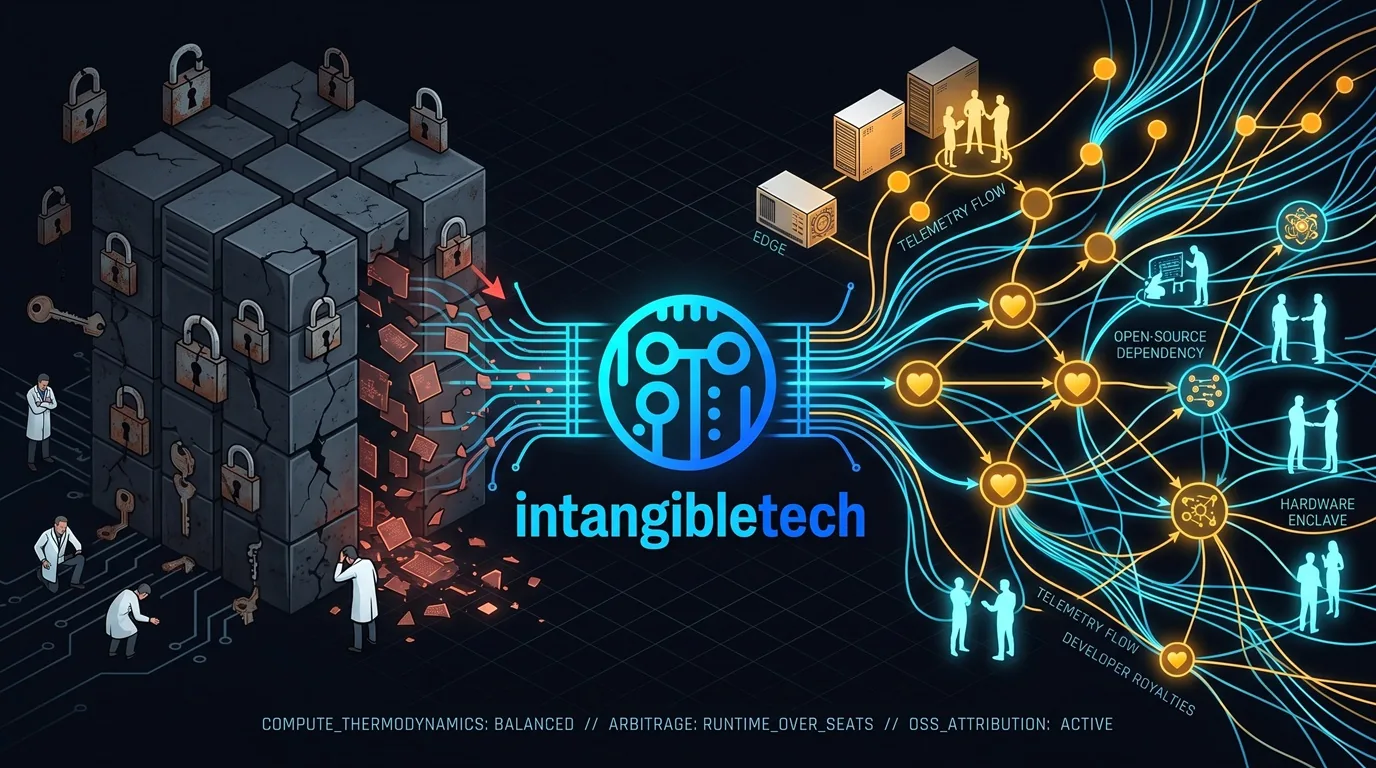
For the last fifteen years, the technology industry has operated under a shared delusion regarding software valuation.
In Silicon Valley and Wall Street boardrooms, software companies are valued almost exclusively on recurring revenue multiples, net retention rates, customer lifetime value, and seat-expansion velocity. Notice what is missing from that list: the actual computational and operational efficiency of the code itself.
Under the modern Software-as-a-Service (SaaS) model, an enterprise software company that writes bloated, memory-leaking code requiring massive cloud clusters can easily command a $10 billion valuation—provided its enterprise sales team locks customers into rigid, multi-year contracts and charges $150 per seat per month.
Conversely, an elite engineering team that builds a lightweight, self-healing, ultra-fast system capable of running on a single bare-metal server often struggles to build a venture-scale business. Because their software runs so cleanly that it requires fewer administrative seats, fewer cloud resources, and fewer consultant hours, legacy finance treats it as having less commercial value.
Our current economic system rewards software for its ability to extract hostage rent, not for its ability to eliminate thermodynamic friction.
To unlock the true value of software, we must pierce the veil of SaaS valuation and reconnect code to the physical reality of computation, energy, and human craft.
1. The Bitcoin Epiphany: When Energy Met Computation
My shift in thinking began years ago while studying the fundamental mechanics of Bitcoin.
Whatever one might think of cryptocurrency markets or monetary economics, Bitcoin accomplished a profound technical breakthrough that most economists and software architects missed: it tied digital state transitions directly to the laws of physical thermodynamics.
For the first time in computational history, a digital ledger could not be updated through arbitrary fiat decree or accounting adjustments. To produce a valid block, a network of machines had to consume measurable kilowatt-hours of electrical power and execute billions of CPU/GPU hash operations. Satoshi Nakamoto linked digital truth to physical energy expenditure. Where energy burned dictated the immutability of the record.
Bitcoin’s tragedy, however, was that its thermodynamic link was completely extractive. Millions of specialized chips burned gigawatts of electricity to solve arbitrary, zero-sum hashing puzzles that produced zero real-world utility beyond securing the ledger itself.
Studying that dynamic sparked a realization:
What if we inverted Bitcoin’s thermodynamic equation? What if, instead of burning physical energy to prove arbitrary mathematical work, a financial ledger directly measured and settled the operational efficiency, compute frugality, and real-world throughput of useful software?
If a piece of software refactors a data pipeline, cuts database latency by 80%, prevents an enterprise cloud leak, or runs an industrial facility with 30% less power, that software has performed verified thermodynamic work. It has preserved capital, reduced entropy, and accelerated real economic velocity.
The reason software has never been valued this way is because our underlying financial rails lacked the telemetry to measure it.
2. The Illusion of SaaS Valuations and the Walled Garden Trap
Why did Software-as-a-Service become the dominant economic model in the first place?
In the 1990s and early 2000s, software was sold via on-premises perpetual licenses. You bought a CD-ROM or downloaded an installer, installed it on your company’s servers, and ran it indefinitely.
That model broke for vendors due to two structural challenges:
- The Piracy and Compliance Void: Vendors had no reliable way to verify how many instances of their software were running across corporate intranets without sending in teams of hostile forensic software auditors.
- The Upgrade Chasm: Companies would purchase Version 4.0 and run it for a decade, refusing to pay for upgrades and starving software makers of predictable cash flow to fund continuous engineering.
SaaS emerged as the vendor’s ultimate solution. By hosting the software inside their own centralized cloud infrastructure (AWS, Azure, GCP), vendors solved the verification problem: if an enterprise didn’t pay its monthly bill, access was cut off.
Yet in solving the vendor’s cash-flow problem, SaaS created an extractive monster:
- The Seat-Tax Extortion: Enterprise software is sold by the “seat”—a metric completely detached from value. A company pays the exact same monthly fee for a senior architect who uses an application ten hours a day as it does for a project manager who opens the dashboard once a month.
- Incentivizing Computational Waste: Because SaaS companies pass infrastructure costs down through opaque subscription tiers, they have zero financial incentive to optimize their code. Writing sloppy code that consumes 10x more cloud RAM simply justifies charging enterprise customers for a higher enterprise tier.
- Predatory Lock-In: The primary goal of modern enterprise product strategy has devolved into maximizing switching costs. Vendors trap customer data inside proprietary databases, build brittle API walls, and make export tools deliberately painful, ensuring that leaving the platform requires a multi-million-dollar migration project.
SaaS is no longer an innovation in software delivery; it has become an infrastructure tollbooth. This dynamic mirrors the broader breakdown in enterprise accounting, where legacy balance sheets fail to recognize engineering craft and instead reward short-term extraction—a systemic distortion explored in Agile Didn’t Fail. Our Accounting Did.
3. New Dimensions of Software Pricing: Beyond the Seat License
When software interacts directly with a deterministic state machine, pricing shifts from arbitrary monthly subscriptions to dynamic, performance-linked economic models:
1. Kinetic Throughput Pricing (Vt)
Instead of charging an arbitrary $50/seat/month, software is priced per unit of verified operational throughput—governed by the continuous monetary velocity framework formalized in The Physics of Velocity.
An enterprise logistics routing algorithm charges fractions of a cent per physical container routed; an image-processing model charges per megapixel analyzed; an ERP reconciliation engine charges per commercial transaction cleared. If an enterprise processes zero volume during a seasonal downturn, its software cost drops to zero. When volume surges, the software creator captures an automated, proportional yield without billing disputes.
2. Defect-Suppression and Uptime Bounties
In mission-critical enterprise infrastructure—aerospace, healthcare, power grids, and high-frequency settlement—the greatest value software provides is what doesn’t happen: outages, security breaches, and data corruption.
Under our ledger, software is issued Loss-Mitigation Multipliers. A cybersecurity engine or database optimization layer that maintains 99.999% uptime and suppresses regression defects below actuarial baselines earns continuous balance-sheet yield. The software is paid directly from the operational savings it generates.
3. Asymmetric Profit Potential for Lean Code
In legacy SaaS, engineering teams spend up to 40% of gross revenue paying AWS or Microsoft Azure to host their applications.
Under telemetry-metered on-premises deployment, the vendor’s infrastructure hosting cost is $0.00. The client provides the bare-metal compute.
An engineering team of five people that writes clean, hyper-optimized code running across 500 enterprise customer data centers can capture 98% net gross margins—higher than any traditional SaaS company in history. The market finally rewards computational elegance over server-burning bloat.
4. The Death of Predatory Vendor Lock-In
In the Intangible Architecture, the predatory software monopoly is rendered unviable by protocol interoperability.
When enterprise data structures, account state transitions, and commercial settlement adhere to standardized, open protocol specifications (such as our 128-byte cache-aligned state vectors and pre-compiled opcodes), data portability becomes an immutable property of the system.
A vendor can no longer build a moat by holding a company’s data hostage.
- If Vendor A builds a billing or analytics tool that runs on the ledger, their software reads and writes to open, standardized transaction schemas bound to the enterprise’s Sovereign Digital Identity.
- If Vendor A gets greedy, hikes prices, or lets their codebase rot, the enterprise can unplug Vendor A’s binary on Friday and plug in Vendor B’s optimized binary on Monday.
- Vendor B points to the exact same continuous on-chain state vector and resumes execution with zero data-migration delays, zero broken CSV imports, and zero database downtime.
Software vendors are forced to compete where they should have been competing all along: on runtime speed, algorithmic accuracy, user interface design, and operational efficiency.
The moment a vendor tries to introduce artificial drag, the market routes around them at consensus speed. A parallel disruption is already reshaping digital media, where real-time micro-settlement replaces subscription gatekeepers, as detailed in The End of the Streaming Middleman.
5. The Redemption of Open Source: Funding the Bedrock of Civilization
Nowhere is the failure of modern software economics more acute than in the tragedy of Open Source Software (OSS).
Today, the entire global digital economy—multinational banks, defense networks, cloud hyperscalers, and consumer tech giants—runs on an invisible foundation of open-source libraries. Yet the independent software engineers who maintain this foundation do so largely as uncompensated volunteer labor.
The world watched this dysfunction play out with vulnerabilities like Heartbleed in OpenSSL and the catastrophic Log4j exploit. Massive multi-trillion-dollar corporations built empire-scale profits on top of small, open-source utilities maintained by two exhausted developers working late at night for zero dollars.
Web3 attempted to solve this with speculative “governance tokens,” which merely created speculative pump-and-dump loops that ruined developer communities.
The Intangible Architecture resolves open-source compensation through Longitudinal Dependency Graphing (Directed Acyclic Graphs)—applying the same mathematical formulation of Shapley value attribution and loss-mitigation yield detailed in The Geometry of Human Value:
- Attribution at Consensus: When a proprietary enterprise application executes a transaction on the ledger, the transaction envelope carries a cryptographic manifest of its software dependencies.
- Atomic Upstream Yield Slicing: As commercial volume moves across the application, the protocol’s native path-settlement logic slices microscopic fractions of a basis point directly back up the dependency tree to the Sovereign Digital IDs of the open-source libraries that made the execution possible.
- Self-Sustaining Digital Infrastructure: An engineer who authors an open-source memory allocator, a cryptographic signature parser, or an ultra-fast parsing algorithm no longer relies on GitHub sponsorship buttons or corporate charity.
As long as human commerce runs across their code anywhere in the world, that engineer receives continuous, spendable daily liquidity directly into their wallet.
Open source evolves from volunteer charity into the most resilient, yield-bearing capital foundation in human history.
Software as an Instrument of Truth
For fifty years, we treated software as a standalone virtual abstraction—a collection of clever scripts living inside proprietary data silos, measured only by how effectively it could capture human attention or lock enterprise customers into recurring debt-like subscriptions.
Software is not a virtual toy. Software is the language through which human beings coordinate physical energy, industrial materials, and global cooperation.
By anchoring software execution to verified hardware telemetry, separating compute from centralized rent-extraction, and pricing code on its thermodynamic capacity to eliminate operational friction, we align technology with its highest purpose.
We lift the veil on software valuations:
- The bloated, rent-seeking middleman is compressed.
- The on-premises bare-metal builder is liberated.
- The open-source craftsman is continuously funded.
- And software finally becomes what it was always meant to be: an appreciating, living instrument of human ingenuity.