
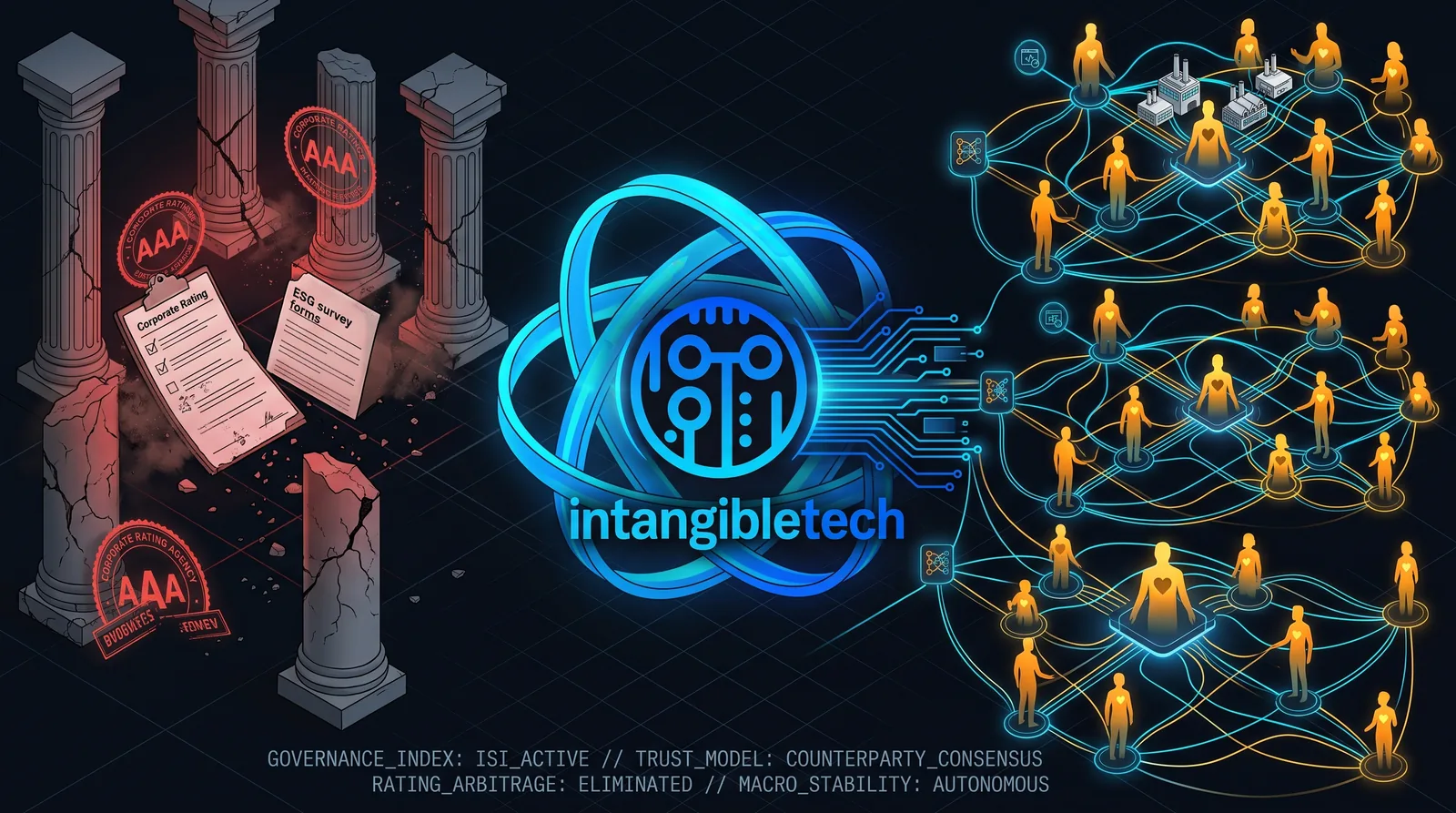
If an economy cannot accurately discern between productive competence and reckless extraction, capital flows to the sociopath, the speculator, and the paper manipulator. Over time, genuine industrial builders are starved of resources, working families are burdened with compounding debt, and institutions rot from within.
For more than a century, modern society has outsourced this sacred responsibility to a handful of centralized gatekeepers: commercial credit rating agencies, consumer score bureaus, ESG consultants, and central bank committees.
We were told that these institutions provide the objective scorecards necessary to price risk, allocate capital, and govern macroeconomic stability.
In reality, they have created a hall of mirrors. They have built an apparatus of backward-looking metrics, systemic conflicts of interest, and cosmetic compliance rituals that reward short-term extraction while remaining blind to the true, living drivers of economic health.
When we architected Intangible Technologies, we recognized that if we were to treat human ingenuity and operational craft as appreciating capital, we could not rely on the broken yardsticks of the twentieth century. We needed an entirely new mathematical primitive.
That primitive is the Impact Score Index (ISI).
The ISI is not a subjective survey, a backward-looking credit score, or a corporate marketing badge. It is a real-time, dynamic metric that continuously evaluates operational resilience, defect suppression, and human succession across the economic network.
At the microeconomic level, it directly dictates an enterprise’s borrowing spreads and an individual’s credit capacity. At the macroeconomic level, it functions as the central governor of the entire monetary operating system, replacing the arbitrary interest-rate decrees of central bankers with an emergent, self-stabilizing equilibrium.
To understand why the ISI represents a foundational leap forward, we must examine the historic failure of the systems it replaces.
1. The Century of Failure: How Legacy Trust Metrics Broke
Modern finance did not start with corrupt rating models. Like many broken systems, it began with a genuine innovation that was corrupted over time.
The Rise and Fall of the Rating Agency Monopolies
In 1909, a financial analyst named John Moody published the first formal manual of railroad securities. At the time, American railways were expanding rapidly, financed by complex bond issues that ordinary investors could not evaluate. Moody’s breakthrough was simple: he analyzed the physical track infrastructure, operating costs, and cargo volumes of these companies, assigning an independent letter grade to their debt.
Crucially, John Moody operated on an investor-pays model. Savers and asset managers paid Moody for an honest, unvarnished evaluation. If his ratings were inaccurate, his business failed.
In the 1970s, the entire structural integrity of that model collapsed.
The industry shifted from an investor-pays model to an issuer-pays model. Suddenly, the corporations issuing the debt were the ones paying Moody’s, Standard & Poor’s, and Fitch to rate them. Around the same time, financial regulators embedded these three private rating agencies directly into federal law, creating a legally protected oligopoly.
The result was the catastrophic subprime mortgage crisis of 2008. Investment banks packaged predatory, defaulting mortgages into complex financial derivatives, then shopped those packages around to the rating agencies. If one agency refused to grant a pristine AAA rating, the bank threatened to take its multi-million-dollar fees to a competitor.
The agencies capitulated, stamping the highest possible safety rating onto financial poison. When the collapse occurred, trillions of dollars of global wealth vanished, while the rating agencies walked into congressional hearings and defended their actions by claiming their ratings were merely protected free speech.
The Farce of Corporate ESG
When institutional investors realized that legacy credit ratings were blind to long-term risk, the corporate world invented a new solution: Environmental, Social, and Governance (ESG) scoring.
ESG promised to force corporations to care about sustainability, ethics, and human labor. Instead, it quickly mutated into a multi-billion-dollar corporate consulting racket.
Because ESG ratings rely on self-reported corporate filings and marketing surveys, they measure bureaucratic paperwork rather than physical reality. A multinational conglomerate can lay off ten thousand skilled manufacturing workers, outsource production to overseas facilities with zero environmental oversight, and mask the destruction by hiring a public relations firm to produce a glossy two-hundred-page sustainability report.
Under legacy ESG frameworks, tobacco conglomerates routinely score higher on sustainability than clean-energy automotive manufacturers simply because they employ better compliance attorneys. It is Goodhart’s Law taken to its absurd extreme: the moment the metric became a marketing target, it ceased to measure anything of actual value.
The Macroeconomic Blindness of GDP and the Fed
At the highest level of our civilization, the metrics that guide national policy are equally broken.
Gross Domestic Product (GDP) is a measure of pure transactional velocity that cannot distinguish between productive health and catastrophic destruction. If a toxic chemical spill poisons a municipal river, GDP rises because the government must spend hundreds of millions of dollars on environmental remediation, healthcare treatments, and legal battles. Yet if a community of master toolmakers and teachers raises healthy, self-reliant children who build durable tools that never break, GDP records zero growth.
Meanwhile, central bank committees attempt to manage national economies by raising or lowering a single benchmark interest rate based on lagging quarterly economic surveys. They are attempting to steer an aircraft carrier through a storm while looking through a three-month-old rearview mirror. If they guess wrong, they trigger devastating cycles of asset bubbles, inflation, bank failures, and forced unemployment.
We have been navigating a supersonic, digital global economy using broken compasses designed for an era that no longer exists.
2. What Is the Impact Score Index?
The Impact Score Index (ISI) is a living, multi-dimensional index that quantifies the true, verified operational capacity of an economic entity—whether an individual craftsman, a growing mid-sized enterprise, or an entire regional supply chain.
Unlike legacy credit scores that simply ask, “Did you pay back your past debts on time?” the ISI asks the fundamental question of solvency: “What is your verified, real-world capacity to coordinate resources, eliminate systemic drag, and generate enduring economic utility?”
The ISI evaluates performance across three fundamental pillars:
Pillar 1: Operational Defect Suppression (Resilience)
In any enterprise, the most significant destroyer of capital is not overhead; it is operational friction, systems downtime, and manufacturing defects. The ISI continuously evaluates an organization’s verified operational reliability against actuarial baselines, capturing hardware-attested uptime and code durability as explored in How Protocol Telemetry Unlocks True Software Value and Dismantles SaaS Lock-In.
An enterprise that maintains high uptime, delivers precision engineering tolerances, and systematically reduces warranty failures demonstrates superior coordination. That resilience directly elevates its score.
Pillar 2: Human Institutional Succession (The Anti-Extinction Pillar)
An enterprise that posts high quarterly profits while burning out its senior staff and refusing to train junior apprentices is an enterprise in terminal decline.
The ISI directly incorporates the health of the organization’s human dependency tree. When an enterprise maintains high talent retention, fosters active mentorship lineages, and successfully transitions complex institutional knowledge to younger generations, its succession rating expands. Conversely, an executive suite that lays off senior builders to hit short-term financial targets triggers an immediate downgrade in its institutional durability.
Pillar 3: Counterparty and Velocity Health (Kinetic Integrity)
The ISI evaluates how an organization interacts with the broader economic network. Does it settle its commercial vendor obligations in real time? Do its downstream clients successfully incorporate its products without experiencing cascading bottlenecks?
By analyzing the health and velocity of an organization’s incoming and outgoing commercial flows across the network, the index measures whether the entity acts as a productive catalyst or an extractive bottleneck.
3. The Micro-Economic Engine: Dictating Credit, Capital Costs, and Talent
In our operating system, the ISI is not a vanity metric displayed on a corporate website. It is the direct mathematical input that governs commercial balance sheets.
Inverting the Cost of Capital
In the legacy banking system, a small or mid-sized business with exceptional engineering discipline often pays ten to twelve percent interest on a working capital line simply because it lacks physical real estate to pledge as collateral. Meanwhile, an over-leveraged corporate conglomerate can issue billions of dollars in low-yield commercial paper because it has an established relationship with Wall Street underwriting syndicates.
The Intangible Architecture eliminates this bias.
When an enterprise draws working capital from the protocol’s liquidity reserves, its dynamic borrowing rate is determined directly by its Impact Score Index:
- An enterprise that maintains a high ISI—demonstrating verified low defect rates, unassailable operational reliability, and deep human succession—crosses the protocol’s prime solvency threshold. Its borrowing spread automatically compresses to prime tiers between one and two percent.
- An enterprise that operates with high turnover, brittle operational processes, and frequent supply-chain failures is assessed a higher risk spread of seven to nine percent.
This dynamic spread is not decided by an arbitrary loan officer. It is an algorithmic output of verified operational health. For a growing enterprise managing fifty million dollars in working capital, the difference between an average ISI and a top-tier ISI represents millions of dollars in annual cash savings on capital costs alone.
Spread Arbitrage: The Talent Pricing Revolution
This mechanism completely restructures how enterprises value and compensate human labor.
In the legacy corporate world, human beings are treated as disposable operational overhead. When a company hires an elite systems architect, a master machinist, or a dedicated clinical director, corporate finance treats their salary as an expense that reduces net profit.
Under our architecture, hiring verified talent represents an immediate, high-yield balance-sheet intervention through Spread Arbitrage:
- When a company hires master craftsmen or experienced systems architects whose personal sovereign track records possess high individual provenance, their addition to the organization directly elevates the enterprise’s composite ISI.
- As the company’s composite ISI rises, the borrowing rate across its entire corporate credit facility instantly compresses.
- A company that saves three to four million dollars a year in capital debt service can comfortably pay those master builders exceptional, premium salaries out of pure balance-sheet optimization.
For the first time in financial history, hiring exceptional human talent is not an expense that depresses earnings; it is the exact capital maneuver that lowers the enterprise’s cost of capital and expands its operational margins (for the underlying mathematical modeling of talent spread arbitrage, see The Geometry of Human Value).
4. Why the ISI Cannot Be Gamed: Game Theory and Structural Integrity
The immediate objection from any seasoned financial executive or risk officer is obvious: “If an enterprise’s borrowing rate depends on its ISI, executives will find a way to manipulate the metric, just as they gamed credit ratings and ESG surveys.”
This skepticism is healthy. However, the ISI is architected with structural and game-theoretic barriers that make cosmetic compliance and fraudulent inflation mathematically unviable.
1. The Elimination of the Issuer-Pays Corruption
An enterprise cannot hire a rating firm to audit its ISI. There is no advisory committee to lobby, no marketing survey to fill out, and no rating agency executive to take out to dinner.
The ISI is derived entirely from the ongoing, verified commercial interactions of the enterprise as transactions clear across the network. You cannot purchase an index rating; you can only generate it through verified performance.
2. Bilateral Cross-Network Verification
In legacy ESG and corporate accounting, a company reports its own numbers. It claims its supply chain is ethical, its inventory is accurate, and its systems are resilient.
On our ledger, every operational event is bilateral.
An enterprise cannot unilaterally claim that it shipped parts on time; the downstream recipient’s signed receipt must settle on the ledger to confirm the handoff. A company cannot claim its software is defect-free; the actual uptime and API responses of the system are continuously verified by independent counterparty nodes across the network.
To fake high operational performance, an enterprise would have to convince hundreds of independent, competing suppliers, clients, and logistics partners to participate in a coordinated conspiracy to falsify their own balance sheets—a coordination problem that becomes impossible at scale.
3. Thermodynamic Friction Against Wash Attribution
Could an enterprise set up dummy shell companies to trade with itself, manufacturing synthetic volume to artificially boost its score?
As we established in our foundational architecture, every commercial transaction moving across our protocol clears through automated liquidity pools that assess an unavoidable turnover fee.
To manufacture the illusion of immense operational velocity, colluding entities must continuously cycle real, spendable liquidity across the rails, burning substantial capital in network fees on every loop.
Faking operational health ceases to be a profitable shortcut; it becomes an unsustainable capital drain that systematically depletes the attacker’s treasury—a core principle of the adversarial threat model detailed in The Anti-Fragile Ledger.
4. Downside Slashing and Mutual Liability
In legacy systems, rating agencies and executive consultants face zero financial liability when they vouch for a failing asset.
Under our protocol, attribution is tied to Down-Graph Liability.
If a senior professional vouches for an apprentice, or an upstream engineering team certifies a critical component, they earn long-tail provenance yield when the work succeeds. But if that component triggers catastrophic failures or operational fraud downstream, the upstream certifying node has its own personal ISI slashed.
Because your own future cost of capital is tied to the long-term validity of what you endorse, actors are economically disincentivized from providing unearned endorsements or participating in mutual praise cartels.
5. The Macroeconomic Governor: An Automated Monetary Equilibrium
While the microeconomic effects of the ISI transform enterprise finance, its macroeconomic implications are even more profound.
The ISI acts as the primary sensory organ and regulatory valve of the broader monetary operating system, replacing blunt central bank interventions with continuous, countercyclical stability.
The Death of the Credit Cycle Boom-and-Bust
In legacy economies, central banks keep interest rates artificially low during political cycles. Cheap credit floods the banking system, encouraging speculative investment in unproductive assets: luxury real estate speculation, subprime consumer lending, and corporate financial engineering.
Eventually, inflation spikes, the central bank panics, hikes rates rapidly, and induces a recession, wiping out thousands of viable businesses along with the speculative ones.
Under the Intangible Architecture, aggregate credit availability is tethered directly to the composite ISI of the entire economy:
- When real-world industrial productivity, defect suppression, and human training expand, the overall capacity of the economic network to absorb and deploy capital safely increases. The system naturally expands liquidity reserves at prime rates to fund that verified growth.
- If operational quality degrades—if systemic defect rates rise, talent churn accelerates, or counterparty bottlenecks mount—the composite ISI across the network automatically contracts. The cost of borrowing rises algorithmically, cooling speculative expansion before it can metastasize into an asset bubble.
There are no emergency meetings of monetary policy committees. There are no sudden shocks to national interest rates. The price and availability of capital adjust organically every second, guided by the actual physical health of the productive economy. This automated stability directly translates into senior, non-speculative 4–8% annual yields for savers through Account Type B, as detailed in The Architecture of Real Yield.
Automatic Insolvency Routing
Under traditional monetary regimes, bankrupt zombie companies are kept alive for years through government bailouts, subsidized emergency loans, and opaque debt restructuring. These failing corporations hoard capital, lock up skilled labor, and drag down the productivity of the entire nation.
On our ledger, an enterprise that suffers a catastrophic, persistent decline in its ISI cannot hide behind creative accounting.
As its operational metrics deteriorate, its borrowing costs rise, and its protocol-enforced credit lines contract. If it fails to remediate its core operational dysfunction, the protocol systematically initiates an orderly, automated unwinding:
- Its productive human assets are freed to migrate their portable provenance to healthier enterprises via Spread Arbitrage.
- Its physical machinery and infrastructure assets are transitioned to solvent operators through decentralized collateral settlements.
- Its outstanding obligations are amortized through remaining network turnover without triggering systemic bank runs.
Failure is isolated and resolved at the cellular level, preventing local corporate rot from escalating into national financial contagion.
The Recovery of Truth
For generations, humanity has accepted a profound contradiction at the heart of economic life.
We have built a civilization capable of mapping the human genome, launching orbital space telescopes, and running global communication networks at the speed of light—yet we continue to navigate our economic affairs using the crude, easily manipulated financial instruments of the industrial past.
We have allowed an unelected cartel of rating agencies to tell us what is safe, a cottage industry of ESG marketers to tell us what is good, and a committee of central bankers to dictate the value of our time and labor.
The Impact Score Index breaks that cycle.
It is an architecture built on the conviction that trust should not be purchased from an intermediary; it should emerge naturally from verified, real-world competence.
By measuring the living realities of human craft, operational discipline, and generational succession—and using those truths to govern the cost of capital—we align the financial plumbing of our world with the flourishing of human civilization.
We have spent centuries following broken compasses.
It is time our economy was guided by the truth.