
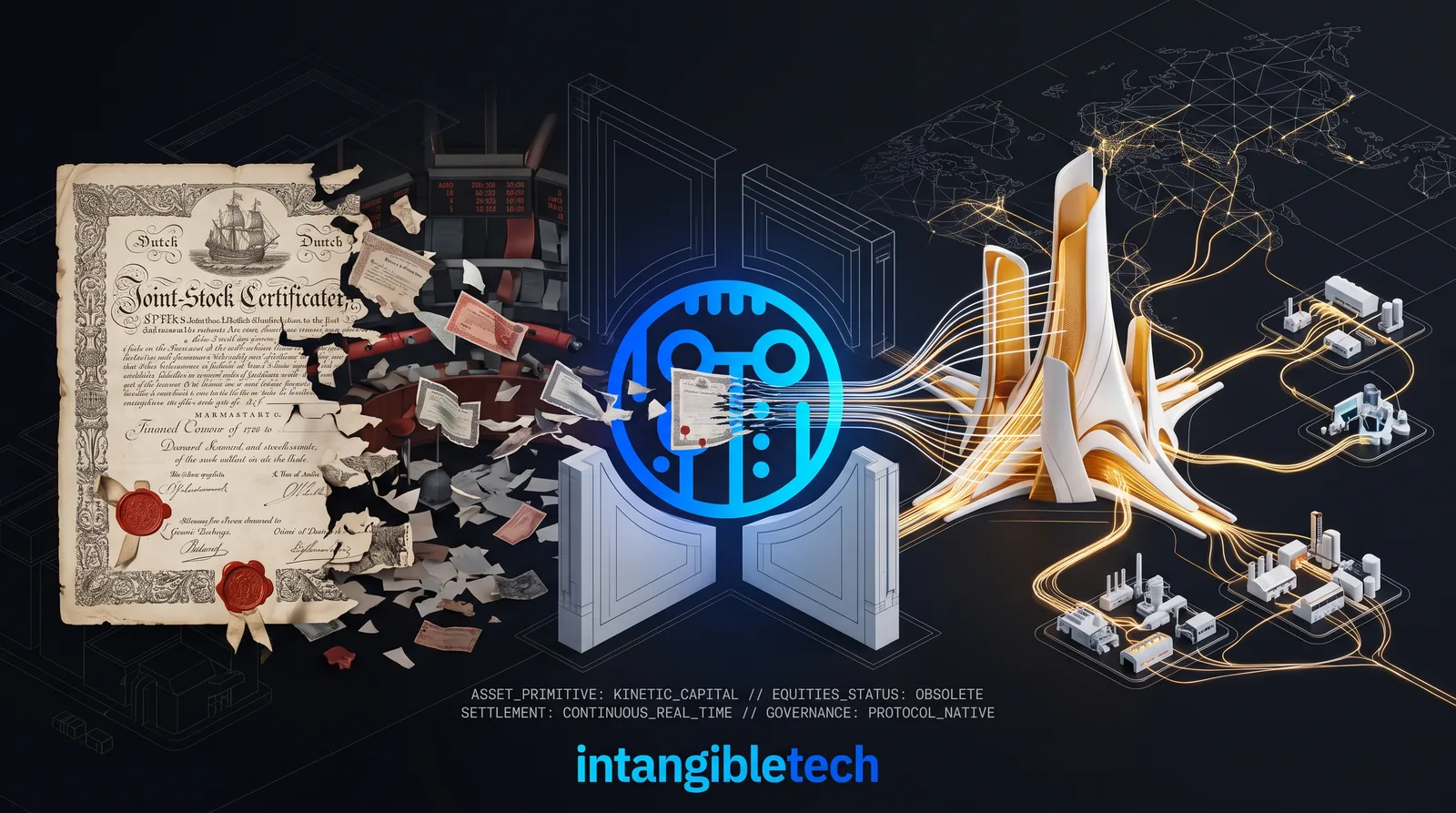
In boardrooms and financial conferences around the world, Wall Street is celebrating what it calls the next frontier of modern finance: the “tokenization of equities.”
Every major investment bank, asset manager, and venture-backed crypto fund has rolled out a pitch deck explaining how they plan to bring the multi-trillion-dollar global stock market onto distributed ledgers. Yet if you strip away the marketing jargon and look at the actual mechanics of what they are building, you encounter an uncomfortable truth.
They are taking a four-hundred-year-old financial instrument—the corporate stock certificate—wrapping it in a Delaware limited liability company or offshore Special Purpose Vehicle, locking the original paper in a legacy custodian’s vault, and minting an on-chain digital receipt.
They have accelerated the settlement window from two days down to seconds, but they have preserved every single operational failure, misalignment of incentives, and structural defect of the twentieth-century public corporation.
Are we actually innovating financial architecture? Or are we just scanning paper certificates into digital formats, slapping an on-chain label on them, and calling it the future?
To understand why the tokenization of legacy equities is an intellectual dead end, we must first understand what a “stock” actually is: why it was invented, the genuine coordination problem it was designed to solve, how it became corrupted by twentieth-century financialization, and how our architecture completely replaces it with protocol-native kinetic capital.
1. The Anatomy of an Invention: Amsterdam, 1602
The corporate stock was not handed down on stone tablets as an eternal law of economics. It was a pragmatic engineering hack invented in Amsterdam in 1602 to solve a specific physical and geopolitical crisis.
Before the turn of the seventeenth century, European maritime trade with the East Indies was conducted on a voyage-by-voyage basis. A syndicate of merchants would pool capital, outfit two or three wooden sailing vessels, buy trade goods, and send the ships around the Cape of Good Hope.
The physical risks were staggering. Ships sank in violent storms; crews were wiped out by disease; vessels were captured by rival empires or pirates. If a ship was lost, the merchants who backed that specific voyage faced financial ruin. Furthermore, because these partnerships were legally dissolved the moment a surviving ship returned and liquidated its cargo of spices, long-term capital planning was impossible. No single merchant could finance permanent overseas harbors, fortified warehouses, or multi-decade trade agreements out of their own balance sheet.
The Dutch East India Company—the Vereenigde Oostindische Compagnie, or VOC—shattered that limitation by inventing the joint-stock corporation.
The VOC introduced three radical innovations that laid the foundation for modern capitalism:
1. Permanent Capital
Instead of dissolving the partnership after a single voyage, the VOC locked investor capital into a permanent, ongoing corporate treasury. Investors could no longer demand their gold back from the company directors whenever global tensions spiked. The capital stayed inside the enterprise, allowing the company to build permanent docks, commission multi-year naval fleets, and weather seasonal downturns.
2. Limited Liability
Investors were no longer personally liable for the debts or disasters of the enterprise. If the VOC lost half its fleet in a typhoon, creditors could not seize the personal homes or estates of the shareholders. An investor’s risk was strictly limited to the amount of gold they had originally committed.
3. Transferable Fractional Claims (Secondary Liquidity)
Because investors could not redeem their capital from the company’s treasury, the Dutch created a secondary market: the Amsterdam Stock Exchange. If an investor needed cash to settle a family debt or fund a new business, they did not liquidate the company; they sold their fractional paper certificate of ownership—their “action” or “share”—to another willing buyer.
The historical purpose of a stock was elegant: it was a technology designed to aggregate passive private capital, diversify physical thermodynamic risk, and direct liquidity into long-horizon industrial coordination that exceeded the lifespan of any single human being.
For two centuries, this model propelled the industrialization of the Western world. It financed the construction of transcontinental railways, steamship lines, national electrical grids, and the steel mills that built modern civilization.
Then, the machine broke.
2. The Great Corruption: From Capital Formation to Financialized Extraction
Somewhere in the middle of the twentieth century, the joint-stock corporation stopped being a tool for long-term industrial coordination and mutated into an engine of financial extraction.
The breakdown occurred across four fundamental dimensions:
The Nominee Illusion and the Death of Shareholder Democracy
When the average individual or corporate treasurer buys a share of stock today through a retail broker or institutional custodian, they believe they own an asset.
Legally, they do not.
Under modern securities market plumbing, virtually all publicly traded shares in the United States are registered in the street name of a single private nominee company called Cede & Company, a subsidiary of the Depository Trust & Clearing Corporation (DTCC). What the investor holds is not a direct property title in the corporation; it is an unsecured contractual entitlement—a security entitlement—against a broker who holds an entitlement against a clearinghouse.
This layered custodian structure completely detached economic ownership from governance. Retail shareholders rarely vote their own shares; their voting proxies are captured by institutional mega-asset managers and proxy advisory monopolies who cast corporate votes according to corporate agendas completely divorced from the desires of the underlying savers. Shareholder democracy became an illusion managed by custodian intermediaries.
The 90-Day Accounting Panopticon
Because legacy corporate accounting relies on retrospective, double-entry batch audits, corporate health is evaluated through arbitrary ninety-day earnings calls.
This quarterly rhythm created a psychological pathology. Chief executive officers and corporate boards are no longer evaluated on whether they are building multi-decade industrial resilience, conducting basic scientific research, or training the next generation of craftsmen. They are evaluated on whether their quarterly earnings-per-share metric beats Wall Street consensus by two cents.
The Share Buyback Cannibalism
When executive compensation was tied directly to stock options and share prices in the 1980s and 1990s, the purpose of the corporation inverted.
Instead of deploying profits to upgrade physical factories, raise worker salaries, or invest in foundational research, executives discovered that the easiest way to hit their bonus thresholds was to engage in financial engineering. Over the past twenty years, American corporations have spent trillions of dollars in commercial debt and operating cash to buy back their own stock—canceling shares to artificially inflate earnings per share on paper while their operational foundations decayed.
The Accounting Blindness to Human Intangibles
Perhaps the most destructive failure of the modern stock construct is its complete inability to account for the living components of the enterprise.
Under legacy Generally Accepted Accounting Principles (GAAP), if a company buys an industrial lathe or a corporate jet, it is capitalized as an asset on the balance sheet. But the software architects who write the core platform, the senior machinists who understand the tolerances of the equipment, and the mentors who spend five years training junior apprentices are classified as flat operational overhead.
When a quarterly economic shock hits, corporate management immediately lays off its most experienced builders to lower operating expenses and protect the stock price, liquidating the true institutional memory of the firm to preserve a paper metric—the exact systemic failure analyzed in Agile Didn’t Fail. Our Accounting Did.
The modern stock is no longer an instrument of shared industrial enterprise. It has become a speculative derivative floating far above the physical and human reality of production.
3. The Tokenization Fallacy: Putting Digital Lipstick on a Decaying System
This brings us to the prevailing trend of “Real-World Asset Tokenization.”
When a financial institution boasts that it has “tokenized” public equities or corporate debt, what has it actually accomplished?
- It sets up an offshore or domestic legal entity.
- It purchases legacy shares of an equity through a traditional broker-dealer.
- It places those shares inside a custodial bank account.
- It issues a digital token on a public or private blockchain representing a legal claim against that entity.
This is not a financial revolution; it is an administrative layer of cost.
The token holder still owns an asset whose underlying health is evaluated only once every ninety days by backward-looking accountants. The token holder still has zero programmatic voice in corporate governance. The enterprise itself is still trapped in the quarterly earnings panopticon, still forced to manage for short-term share price manipulation, and still blind to the value of its human capital.
If the underlying financial primitive is broken, making it trade twenty-four hours a day on a blockchain does not solve the problem. It simply accelerates the velocity of a flawed machine.
4. The Transition: From Speculative Equities to Protocol-Native Kinetic Capital
In the Intangible Architecture, we do not tokenize legacy stocks. We make them obsolete.
We replace the static paper share with Protocol-Native Kinetic Capital.

Instead of buying a speculative certificate that sits detached from operational reality, capital participation in our architecture is directly wired into the real-time operational and thermodynamic pulse of the enterprise.
To understand this transition, look at how the core elements of the traditional stock evolve into living protocol primitives:
From Discretionary Dividends to Continuous Velocity Yield
In the legacy stock market, an investor buys a share in hopes of receiving a dividend. A dividend is a backward-looking, discretionary check declared by a board of directors months after profits have been earned—often subject to accounting manipulation, tax friction, and executive discretion. If the board decides to cancel the dividend to fund an unvetted acquisition, the shareholder has no recourse.
In the Intangible Architecture, dividends are replaced by programmatic kinetic yield.
When an enterprise operates on our ledger, its commercial revenue does not sit in an opaque corporate bank account. Invoices, consumer checkouts, and B2B vendor payments clear across native Layer-0 Automated Market Maker liquidity corridors in sub-second finality.
As that commercial velocity circulates, the protocol captures an atomic, pre-compiled liquidity turnover fee.
That fee does not pass through a board of directors’ committee. It streams directly, continuously, and programmatically into the sovereign wallets of the capital providers in liquid, spendable fiat stablecoins. Capital allocators do not wait ninety days for a dividend declaration; they receive an un-diluted, non-inflationary stream of yield generated by the real-time, second-by-second commercial throughput of the enterprise—the core mechanism powering Account Type B’s 4–8% real yield.
From Speculative Multiple Expansion to Real-World Operational Health
The price of a legacy stock fluctuates wildly based on market sentiment, macroeconomic rumors, interest rate announcements by central banks, and social media hype. A company can increase its real-world physical efficiency by fifty percent, yet watch its stock price crater because a Wall Street analyst missed a revenue forecast by a fraction of a percent.
In our architecture, the valuation of an enterprise is anchored to its verified operational and human telemetry.
Through hardware roots of trust, the system measures physical operational reality: machine runtime hours, assembly-line defect suppression, on-time supply chain handoffs, and institutional talent retention.
Capital allocators are not buying an abstract promise; they are participating in a verifiable economic engine whose capacity to coordinate resources and generate kinetic turnover is measured continuously.
5. The Dual Engine: Real-Time Intangible Visibility Paired with Debt Amortization
How is it possible to run an enterprise without the quarterly earnings game and without compounding corporate debt?
This shift is enabled by the convergence of two foundational economic inventions within our protocol:
Invention 1: The Real-Time Capitalization of Intangible Craft
In our architecture, human knowledge, systems architecture, and operational craft are no longer written off as deadweight operational expenses.
When a team of engineers stabilizes an enterprise codebase, or when master technicians train junior apprentices, those contributions are signed by their Sovereign Digital Identities on a Cryptographic Dependency Directed Acyclic Graph.
The protocol quantizes Defect Suppression Yield. When an architectural choice prevents operational failures—cutting database downtime, eliminating inventory stockouts, or reducing warranty claims—the system measures that performance against actuarial baselines.
The preserved operating spread is credited directly to the enterprise’s balance sheet as Intangible Capital. (For the full mathematical mechanics of how Shapley DAG attribution and loss-mitigation yield convert human craft into working capital, see The Geometry of Human Value.)
For the first time in financial history, corporate balance sheets reflect the true reality of modern enterprise:
- Retaining seasoned engineers, experienced operators, and master craftsmen actively expands the company’s capitalized balance sheet.
- Firing senior talent to cut short-term costs immediately triggers a catastrophic downgrade in the enterprise’s on-chain resilience rating, instantly increasing its cost of capital.
Management is mathematically stripped of the ability to destroy long-term human capability for short-term paper gains.
Invention 2: The Continuous Velocity Amortization Engine
In legacy corporate finance, companies borrow capital by issuing bonds or taking bank loans that compound with interest over time. If a company hits a business downturn, that compounding debt clock keeps ticking, eventually driving the enterprise into bankruptcy or forcing it into the hands of predatory restructuring funds.
We inverted the mathematics of debt. (For the complete equations demonstrating how real-time velocity inverts compounding debt into self-liquidating capital, see The Physics of Velocity.)
When an enterprise draws working capital from the protocol’s liquidity pools, the debt is not governed by compounding usury. Instead, the debt is linked directly to network transaction velocity.
Every time the enterprise ships a product, processes an invoice, or delivers a service, the microscopic turnover fee generated by that transaction is split: a portion funds the kinetic yield of capital providers, and a portion is routed directly toward burning down the principal balance of the debt.
The more useful economic work the enterprise performs in the real world, the faster its debt is systematically retired. Commercial debt ceases to be an existential, compounding liability that threatens corporate survival; it becomes a self-liquidating operational buffer that amortizes naturally through production.
6. Restoring Sovereignty: Liquid Governance Without Disenfranchisement
The final structural defect of the legacy stock is the complete breakdown of governance.
Today, if a shareholder wants to participate in corporate voting, they are confronted with a broken choice. Either they hold their shares directly and spend hundreds of hours analyzing complex, opaque proxy ballots across dozens of companies, or they hand their shares to an asset management conglomerate that votes their economic weight according to institutional agendas that the shareholder may actively despise.
Our architecture introduces Protocol-Native Liquid Governance:
- Separation of Economic Yield from Governance Voting: Under our ledger, your economic right to receive kinetic yield is completely decoupled from your obligation to vote on operational proposals. You do not have to forfeit your income to exercise your voice, nor do you have to surrender your voting rights to receive your yield.
- Granular, Delegative Proxy: You do not have to cast an uninformed ballot on complex engineering decisions, nor do you have to hand your proxy to an asset manager for five years. Through native cryptographic delegation, you can route your voting weight for technical decisions directly to an independent software engineering guild, your voting weight for executive compensation to an operational governance council, and retain your vote on major structural mergers—revoking that delegation instantly at any second with a single cryptographic transaction.
- Direct Sovereign Custody: There is no Cede & Company. There is no DTCC. There are no nominee accounts. Your capital participation and your governance rights are bound directly to your personal Sovereign Digital Identity. You own the asset directly, and your voice cannot be captured or silenced by financial intermediaries.
7. The Inventions That Make This Reality
This is not an aspirational manifesto. It is an engineered operating system made viable by specific, non-speculative technical breakthroughs:
- The 128-Byte Deterministic State Machine: By compiling ledger entries into fixed, 128-byte cache-aligned memory structs running on bare-metal silicon, our Layer-0 engine executes multi-tier kinetic yield distributions and dependency-tree routing in nanoseconds, operating at over one million transactions per second without gas fees or network congestion.
- Hardware Roots of Trust (Silicon-Attested Telemetry): We eliminate accounting fraud at the physical layer. Corporate performance is not ingested through self-reported PDF financial statements; it is attested directly through tamper-resistant Trusted Platform Modules and secure hardware enclaves embedded within the factory machines, energy grids, and computing servers that do the actual work.
- Pre-Compiled Non-Turing-Complete Financial Opcodes: Rather than deploying vulnerable, general-purpose smart contracts that invite exploits and drain network throughput, our protocol runs on eight formally verified, immutable primitives. These opcodes execute atomic revenue splits, velocity debt amortization, and governance delegation directly at consensus.
- Symmetrical Integration with Stellar as the Global Notary: While high-speed operational accounting happens locally on bare-metal Layer-0 nodes, periodic cryptographic state roots are anchored directly to the Stellar network. Stellar’s Federated Byzantine Agreement provides the unalterable, globally recognized bedrock of truth, ensuring that no local corporate ledger can ever be falsified or desynchronized without immediate mathematical detection.
The Sunset of the Speculative Age
In 1602, the merchants of Amsterdam took a momentous leap forward. They recognized that the coordination challenges of their era could not be met with medieval merchant guilds and temporary partnerships, so they invented the joint-stock company to cross oceans.
Four hundred years later, civilization has outgrown that vehicle.
We cannot coordinate a global, high-frequency, knowledge-driven economy on an information architecture designed for wooden sailing ships and parchment ledgers. We cannot build a prosperous, stable future on financial rails that reward the destruction of human capability, force corporate managers into ninety-day panic cycles, and treat real-world production as a secondary derivative of paper speculation.
Tokenizing the stock market is looking backward. It is an attempt to preserve the privileges of an extractive financial intermediary class by giving their dying tools a digital coat of paint.
Intangible Technologies looks forward.
By wiring capital directly to real-time operational truth, replacing discretionary dividends with continuous kinetic yield, recognizing human craft as an appreciating balance-sheet asset, and inverting debt into a self-liquidating engine of production, we are not merely improving the stock market.
We are building the financial operating system for the next four hundred years of human enterprise.