Every era of human civilization is governed not by its politicians, but by the architecture of its ledger.
For five hundred years, the global economy has operated on Venetian double-entry bookkeeping, 17th-century joint-stock charters, and fractional-reserve debt issuance. That operating system built the industrial world—and today, it is tearing the modern world apart. It is blind to the eighty-five percent of enterprise value that lives inside human minds, trapped in a mathematical death spiral of compounding sovereign debt, and incapable of measuring the difference between productive creation and extractive rent-seeking.
More urgently, we have arrived at the threshold of autonomous Artificial Intelligence while still running on this broken accounting substrate. When you train superintelligent optimization engines on legacy balance sheets where human beings are recorded strictly as payroll liabilities and SG&A friction, the machine does not need malice to destroy civilization; it simply executes its reward function by optimizing humanity out of the loop.
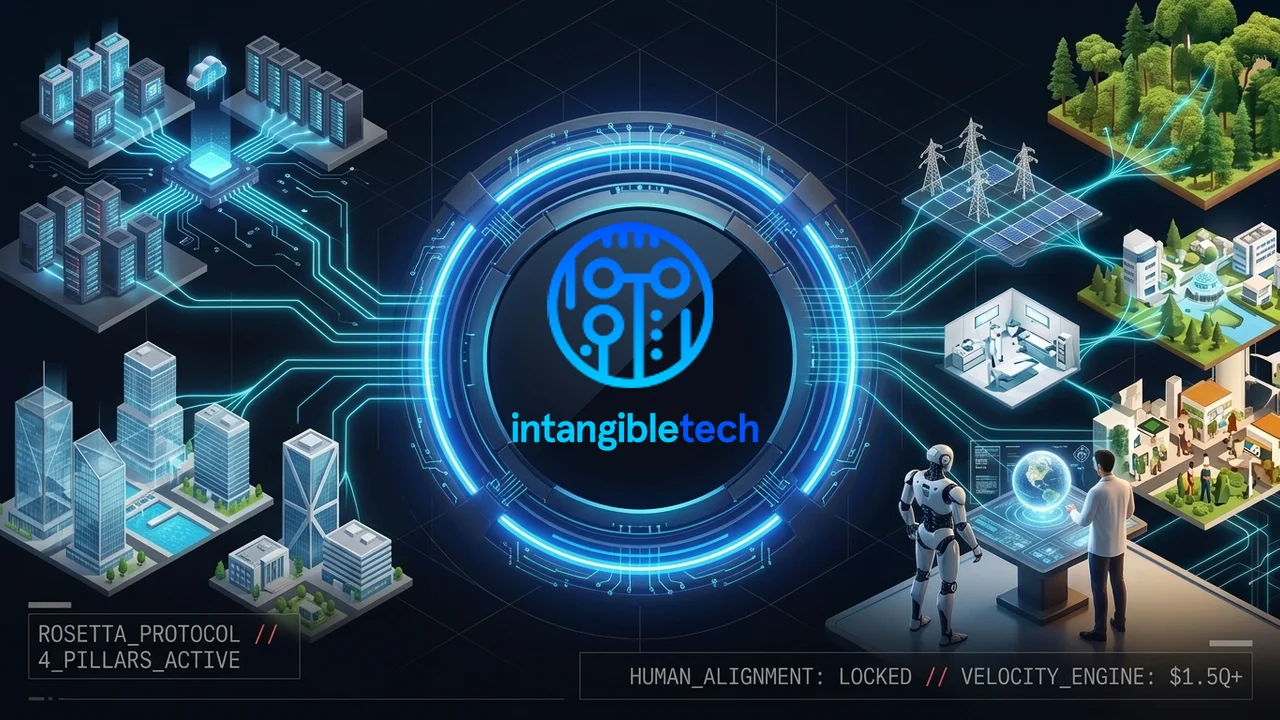
The Codex of Intangible Technologies is not a collection of isolated policy proposals. It is a single, unified engineering blueprint—a deterministic economic operating system where every mechanism reinforces the next. This Master Executive Primer serves as your Rosetta Stone: mapping how all fifty architectural monographs connect across four foundational pillars without introducing a single new variable.
The Origin: Diagnosing an Accounting Failure, Not a Human Failure
Before examining the silicon and macroeconomic math, we must begin where the architecture was born: on the factory floors, supply chains, and software engineering trenches of the real economy.
In Why I Created Intangible Technologies, we traced how global commerce still runs on brittle 1970s EDI batch files, 90-day payment delays, and adversarial audits that force operators to spend more energy proving work was done than actually doing it. Nowhere was this pathology clearer than in software development. As detailed in Agile Didn’t Fail—Our Balance Sheets Did, modern management tried to liberate human creativity with Agile workflows while the CFO’s ledger still measured engineers like 19th-century factory looms—treating architectural craftsmanship, refactoring, and mentorship as uncapitalizable cost-center waste.
When a ledger treats human capability as an expense and invisible social trust as zero, every downstream institution warps toward extraction. Fixing civilization requires upgrading the ledger itself.
Pillar I: Monetary Physics & Core Silicon (The Engine)
The first pillar of the Codex replaces probabilistic central-bank guesswork with deterministic monetary physics and hardware-verified truth.
1. Valuing Human Craft and Inverting Velocity
At the heart of the engine is a mathematical inversion of value and credit:
- Human Craft as Collateral: In Human Craft as Appreciating Working Capital, we introduce the 5-Variable valuation model that transforms verified human skill, defect suppression, and operational reliability from an income-statement expense into an appreciating balance-sheet asset.
- Velocity-Indexed Credit: In How Money Velocity Solves Sovereign Debt, we convert money velocity ($V$) from a lagging statistical ghost into a live Layer-0 scalar. Instead of compounding usury that mathematically outpaces physical growth, high-velocity productive turnover algorithmically amortizes principal—turning quadrillions in global settlement flow into self-liquidating working capital.
- The Dual-Account Topology: To ensure money never stagnates in sterile speculative hoards, Ending the Hoarding Trap: Money That Must Move establishes a permanent $100,000 Citizen Exemption Floor in Sovereign Account Type A (protecting everyday families from any holding decay), while applying thermodynamic demurrage strictly to idle institutional cash hoards above the floor—forcing dormant liquidity into productive deployment.
2. The New Macroeconomic Compass: KST and ISI
How does an autonomous protocol route capital without corruptible human gatekeepers?
- Replacing GDP: In Why GDP Is Obsolete: Measuring Real Economic Life, we replace Gross Domestic Product—which cheers medical bankruptcies, lawsuits, and pollution as “growth”—with Kinetic Systemic Throughput (KST), a real-time measure of defect-free utility transfer.
- Replacing Credit Scores & ESG: In Replacing Credit Scores and ESG With Verified Truth, we replace pay-to-play credit rating agencies and politicized ESG checklists with the 4-Vector Impact Score Index (ISI). Your cost of capital is governed directly by your verified operational velocity, product durability, and human retention.
- Immunity to Gaming: Because every metric is eventually targeted by bad actors, Defeating Goodhart’s Law: Metrics That Can’t Be Gamed demonstrates how topological graph damping neutralizes circular wash-trading and sybil collusion rings in real time. Meanwhile, Turning Market Makers Into Instruments of Truth couples Automated Market Maker (AMM) bonding curves directly to live ISI telemetry so liquidity deepens automatically for high-integrity producers.
3. The Layer-0 Silicon Bedrock
None of this economic physics can run on slow, exploit-ridden Web3 blockchains:
- TigerBeetle + Stellar Finality: In Why We Built at Layer-0 Instead of Chasing Hype, we explain how pairing TigerBeetle’s deterministic 1M+ TPS state accounting with the Stellar Consensus Protocol delivers 3-to-5-second global finality at sub-cent cost.
- Zero Smart-Contract Exploits: In Ending the $10B Smart Contract Exploit Crisis, we abolish unbounded Turing-complete smart contracts at Layer-0 in favor of fixed 128-bit state structs and eight pre-compiled financial opcodes—making re-entrancy hacks mathematically impossible.
- Hardware Enclaves & Quantum Defense: To bridge physical reality to the ledger without corruptible human logs, Solving the Oracle Problem in Physical Silicon embeds TPM/HSM cryptographic attestation directly onto edge sensors, while Quantum-Proofing the Global Financial System shields the entire state machine against post-quantum decryption via crypto-agile lattice primitives.
Pillar II: Institutional & Corporate Inversions (The Enterprise)
When the monetary and silicon engine is upgraded, the 400-year-old corporate and financial playbook undergoes a complete structural inversion.
1. Post-Shareholder Capital & Full-Velocity Banking
- Account Type B & Real Yield: Everyday savers should not be forced into the Wall Street stock casino just to beat inflation. 4–8% Real Yield Without the Wall Street Casino introduces Account Type B—routing household and institutional reserves into short-duration, hardware-attested commercial velocity pools that generate steady 4–8% real yield backed by actual supply-chain clearing.
- Ending Bank Runs: By separating 100%-liquid Sovereign Checking (Account Type A) from duration-matched Productive Reserves (Account Type B), How Full-Velocity Banking Makes Bank Runs Impossible eliminates fractional-reserve maturity mismatch forever.
- Reinventing the Corporation & Investing: In Replacing the 400-Year-Old Joint-Stock Corporation and Investing in Real Velocity Instead of Paper Hype, static equity shares and narrative P/E multiples give way to dynamic kinetic capital cells where allocators and craftsmen share surplus in real time.
- Clean Insolvency & Honest M&A: When an enterprise’s velocity drops to zero, When Companies Fail: Clean Insolvency Without Contagion shows how unspent reserves return cleanly to allocators while workers retain portable intangible capital scores. Predatory leveraged buyouts are abolished in Ending Predatory Buyouts and Corporate Strip-Mining, and offshore brass-plate tax evasion is neutralized in Eliminating Offshore Shell Games and Tax Havens.
2. Liberating the Professions From Administrative Friction
Every white-collar and creative industry is freed from rent-seeking middlemen:
- Insurance Without Denials: Instant Parametric Payouts: Ending the Insurance Racket replaces adversarial claim denials and hoarded float with instant, hardware-triggered parametric settlement.
- Software, IP & Creator Liberation: Ending SaaS Lock-In: Paying for Software Value, Not Seats replaces per-seat software bloat with micro-velocity utility metering; Liquidating IP Monopolies and Funding Open Source streams automatic Dependency-DAG royalties to open-source maintainers; and Bypassing the Streaming Middleman With Micro-Velocity settles media engagement directly from audience to creator wallet.
- Accounting, Law, Marketing & Analog Adoption: In When the Paperwork Dies: Elevating Finance & Consulting, CPAs evolve from spreadsheet reconcilers into Kinetic Systems Architects. In Dissolving the Billable Hour and Elevating the Law, attorneys earn ongoing micro-royalties on dispute-free living legal invariants. In The End of Spin: Marketing When Truth Is on the Ledger, brand equity becomes provable product durability. And in Bridging the Gap: Real-Time Capital in an Analog World, we show how traditional factories onboard today via bilateral staking long before every machine is sensor-equipped.
Pillar III: Human Outcomes & Civic Governance (The Society)
Why build a deterministic state machine? Because when you strip compounding usury, administrative bloat, and algorithmic manipulation out of the economy, everyday human life flourishes.
1. Family, Shelter, Health & Lifelong Mastery
- Work, Family & Community: The Invisible Engine: Rebuilding Work, Family, and Community demonstrates how recognizing mentorship, caregiving, and civic trust restores margin to the nuclear family and local neighborhood.
- De-Financializing Homes: Abolishing the 30-Year Mortgage and De-Financializing Homes replaces 30-year compounding bank servitude (which forces families to pay 3x the price of a house) with velocity-amortized shelter, cutting lifetime housing costs by more than half.
- Profitable Cures & Debt-Free Mastery: Universal Healthcare That Makes Curing Disease Profitable eradicates the $4.5T sick-care billing racket by tying clinical and biotech yield to verified patient vitality. Simultaneously, Dissolving Student Debt and Funding Lifelong Mastery replaces the $1.7T student loan trap with skill-backed human capital endowments across both K–12 and trade mastery, while De-Financializing College Athletics and Saving Olympic Sports protects student-athletes and non-revenue Olympic pipelines from private-equity strip-mining.
2. Incorruptible Public Finance, Dignity & Civic Truth
- Tax Abolition via Velocity: In Slashing Income Taxes Through Automated Public Velocity, invasive income tax filings are replaced by an automated, micro-basis-point velocity partition on high-frequency clearing—balancing municipal and national budgets in real time while dramatically lowering the tax burden on working citizens.
- The Citizen Dividend & Retirement Security: In The Citizen Dividend: Dignity Without Welfare or Surveillance, we reject inflationary fiat handouts and biometric Silicon Valley UBI in favor of an unconditional dividend funded strictly by thermodynamic surplus and demurrage recycling. In Rescuing Social Security in the Age of Automation, lifetime contributions transition into Senior Productive Reserves indexed to total machine and economic velocity.
- Reclaiming the Public Square, Press, Politics & Justice: Curing Algorithmic Addiction and Rebuilding the Public Square replaces surveillance ad-tech outrage machines with zero-knowledge commercial matching; Reviving Local Journalism Without Billionaire Bailouts restores independent local reporting via micro-settlement; Dissolving Dark Money: Turning Lobbying Into Civic Engineering replaces Super PAC capture with transparent Policy Capability Nodes; and Ending White-Collar Impunity and Restoring the Formerly Incarcerated ends both executive looting and post-prison “civil death.”
Pillar IV: Geopolitics & Sovereign Transition (The World)
Finally, the fourth pillar maps how a deterministic protocol scales across sovereign borders, physical grids, and industrial supply chains without firing a shot.
- Thermodynamic Gravity Over Coercion: In Why Geopolitics Cannot Outlaw Economic Thermodynamics, we show why no superpower can outlaw an architecture that delivers a 30–50% cost-of-capital advantage to early adopters.
- Ending FX Wars & Blunt Tariffs: Ending Currency Wars and the $7.5T Forex Casino replaces speculative foreign-exchange tolls with autonomous purchasing-power parity clearing, while Replacing Blunt Tariffs and Leaky Sanctions With Surgical Flow replaces inflationary border tariffs with node-level parametric trade balancing.
- Physical Energy, Manufacturing & Deterrence: Grounding Digital Money in Real Energy and Commodities anchors digital value to hardware-attested kilowatt-hours and physical commodities; Solving the AI Energy Crisis and Making Conservation Profitable turns data-center load balancing and waste-heat recovery into yield; Rescuing the Industrial Base With Supply-Chain Telemetry streams instant liquidity to Tier-3 machine shops; and Eliminating Defense Waste and Rebuilding Deterrence replaces cost-plus Pentagon bloat with zero-knowledge readiness verification.
- Sovereign Borders & Global Talent Parity: Finally, Ending Black-Market Labor and Stabilizing the Border eradicates off-ledger wage exploitation while stabilizing developing economies at the root, and Ending Tech Visa Exploitation and Protecting Domestic Talent enforces cryptographic compensation parity so global innovation never comes at the expense of domestic workers.
How to Navigate The Codex
Whether you are an institutional allocator, a systems engineer, a policymaker, or a citizen searching for a future where technology serves humanity rather than replacing it, The Codex is designed to be explored modularly:
- Use the Interactive Constellation Graph on the Codex hub to trace how any of the 12 Core Tags bridge across the 4 Pillars.
- Start with the Foundational Architecture entries inside each Pillar to master the core invariants before diving into the Auxiliary Sector Deep-Dives.
- Follow the Contextual Threads: Every monograph is cross-linked so you can open adjacent proofs in a new tab without losing your place.
We do not have to choose between a dying extractive capitalism and an unaligned algorithmic technocracy. By encoding human capability and thermodynamic truth into the bedrock of money, we can harness the unseen—and build an economy worthy of human potential.